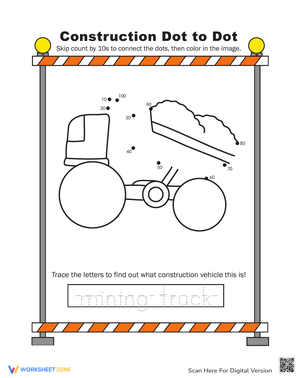
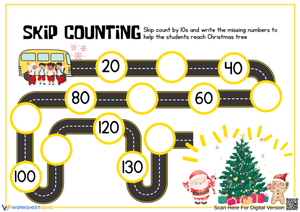
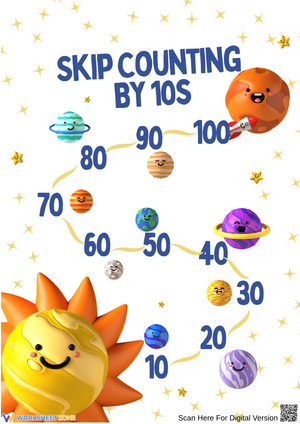
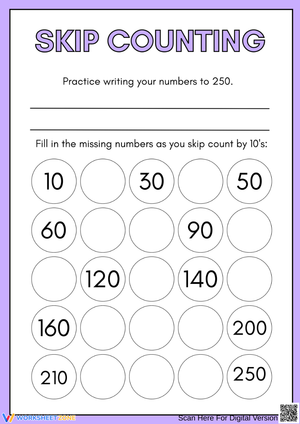
These 1st grade by 10 printable worksheets give teachers four targeted practice formats for building counting-by-tens fluency — the skill that converts memorized chanting into genuine place value understanding. First graders arrive at skip counting after mastering one-to-one correspondence, and these worksheets move them deliberately toward the next level: seeing number structure in groups rather than in individual units.
The Specific Skills Targeted
Each worksheet isolates a different entry point into the sequence. Four formats are included:
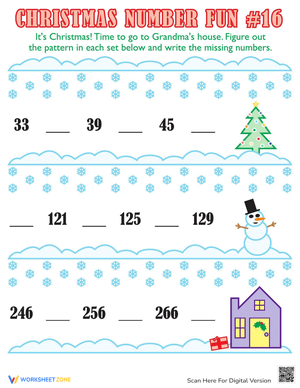
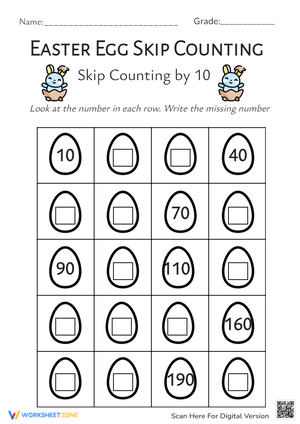
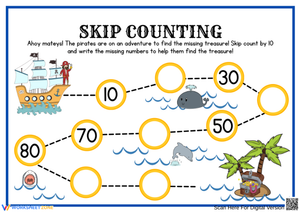
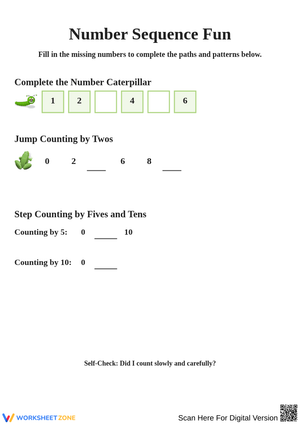
- Missing number sequences — rows like 20, ___, 40, 50 where students fill the gap, which forces retrieval rather than recognition
- Hundreds chart shading — students shade every multiple of ten, making the right-column pattern visible in a way that oral drills cannot replicate
- Base-ten block matching — students connect numerals (30, 60, 80) to block illustrations of the corresponding rods, building the link between symbolic and pictorial representation
- Dime counting — images of dimes linked to coin totals, grounding the abstract sequence in something first graders find tangible and worth knowing
These four formats are not redundant — they address different cognitive demands. Shading a hundreds chart is a pattern recognition task. Matching blocks to numerals is a translation task. Filling missing numbers is a recall task. Using them across a week gives a fuller picture of where each student actually stands than any single format could.
Common Misconceptions to Watch For and Correct
The most persistent error is treating the counting sequence as a memorized word list rather than a structural pattern. A student who can say "ten, twenty, thirty, forty" in unison during calendar time will often freeze mid-sequence on a worksheet if they lose their place, because they have no structural anchor to recover from. The correction is explicit attention to the ones digit: it holds at zero while the tens digit increases by one. Once students see that 10, 20, 30 is really 1→2→3 in the tens column with a permanent zero alongside, they gain a self-correction mechanism that chanting alone never provides.
A second error emerges near the end of the sequence. Students who write 90 correctly will sometimes follow it with 110 instead of 100 — they are applying "+ten" to 90 and producing a number that doesn't fit the visual pattern they've practiced. They sense the error immediately but cannot explain it. This is a signal that the student understands the arithmetic rule but has not yet built a stable mental model of 100 as a landmark rather than just another step. The hundreds chart worksheet addresses this directly, because 100 appears on the chart as something visible to anchor to.
Standard Alignment
CCSS 1.NBT.C.5 requires first graders to mentally find ten more or ten less than any two-digit number without counting. The worksheets that build the sequence from zero (10, 20, 30 . . .) lay the groundwork before that standard fully activates; missing-number problems — where students must identify 40 as the missing term between 30 and 50 — sit squarely inside 1.NBT.C.5 territory. The set also connects backward to 1.NBT.A.1, the requirement to count to 120 starting from any number, because hundreds chart shading makes the full 1–120 range visible and structured rather than just orally rehearsed during morning meeting.
Recommended Lesson-Planning Strategies for These Worksheets
The hundreds chart shading worksheet is the right starting point — it gives students a visual anchor before they attempt recall-based tasks. Follow it the next day with the missing-number sequence, then base-ten block matching, then dime counting. That order moves from pattern recognition to recall to representation to application, following a gradual release of cognitive demand across the week rather than front-loading the hardest format.
In terms of daily placement, missing-number sequences work well as Monday warm-ups immediately after morning meeting: brief, low-stakes, and effective at reactivating what slipped over the weekend. The dime-counting worksheet fits at the end of math class on a Friday, when first graders stay more focused if the context involves something concrete they recognize. Avoid assigning the 1st grade by 10 printable worksheets on the same day students first handle base-ten rods as manipulatives — let them spend a full lesson with the physical objects, then bring out the worksheet the following day when the connection is still fresh but the novelty has settled.
Differentiating These Worksheets Across Ability Levels
Students who are still consolidating one-to-one counting fluency need a hundreds chart taped to their desk before they begin any of these worksheets. This is not a temporary support to remove quickly — it reduces working memory load so students can focus on the tens pattern itself rather than reconstructing the number line from scratch on every problem. For these students, the hundreds chart shading worksheet functions as introduction rather than practice, and the missing-number sequence should initially cover only the first five multiples of ten before extending toward 100.
Students who have already internalized the basic sequence from zero are ready for non-zero starting points: sequences that open at 30 or 50 rather than 10, or problems with two consecutive blanks instead of one. The 1st grade by 10 printable worksheets in this set require minimal modification to reach that level — write a new starting number at the top of a sequence and the existing format handles the rest. Students working above grade level can also attempt the extension version of the task: counting by tens from a non-multiple like 4 (4, 14, 24, 34), which 1.NBT.C.5 points toward as a more advanced application of the same place value logic.
Frequently Asked Questions
Do students need to have the full sequence memorized before using these worksheets?
No. The hundreds chart shading worksheet is accessible even to students who are still building the sequence, because the chart provides enough visual structure to guide the task. The missing-number and base-ten block formats assume more fluency, so those work better after a student can produce the sequence independently from zero to 100. Use the shading worksheet first to see where each student stands before assigning the recall-heavy formats.
How does mastering tens-counting connect to second-grade math?
Second grade introduces adding and subtracting two-digit numbers with regrouping (2.NBT.B.5 and 2.NBT.B.7). Students who understand tens as countable units — not just as words in a sequence — approach regrouping with a structural foundation. Students who only memorized the chant tend to make consistent regrouping errors because they treat the tens digit as an arbitrary symbol rather than a count of groups. The base-ten block matching worksheet builds exactly the representational understanding that second-grade regrouping depends on.
Can these worksheets be used for formative assessment?
The missing-number sequence worksheet functions well as a brief formative check: three or four problems reveal quickly whether a student is retrieving the pattern or guessing at gaps. The 1st grade by 10 printable worksheets should not replace a formal assessment, but the completed pages create a useful paper trail for parent conferences and for tracking which students need continued review before the class advances to adding and subtracting with multiples of ten.
What manipulatives pair most naturally with this set?
Linking cubes snapped into rods of ten are the most direct pairing, especially alongside the base-ten block matching worksheet. Students who count physical rods before writing totals make far fewer matching errors than students working from illustrations alone. Real dimes or plastic play money belong with the dime-counting worksheet for the same reason — the physical handling reinforces what the image represents. A large floor number line works well as a whole-class opener: have students step ten paces at a time, then sit down to open the worksheet while the physical experience is still in working memory.













 Interactive Worksheet Maker
 Quiz Maker
 Word Search Maker
 Crossword Puzzle Maker
 Word Scramble Generator
 Sentence Scramble Generator
 Handwriting Worksheet Generator
 Name Tracing Generator
 Fill In The Blank Generator