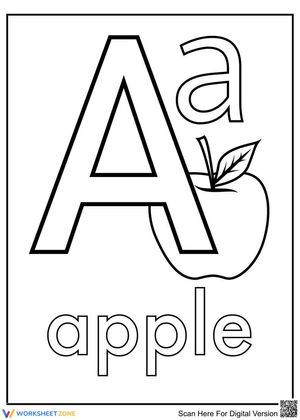
A is for Apple Handwriting worksheets for 1st Grade
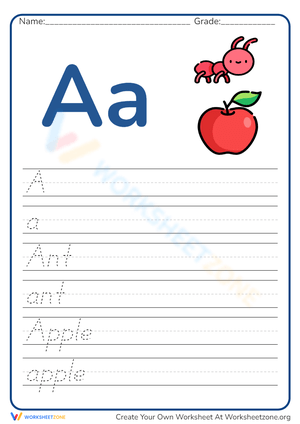
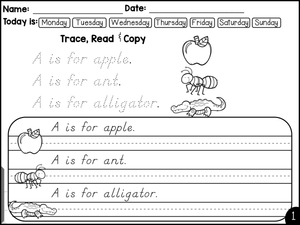
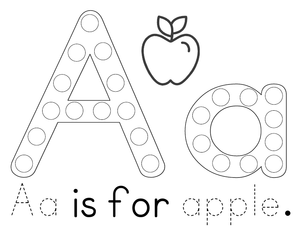
These a is for apple handwriting worksheets for 1st grade give teachers a print-ready collection of letter A formation exercises that pair fine motor practice with early phonics work — connecting the written symbol to the short /a/ sound from the very first stroke. Each worksheet targets a specific aspect of letter A formation, from guided tracing to independent writing, so the work builds across a logical sequence rather than repeating the same task in a different color. The apple theme is functional, not decorative: first graders encounter "apple" in decodable readers constantly, and anchoring the letter to a word they already recognize accelerates symbol-sound correspondence.
Skills These Worksheets Target
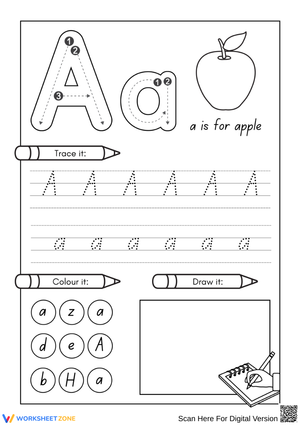
The set addresses uppercase and lowercase A formation with separate attention to each, because the motor demands are genuinely different. Uppercase A is a three-stroke letter — two diagonal lines meeting at a peak, then a crossbar — and first graders often need to practice the crossbar height separately before it lands consistently at the midline. Lowercase a is a one-unit continuous form: a counterclockwise arc that closes into a bump, then a short descending stroke. Students who treat it as two separate movements (a circle plus a line) produce letters that look disconnected and drift off the baseline.
Beyond letter shape, the worksheets build consistent baseline placement, uniform sizing between uppercase and lowercase forms, left-to-right directionality reinforced through row-by-row repetition, and the phoneme-grapheme connection through the /a/ anchor word "apple." These aren't separate goals — they develop together when the format gives students clear starting points, midline guides, and a word they already know.
Student Mistakes to Watch For During Letter A Formation
The most consistent error in first grade letter A work is bottom-up formation. Students who haven't internalized top-down directionality start the diagonal strokes of the uppercase A from the baseline and draw upward to meet at the peak — the finished letter looks identical, but the habit creates serious speed and legibility problems as writing demands increase in second and third grade. When circulating during practice, watch where the pencil starts, not just what the finished letter looks like.
Lowercase a produces a different set of errors. Many first graders write something that looks like a printed q — they form the circle correctly but add the vertical line on the wrong side. Others produce an open form, essentially a backwards c with a tail, never closing the arc. A third group over-rotates and lands closer to a d. These aren't random; they reflect where each child is in visual-motor integration. Naming the pattern out loud during instruction — "I'm seeing some letters that look like a q — let's check our circle direction together" — is more efficient than individual correction after students have already filled a row with the same error.
Why Motor Practice and Phonics Work Best Together at This Grade
First grade is the window when automatic letter formation and phonics decoding develop simultaneously, and cognitive load is a real constraint. When a child has to think about how to form the letter and decode the word at the same time, neither task gets full attention. The apple anchor in these worksheets reduces that load: because "apple" is a sight-familiar word for most entering first graders, the phoneme connection comes automatically — students say /a/ without having to decode. That frees working memory for the motor task of formation. In practice this shows up as fewer erasures and less pencil-freezing mid-letter, which tells you the student is processing one thing at a time rather than two.
Fitting These Worksheets Into Your Lesson Plans
The most reliable use pattern for a is for apple handwriting worksheets for 1st grade is the first eight to ten minutes of the literacy block, before the day's primary reading instruction. At that point, students are settled but not yet cognitively fatigued, and the repetitive, low-stakes nature of tracing rows warms up fine motor control for the writing tasks that follow. Morning arrival works too, but supervision is thinner then, and part of the value of letter A formation practice comes from the teacher narrating stroke order aloud — "over the top and slide, over the top and slide, across the middle" — which can't happen if you're taking attendance at the same time.
In literacy centers, the apple-themed format pairs well with a picture sort focused on short /a/ words. Students complete the handwriting worksheet at one station, then move to a card sort where they identify other short /a/ words, and the repetition across modalities deepens the sound-symbol link without feeling like the same task twice. One practical note: print on cardstock if students will use the worksheets as dry-erase surfaces for repeated practice — standard copy paper warps almost immediately under a whiteboard marker.
Adjusting These Worksheets Across Ability Levels
For students still developing the grip strength to control a standard pencil, the tracing rows function as a guided path — and that path holds more value when you have the student trace with a finger first, then a crayon, then the pencil. The finger pass forces a slower motor rehearsal that makes the pencil pass noticeably cleaner. For students who find the standard lines too narrow, printing at 115–120% on the copy machine widens the writing space without changing the task structure.
Strong writers who form the letter accurately from day one need a different challenge. Ask them to write a full word — "apple," "ant," "add" — using the same careful stroke sequence, then compare the letter A in their word to the model on the worksheet. That transfer task, applying a practiced skill in a new context, is where mastery actually shows. This use of a is for apple handwriting worksheets for 1st grade as a baseline rather than a ceiling keeps each worksheet productive for your highest writers without requiring a separate activity.
Standard Alignment
These worksheets address CCSS.ELA-LITERACY.L.1.1.A, which requires first graders to print all upper- and lowercase letters legibly. In instructional terms, legibility at this grade means consistent baseline placement, recognizable letterforms, and appropriate sizing — not calligraphic precision. The standard sits within the Language strand alongside phonics and vocabulary work, which means treating handwriting practice as part of language arts instruction, rather than a separate fine motor exercise, is exactly the integration the standard implies. The apple anchor word pulls phonics directly into the formation work, so a single session touches both the handwriting standard and phonemic awareness goals.
Frequently Asked Questions
What is the correct stroke order for uppercase and lowercase A?
For uppercase A: start at the top center, draw a diagonal line down to the lower left, return to the top, draw a diagonal line down to the lower right, then add a horizontal crossbar at the midline. For lowercase a: beginning at the 2 o'clock position, draw a counterclockwise arc that closes at the same starting point, then add a short descending stroke straight down on the right side. The critical habit for both forms is top-down initiation — the pencil starts at the highest point of the letter, every time.
How long should letter A practice sessions run for first graders?
Ten to fifteen minutes is the practical ceiling before fine motor fatigue sets in and letter quality declines. Short daily sessions build more durable muscle memory than longer weekly blocks. The row-by-row structure of each worksheet gives students a clear, completable unit of work, which matters for first graders' sense of progress — finishing a row is a tangible milestone in a way that "practicing for twenty minutes" is not.
Can these worksheets support students who have fine motor delays?
Yes, with two straightforward adjustments. Triangular pencil grips reduce the hand strain that causes letter quality to deteriorate mid-row. And printing a is for apple handwriting worksheets for 1st grade at an enlarged size gives students with limited motor control more room to work, making early successes visible and motivating before they transition to standard-sized lines. For students significantly behind grade-level expectations, pairing the worksheet with a brief sand-tray tracing activity before pencil work builds the same motor pattern through a different sensory channel.
Do these worksheets use standard manuscript print or D'Nealian letterforms?
The set uses standard manuscript print — the vertical, block-style letters most common in U.S. first grade classrooms. D'Nealian forms include a slight slant and small entry and exit tails intended to ease the later transition to cursive. If your school uses D'Nealian, confirm the letter models before distributing these worksheets, because students taught one form and shown another experience genuine confusion about which version is correct — and that confusion tends to produce inconsistent, hybrid letters rather than either form done well.
Clear All