


























Views
Downloads

Letter A Worksheet — Printable Grade 1 ELA
Paste this activity's link or code into your existing LMS (Google Classroom, Canvas, Teams, Schoology, Moodle, etc.).
Students can open and work on the activity right away, with no student login required.
You'll still be able to track student progress and results from your teacher account.
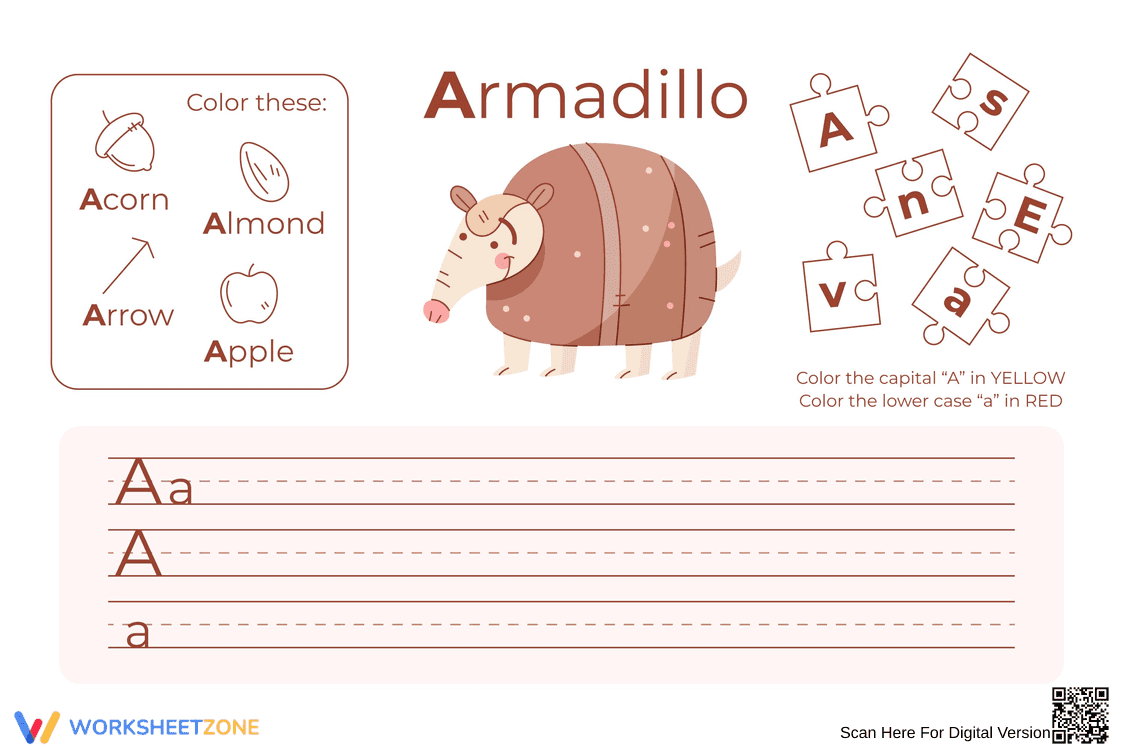
This Grade 1 English worksheet provides targeted practice with the Letter A, helping students develop foundational handwriting and letter recognition skills. By combining tracing exercises with engaging coloring tasks, young learners build fine motor control and phonetic awareness in a single, accessible activity.
At a Glance
- Grade: 1 · Subject: English
- Standard:
CCSS.ELA-LITERACY.L.1.1.A— Print all upper- and lowercase letters- Skill Focus: Letter recognition and tracing
- Format: 1 page · 3 tasks · No answer key · PDF
- Best For: Independent practice and centers
- Time: 10–15 minutes
This single-page resource features three distinct activities designed to reinforce letter familiarity. Students begin by identifying and coloring objects that start with the target letter, such as an acorn and an armadillo. Next, they complete a visual discrimination task by finding and coloring specific puzzle pieces containing uppercase and lowercase forms. Finally, guided tracing lines offer structured handwriting practice for both capital and lowercase letters.
Zero-Prep Workflow
This worksheet is designed for immediate classroom implementation with minimal teacher setup.
- Print (1 minute): Generate the PDF and print a class set. The black-and-white design ensures clear copies.
- Distribute (1 minute): Hand out the pages along with crayons and pencils. The visual instructions allow students to begin immediately.
- Review (1 minute): Quickly scan completed pages to verify correct letter formation and accurate color-coding of the puzzle pieces.
With under two minutes of total prep time, this resource serves as an excellent option for morning work, literacy centers, or an emergency sub plan.
Standards Alignment
This activity aligns directly with CCSS.ELA-LITERACY.L.1.1.A, requiring students to print all upper- and lowercase letters accurately. It also supports early phonics skills by associating the target letter with corresponding initial sounds in familiar words. Both standard codes can be copied directly into lesson plans, IEP goals, or district curriculum mapping tools.
How to Use It
Deploy this worksheet during morning arrival to establish a calm, productive routine before direct instruction begins. Alternatively, place it in a literacy center as an independent rotation task. While students work, teachers can conduct quick formative assessments by observing pencil grip and stroke direction during the tracing segment. The entire activity typically takes 10 to 15 minutes to complete.
Who It's For
This resource is ideal for first-grade students refining their handwriting, as well as kindergarteners needing enrichment or older students requiring fine motor intervention. The clear visual cues provide built-in differentiation for English Language Learners. Pair this worksheet with an alphabet anchor chart or a read-aloud focusing on initial vowel sounds to maximize instructional impact.
Developing automaticity in handwriting is a critical component of early literacy that directly impacts future writing fluency. According to Fisher & Frey (2014), providing students with structured, repetitive practice in letter formation reduces cognitive load, allowing young writers to eventually focus on content generation rather than the mechanics of writing. This resource supports that developmental milestone by targeting CCSS.ELA-LITERACY.L.1.1.A, ensuring students can print all upper- and lowercase letters with confidence. By integrating visual discrimination tasks and fine motor coloring exercises alongside traditional tracing, the activity engages multiple learning modalities. This multimodal approach reinforces letter recognition and spatial awareness on the page, building a solid foundation for subsequent phonics and spelling instruction. Consistent practice with targeted materials ensures students master these essential mechanical skills efficiently.


