




























Views
Downloads
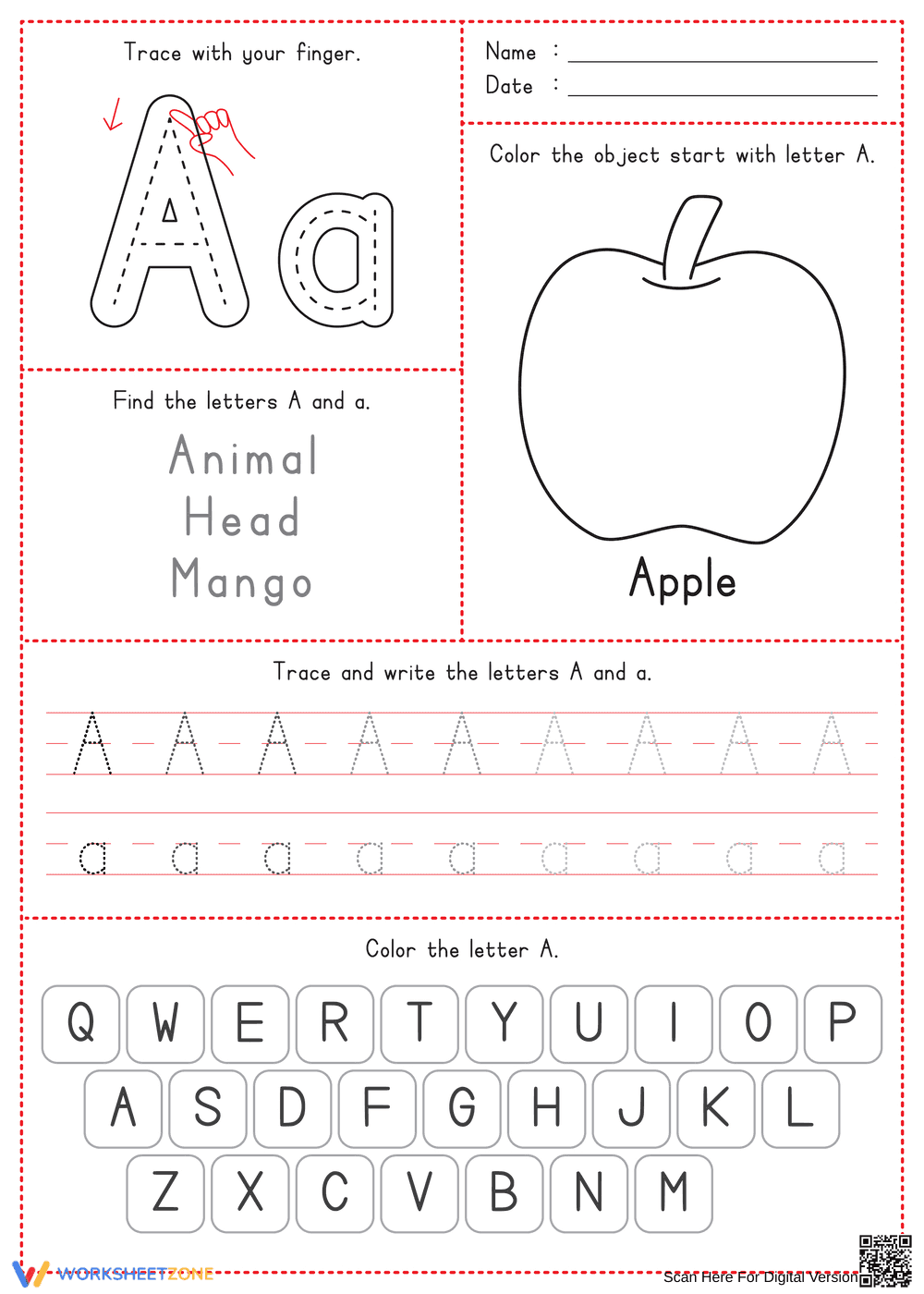

Grade K Letter A — Printable No-Prep Worksheet

Paste this activity's link or code into your existing LMS (Google Classroom, Canvas, Teams, Schoology, Moodle, etc.).
Students can open and work on the activity right away, with no student login required.
You'll still be able to track student progress and results from your teacher account.
This foundational Letter A worksheet helps early learners master alphabet recognition and basic handwriting skills. By combining tracing, coloring, and visual identification tasks, students build essential fine motor control and phonemic awareness. This single-page resource provides immediate, engaging practice for recognizing both uppercase and lowercase forms.
At a Glance
- Grade: K · Subject: ELA
- Standard:
CCSS.ELA-LITERACY.RF.K.1.D— Recognize and name all alphabet letters- Skill Focus: Letter A recognition and formation
- Format: 1 page · 5 problems · No answer key needed · PDF
- Best For: Morning work or centers
- Time: 10–15 minutes
Inside this comprehensive single-page activity, educators will find five distinct task types designed to reinforce letter mastery. Students begin with finger tracing to build muscle memory, followed by a phonics-based coloring activity featuring an apple. The page also includes a visual discrimination task to find specific letters among words, traditional dotted-line tracing for handwriting practice, and a keyboard-style letter hunt to connect physical writing with digital literacy concepts.
Zero-Prep Workflow
This resource requires under two minutes of teacher preparation.
- Print (1 minute): Simply download the PDF and print the required number of copies. The design ensures ink-saving reproduction.
- Distribute (30 seconds): Hand out the pages along with basic supplies like pencils and crayons. No special manipulatives or cutting are required.
- Review (30 seconds): Read the simple, clear instructions aloud to the class. The intuitive layout allows students to proceed independently.
Because it requires no complex setup, this activity is highly suitable for emergency sub plans or spontaneous independent work stations.
Standards Alignment
This activity is directly aligned to CCSS.ELA-LITERACY.RF.K.1.D, requiring students to recognize and name all upper- and lowercase letters of the alphabet. It also supports early handwriting standards by having students print letters using proper proportion and line placement. Both standard codes can be copied directly into lesson plans, IEP goals, or district curriculum mapping tools.
How to Use It
This worksheet serves as excellent morning work to reinforce the letter of the week. Alternatively, it functions perfectly within a literacy center rotation following direct instruction on the Letter A. As a formative assessment tip, observe students during the finger-tracing and pencil-tracing sections to ensure they are starting at the top line and following the correct directional arrows. Expected completion time is 10 to 15 minutes.
Who It's For
This resource is primarily designed for Kindergarten students, though it serves as an excellent intervention tool for first graders needing foundational phonics review or Pre-K students demonstrating early readiness. To differentiate for students needing extra support, teachers can provide a tactile alphabet card or highlight the tracing lines with a bright marker. This worksheet pairs naturally with a read-aloud focused on short 'A' sounds or a classroom alphabet anchor chart.
Early alphabet knowledge is a critical predictor of later reading success and overall academic confidence. This resource directly targets CCSS.ELA-LITERACY.RF.K.1.D, ensuring students can recognize and name all alphabet letters with automaticity. According to Fisher & Frey (2014), providing multiple modalities for learning—such as the tracing, coloring, and visual discrimination tasks included here—significantly improves retention and engagement in early childhood literacy instruction. Integrating physical handwriting practice with visual identification on a simulated keyboard bridges traditional and modern literacy skills, solidifying the neural pathways required for fluent reading. Regular, focused practice on individual letters like the Letter A establishes the foundational decoding skills necessary for future academic achievement, making this simple, targeted activity a vital component of any comprehensive early literacy curriculum.


