


























Views
Downloads
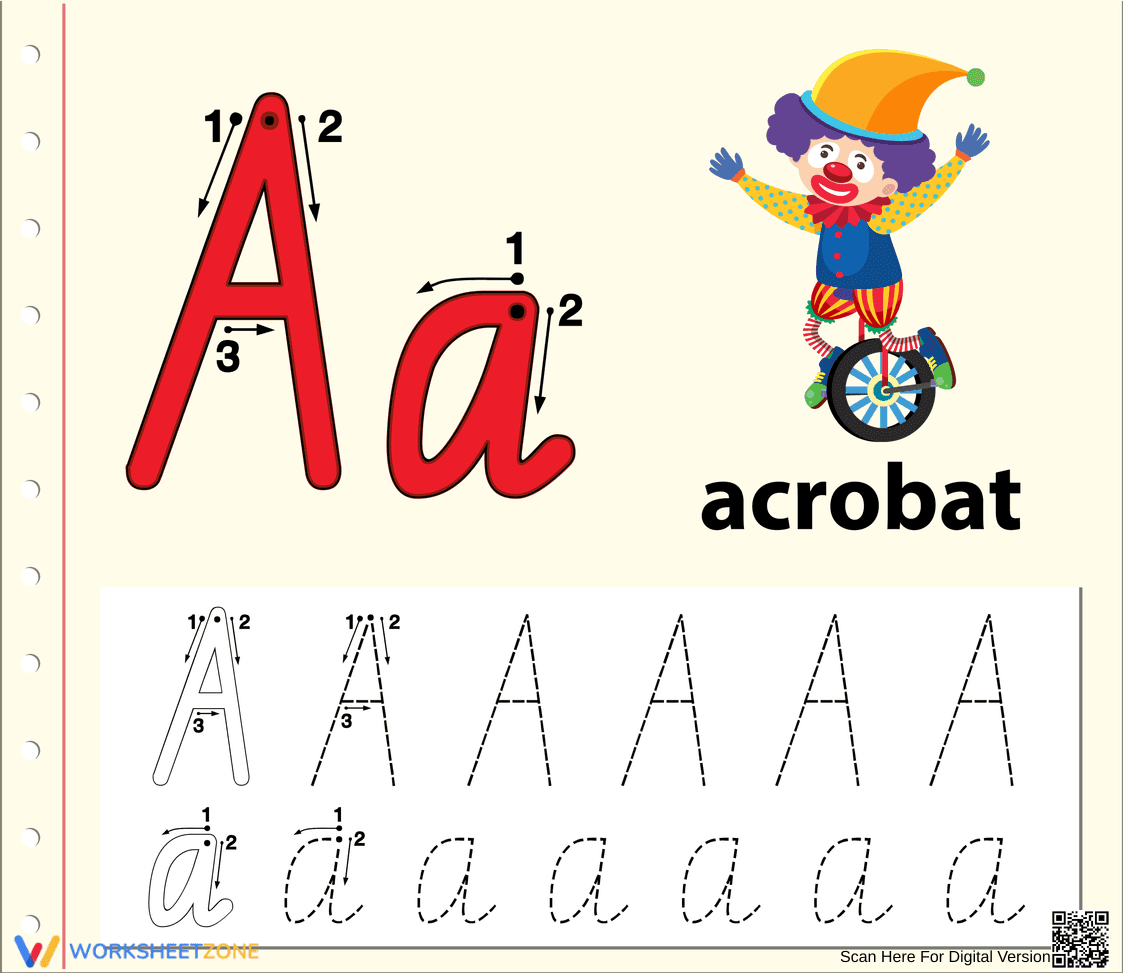

Cursive Letter A Tracing Worksheet | Grade 1 Printable
Paste this activity's link or code into your existing LMS (Google Classroom, Canvas, Teams, Schoology, Moodle, etc.).
Students can open and work on the activity right away, with no student login required.
You'll still be able to track student progress and results from your teacher account.
This Grade 1 cursive letter A tracing worksheet provides a structured way for students to master the fluid motions of cursive handwriting. By focusing on both uppercase and lowercase forms, learners build the muscle memory required for legible script. The inclusion of visual cues ensures students follow the correct stroke order for every letter.
At a Glance
- Grade: 1 · Subject: English
- Standard:
CCSS.ELA-LITERACY.L.1.1.A— Form all upper- and lowercase letters accurately using proper stroke sequence- Skill Focus: Cursive letter A formation
- Format: 1 page · 14 problems · Answer key included · PDF
- Best For: Daily handwriting practice or morning work
- Time: 10–15 minutes
Inside this resource, you will find a clean, one-page layout featuring large-scale models of the cursive letter A. The worksheet includes 7 uppercase and 7 lowercase tracing tasks. Each letter is accompanied by numbered directional arrows to guide the student's pencil. A thematic acrobat illustration provides a phonetic connection to the letter sound, helping students associate the shape with its linguistic role.
The zero-prep workflow is designed for busy educators. Print the single-page PDF in less than 30 seconds. Distribute the sheets to students for a 10-minute independent practice session. Review the formation by checking the starting points and stroke directions. Total teacher preparation time is under 2 minutes, making it an ideal choice for sub plans, transition periods, or early finisher activities.
This worksheet aligns with CCSS.ELA-LITERACY.L.1.1.A, which requires students to demonstrate command of the conventions of standard English grammar and usage by forming letters correctly. While cursive is often introduced as an extension, this practice supports the foundational motor skills required by the standard. This code can be copied directly into lesson plans, IEP goals, or district curriculum mapping tools.
Use this worksheet during the independent practice phase of a handwriting lesson. After demonstrating the cursive strokes on the board, assign this page for students to complete at their desks. It also serves as an excellent formative assessment tool; observe students as they trace to identify those struggling with pencil grip or stroke sequence. Expected completion time ranges from 10 to 15 minutes.
This resource is perfect for first-grade students beginning their cursive journey. It is also suitable for older students needing remedial handwriting support or English Language Learners building letter-sound associations. Pair this with a cursive alphabet anchor chart or a short reading passage featuring words that start with the letter A to reinforce the lesson in a broader context.
According to the RAND AIRS 2024 report on foundational literacy, consistent tactile practice with letter formation is a critical predictor of later writing fluency and orthographic mapping. This worksheet targets CCSS.ELA-LITERACY.L.1.1.A by providing 14 specific tracing opportunities that reinforce the motor pathways necessary for cursive mastery. Research from Fisher & Frey (2014) emphasizes that the gradual release of responsibility—moving from guided directional arrows to independent tracing—helps students internalize complex stroke patterns. By isolating the letter A, this resource allows for high-frequency repetition without cognitive overload. Educators can utilize this tool to bridge the gap between simple letter recognition and the fluid production of text. The structured layout ensures that students maintain proper alignment and proportion, which are essential components of legible handwriting as identified in national NAEP writing frameworks.


