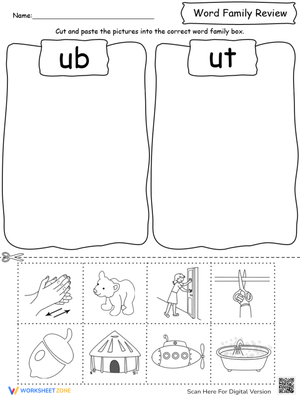
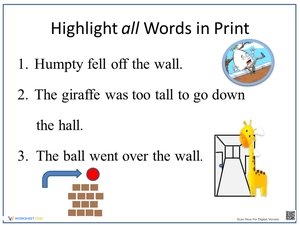
Onsets and rimes printable worksheets for 1st grade train students to see words as two-part structures rather than strings of individual phonemes — a shift that makes decoding faster and spelling more predictable. When a child recognizes -op as a reliable chunk, reading hop, crop, and stop becomes a matter of handling the front of the word, not reassembling four sounds from scratch. These worksheets give teachers focused, low-prep practice that slots naturally into phonics instruction, center rotations, and small-group work.
The Specific Skills Each Worksheet Targets
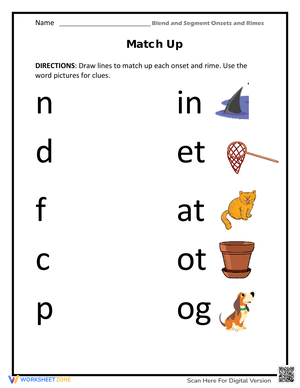
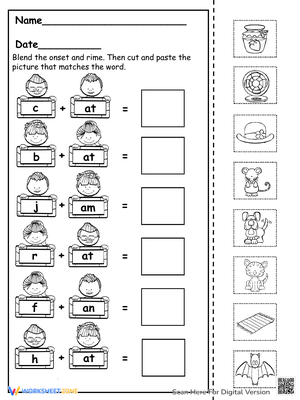
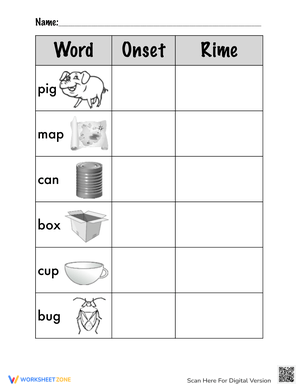
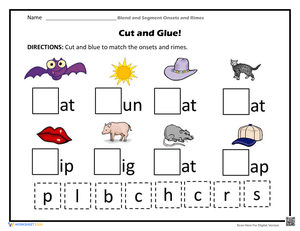
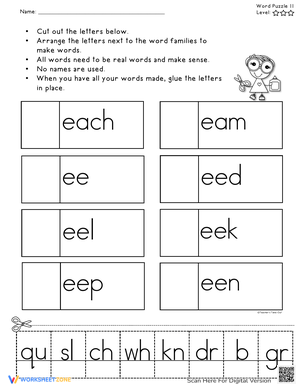
Each worksheet isolates the structural split between onset — the consonant or consonant cluster before the vowel — and rime — the vowel and everything after it. Grade 1 students practice this split in multiple directions: reading from onset to rime, identifying the shared rime across a set of words, and substituting onsets to generate new words within the same family. Task types across the set include:
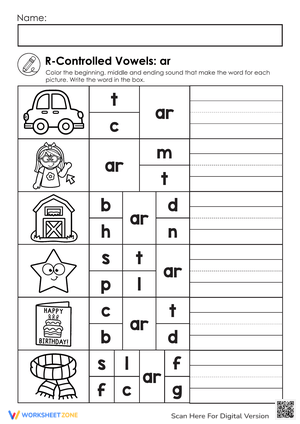
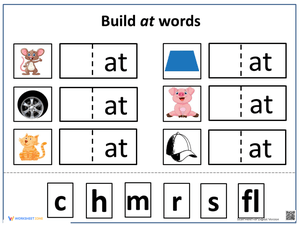
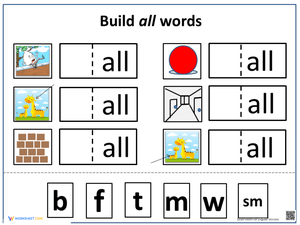
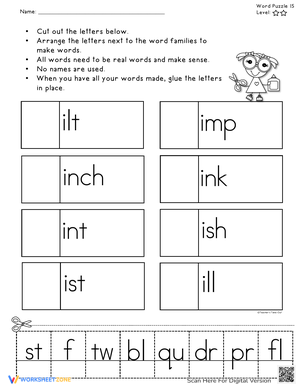
- Blend and write: Students combine a printed onset with a target rime and record the complete word.
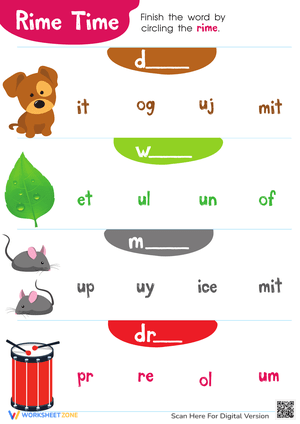
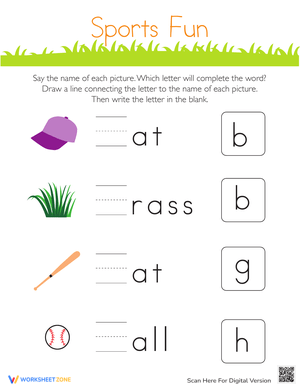
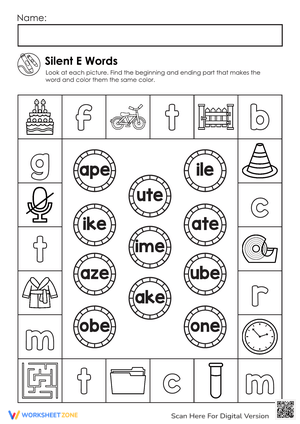
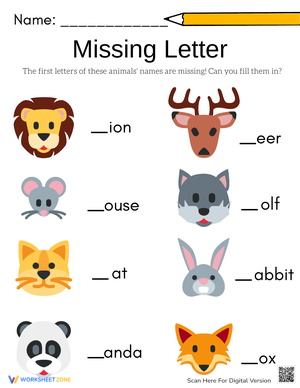
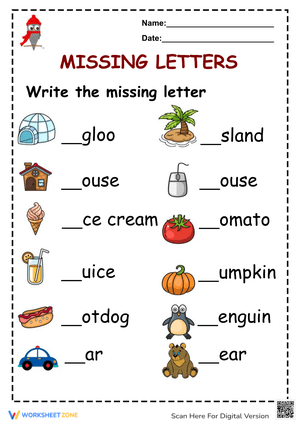
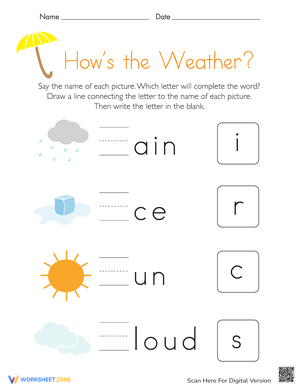
- Fill in the missing part: Some worksheets supply the rime and ask for the onset; others reverse that.
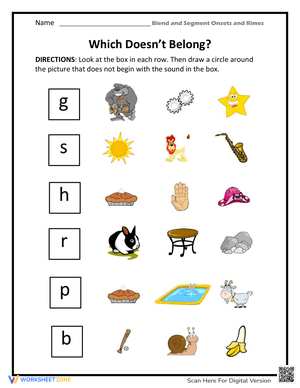
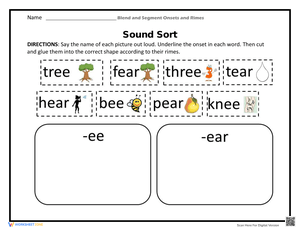
- Read and sort: Learners categorize picture-word pairs by shared rime into labeled columns.
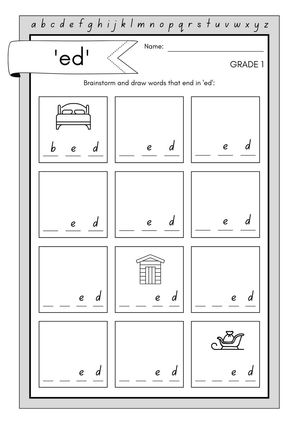
- Word-family extension: After completing a given set, students write one or two additional words following the same pattern.
- Trace and write: Structured writing lines reinforce letter formation alongside the phonics content.
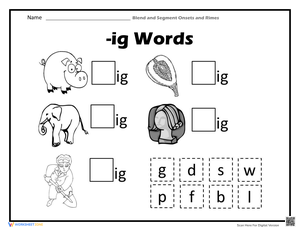
Picture cues appear with CVC words throughout the set, letting students cross-check a decoded word against spoken vocabulary — a habit that carries directly into independent reading.
Mistakes First Graders Make That These Worksheets Help You Catch
Two predictable errors appear consistently in first-grade onset-rime work. The first involves consonant-cluster onsets: a student who reads b-at without trouble will often stumble on fl-at — not because the rime changed, but because the two-phoneme onset fl feels like a separate decoding problem. Without practice pulling blends away from rimes, students treat flat as three parts (f, l, at) instead of two. Worksheets that pair single-consonant and cluster onsets with the same rime function as quick diagnostics: students who handle both are reading the pattern; students who stumble on the cluster are still working phoneme by phoneme. The second error is rime confusion between similar short-vowel families — students who learned -an and -am in the same week will sometimes write fam when they mean fan. A side-by-side sort requiring students to attend to the final consonant before placing a word catches that confusion before it hardens into a habit.
Building These Worksheets Into Your Weekly Literacy Block
The most practical approach is to anchor one rime across three or four consecutive days while rotating the task format. Students might read -ig words with teacher support on Monday, sort -ig picture words independently on Tuesday, and fill in onsets to write complete words on Wednesday. The pattern stays familiar enough that working memory can focus on accuracy. By Thursday, a quick oral read-aloud of the word list works as a formative check — fluency on a known pattern is a cleaner performance signal than a graded paper.
- Whole group: Project the worksheet, model one example, then have students complete the rest as a phonics follow-up to direct instruction.
- Small group: Students say each word aloud before writing; the teacher listens for blending errors before any pencil work begins.
- Centers: Pair the worksheet with letter tiles so students build each word before recording it.
- Intervention: Reduce the task to five or six words on one rime and add oral blending with the teacher before independent written practice.
Why Onset-Rime Chunking Works at This Developmental Stage
First grade is the window when readers begin shifting from phoneme-by-phoneme decoding toward recognizing larger units. Holding three or four separate phonemes in working memory while simultaneously blending them is genuinely taxing for a six-year-old. Onset-rime work reduces that cognitive load by giving students two chunks to manage instead of four. A child who holds -op as a recognized unit only needs to identify the onset and attach it — a two-step process that builds reading rate and makes fluency practice feel attainable rather than exhausting. Repeated exposure to a core set of rimes also supports orthographic mapping: after reading and writing pan, ran, and tan across multiple sessions, students stop consciously segmenting -an and start recognizing it automatically.
Standard Alignment
These worksheets address CCSS.ELA-LITERACY.RF.1.2, which requires first graders to demonstrate phonological awareness by orally producing single-syllable words through blending sounds — including onset and rime — and by segmenting single-syllable spoken words into their complete sequence of individual sounds. Within that standard, onset-rime work sits after phonemic isolation activities and before full four-phoneme segmentation tasks. Teachers who pair onsets and rimes printable worksheets for 1st grade with RF.1.3a instruction — spelling-sound correspondences for common short-vowel patterns — will find that CVC word families are precisely where phonological awareness and phonics practice converge in a single task.
Adjusting These Worksheets for the Full Range of First-Grade Readers
For students still developing oral blending, reduce each worksheet to five or six words on a single regular rime and have students say each word aloud before writing anything. Keep the picture cues in place — removing them raises the difficulty in ways that aren't useful when the goal is establishing the basic concept. The written task becomes a confirmation of successful oral blending, not a separate decoding challenge.
Students who move through CVC families quickly are ready for worksheets that introduce consonant-cluster onsets alongside familiar rimes — fl-at, tr-ap, sl-ig. A compare-and-sort page that places two similar rimes side by side, such as -an beside -am, pushes these students to attend carefully to the final phoneme. For homework and center use, onsets and rimes printable worksheets for 1st grade require no caregiver explanation beyond the page itself — the pattern repeats visibly across every word in the set, which makes independent practice practical at both school and home.
Frequently Asked Questions
What is the difference between an onset and a rime?
The onset is the consonant or consonant cluster that comes before the vowel in a syllable. The rime is the vowel and everything that follows it. In flag, the onset is fl and the rime is -ag. In bat, the onset is b and the rime is -at. Some words have no onset — at and up begin directly with the rime — but every single-syllable word contains one.
Which rime patterns should teachers introduce first?
Start with short-vowel CVC rimes where the words fall within first-grade vocabulary and are easy to represent with pictures: -at, -an, -op, and -ig are reliable entry points. Avoid introducing two families that share the same vowel — -an and -am, for instance — in the same week until each is secure independently. The phonetic similarity between those rimes creates confusion that takes real instructional time to undo.
Do these worksheets suit intervention students as well as core phonics instruction?
Yes. In core instruction, a worksheet moves through several onsets with one rime in roughly ten minutes. In intervention, the same worksheet becomes an oral-first activity: teacher and student say each onset and rime aloud, blend together, and then the student writes. That sequence provides an auditory model before the visual-motor demand of writing. The onsets and rimes printable worksheets for 1st grade format suits both settings because tasks are short, patterns repeat predictably, and pacing can be adjusted without changing materials.












 Interactive Worksheet Maker
 Quiz Maker
 Word Search Maker
 Crossword Puzzle Maker
 Word Scramble Generator
 Sentence Scramble Generator
 Handwriting Worksheet Generator
 Name Tracing Generator
 Fill In The Blank Generator