1st Grade OA Worksheets for Long O Phonics Practice
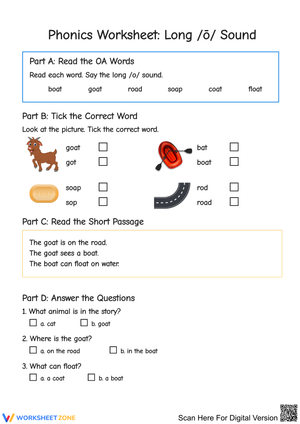
These 1st grade OA worksheets give students repeated, structured practice with the oa vowel team — the spelling that carries the long o sound in words like boat, coat, goat, road, and soap. Each worksheet targets a specific decoding or spelling skill so teachers can drop them into phonics blocks, centers, or small-group reteaching without restructuring a lesson around them.
What's Inside the Set
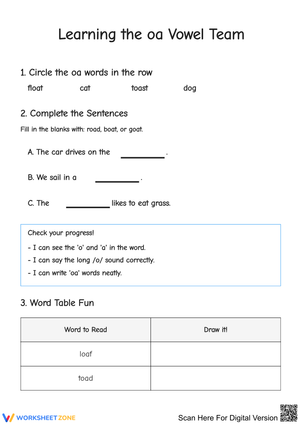
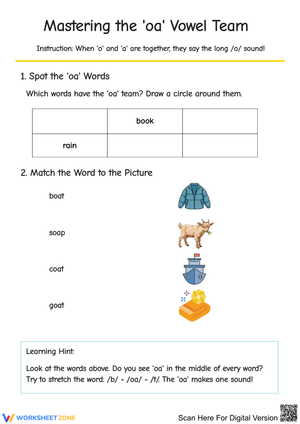
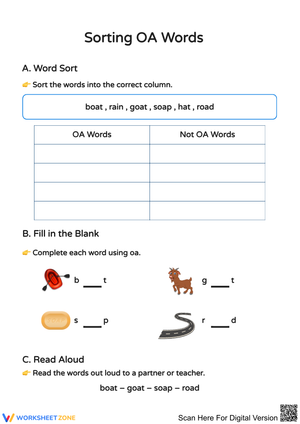
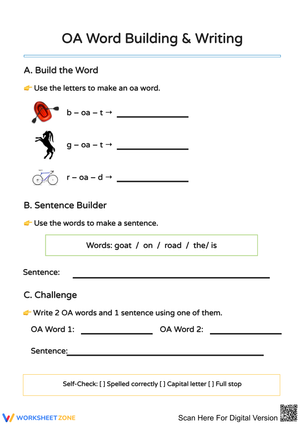
The worksheets address the full range of skills a first grader needs to internalize a vowel team — not just recognize it in isolation, but read it fluently and spell it independently. Tasks across the set include circling oa words in a word bank, matching pictures to written words, reading OA words in short phrases, sorting oa against other long o spellings like o_e and ow, filling in missing letters, and completing simple sentences using OA vocabulary.
The sorting tasks deserve particular mention. Students at this stage often hear the long o sound accurately but haven't yet built a reliable visual memory for the different ways it can be spelled. Asking them to place rope, road, and row into separate columns — same sound, different letters — builds that spelling awareness faster than reading practice alone. It also surfaces a specific confusion that shows up constantly in student writing: children who can read goat correctly will still write gote or gowt on a dictation because they're relying on the sound, not the pattern.
Standard Alignment
These worksheets address CCSS RF.1.3b, which calls for first graders to decode regularly spelled one-syllable words, and RF.1.3a, which covers knowledge of long and short vowel sounds in one-syllable words. Vowel teams like oa appear in the Grade 1 phonics sequence because students at this stage have already secured CVC patterns and are ready to learn that a single vowel sound can be spelled more than one way — a conceptual shift that these worksheets directly support through comparison and sorting tasks.
Smart Ways to Work These Worksheets Into Your Week
The most reliable placement for an OA worksheet is the ten minutes immediately following a phonics mini-lesson — after you've written boat and road on the anchor chart, underlined the vowel team, and had students read several words chorally. That transition from oral blending to independent print work is where the pattern either sticks or doesn't, and a focused worksheet makes the gap visible before students move into reading groups.
Beyond that anchor slot, the worksheets fit naturally into literacy centers (the sorting and color-coding tasks run independently once students understand the routine), Monday morning review after a weekend away from the pattern, and small-group reteaching with three or four students who are still guessing at long o words rather than decoding them. The homework worksheets in the set use simple directions and familiar vocabulary, which matters — a page a student can't do without a parent explaining it isn't usable homework.
Frequent Student Errors Worth Watching For
The error that appears most reliably in student work is vowel team omission under pressure. When first graders are working quickly — especially on sentence-completion tasks — they'll write bot or cot rather than boat or coat. They know the short vowel pattern and it's faster to apply. The fix isn't more drilling on OA in isolation; it's asking students to mark the vowel team before reading or writing any word on the worksheet. A quick underline or box around oa slows the reflex toward familiar patterns and builds attention to the specific spelling.
A second error involves position. Some students over-generalize oa and try to use it at the end of words — writing gloa for glow or toa for toe. This is worth addressing directly, because oa almost never appears at the end of an English word. Pointing that out explicitly, even in first grade, gives students a useful constraint: if they're hearing the long o sound at the end of a word, oa is almost certainly not the right choice.
Why This Format Works for First Graders
Cognitive load matters significantly at this stage. First graders are still building automaticity with basic letter-sound correspondences, so any worksheet that mixes multiple unfamiliar patterns on the same page pushes too many demands into working memory at once. Keeping each worksheet focused on oa — with clear print, familiar vocabulary, and enough white space — means students can direct attention to the vowel team rather than managing the overall complexity of the page.
The progression within the set follows a gradual release sequence: identification tasks appear before production tasks, picture support scaffolds early decoding work, and sentence-level application comes after students have had repeated exposure to the individual words. That ordering isn't accidental — students who try to write OA sentences before they can reliably read OA words produce confused work that's hard to assess meaningfully.
Frequently Asked Questions
What OA words appear across the worksheets?
The set draws from the core first-grade OA vocabulary: boat, coat, goat, road, soap, toad, load, and foam. These words are concrete enough that picture support is straightforward, and they appear often enough in decodable readers that students will meet them outside worksheet practice.
How should I introduce OA before using the worksheets?
Direct modeling first: write three or four OA words on a whiteboard, underline the vowel team, and have students blend each word chorally. Then contrast one OA word with the same word spelled using a different long o pattern — say, road alongside rode — so students hear that the sound doesn't change but the spelling does. The worksheet works best as the handoff from that oral-to-print transition, not as the first contact with the pattern.
Can these worksheets work for small-group intervention?
They're well-suited for it. The matching and picture-support pages give a teacher something concrete to work through alongside a student who is guessing rather than decoding — you can pause, point to the vowel team, and prompt blending without losing the thread of the activity. The sorting tasks also generate useful diagnostic information in a small group: you can hear exactly where a student's reasoning breaks down when they're placing words and explaining their choices aloud.
What comes after OA practice?
Once students are reading and spelling OA words reliably, the natural next step is a direct comparison across all three common long o spellings: oa, o_e, and ow. A three-column sort using words from all three patterns consolidates the vowel team concept and prepares students for the more complex decoding they'll encounter in second-grade text. Finishing each OA worksheet session by reading a decodable sentence or two with oa words reinforces that phonics exists to support reading — not just to complete a page.
Clear All