These ai and ay worksheets for 1st grade give teachers a focused, print-ready way to tackle one of phonics' most reliably teachable rules: the position-based spelling distinction between two vowel teams that produce exactly the same sound. Students who arrive at this skill have already worked through short vowels, digraphs, and silent-e patterns — they're ready for the next layer, and this particular rule is unusually consistent, which means direct practice pays off fast.
The Spelling Rule These Worksheets Are Built Around
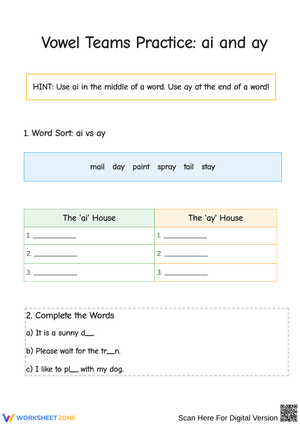
Ai appears in the middle of a word or syllable, always followed by a consonant — rain, trail, paint, waist. Ay closes the word or syllable with no consonant after the long /a/ — play, tray, stay, birthday. First graders grasp this positional logic faster than most teachers expect, especially when it's tied to a physical anchor. Some teachers tap their chest when they say "ai in the middle" and sweep a hand outward for "ay at the end." The worksheets reinforce that same thinking in print, asking students to look at where the vowel team sits in the word before they write anything.
What Students Do on Each Worksheet
Each worksheet isolates a different processing demand so students aren't repeating the same cognitive task across the whole set.
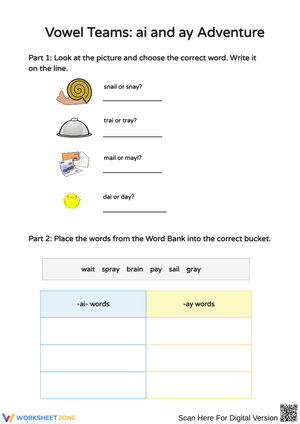
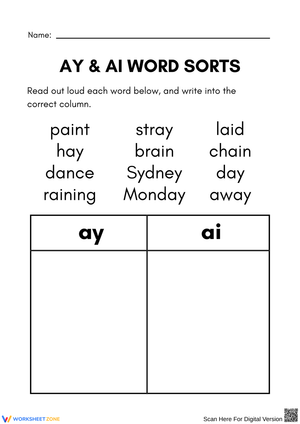
- Word sorts — students read words from a mixed list and write them under the correct vowel team column, forcing active categorization rather than passive copying
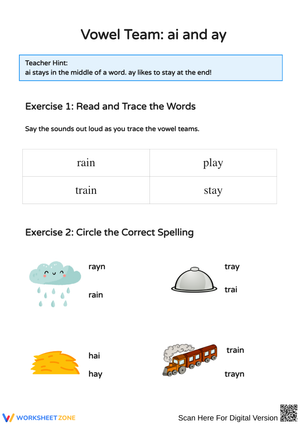
- Picture-to-spelling matching — students look at an image (a snail, a tray), identify the word, and write it under the right pattern header
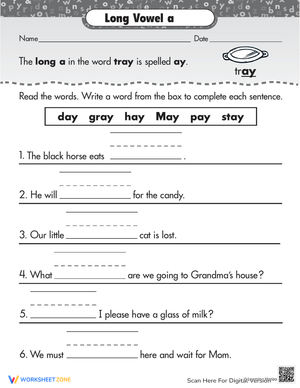
- Cloze sentences — a sentence with a blank and two spelling choices, such as Did the dog w___t by the door? (wait / wayt) — students circle the correct form and rewrite the word in full
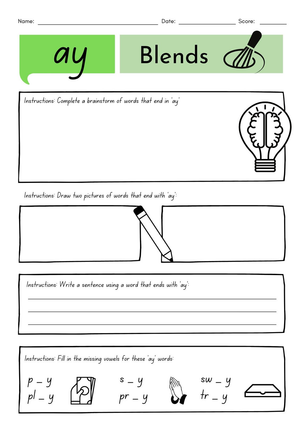
- Word building — students are given a consonant frame and must select "ai" or "ay" to complete the word based on what letters follow
- Short decodable passages — three to five sentences built almost entirely from ai/ay words, where students read and then underline every vowel team they find
That last activity matters. Isolated word lists don't tell you whether a student can hold onto the rule while also tracking meaning. A first grader who sorts sail correctly in a word sort can still stumble over "The snail left a trail in the rain" when reading has to happen at pace.
Mistakes Students Make That These Worksheets Help You Catch
The most predictable error isn't random — students default to ay for nearly everything because it's usually introduced first and looks simpler. You'll see "trayn" for train, "mayl" for mail, and "wayt" for wait with real consistency. A trickier mistake surfaces with words where a consonant cluster follows the vowel team: "paint" becomes "paynt" because the student reasons, "the /a/ sounds like it's at the end." That's actually logical — and the word-building worksheets address it directly by including several ai-plus-cluster words so students have to confront that boundary rather than avoid it.
There's a second pattern worth noting. Students who have been drilled heavily on silent-e words sometimes try to transfer those rules onto vowel teams, producing spellings like "raine" or "playe." If you're seeing that in a student's independent writing, one worksheet from this set on word building — where no extra letters can be added after the vowel team unless they're provided in the frame — gives you a focused correction tool without reopening the whole silent-e lesson.
Standard Alignment
These worksheets address CCSS.ELA-LITERACY.RF.1.3.C, which requires first graders to know common vowel team conventions for representing long vowel sounds. In classroom terms, this standard sits in the second half of the year — after students read CVC and CVCe words with fluency but before they move into more complex vowel teams like "oa," "ee," or "ea." For teachers using a structured literacy sequence, this is the point where phonics instruction shifts from single-pattern decoding to choosing between competing spellings for the same sound. That shift is a genuinely new cognitive demand, and the variety of activity types in this set addresses it from multiple angles.
Working These Worksheets Into Your Phonics Rotation
The word sort worksheets earn their place in the ten minutes after morning meeting — students are seated, attention is reasonably high, and you haven't moved into the main lesson block yet. Run three to four examples together on the board, then send students to their seats for the independent sort while you pull a small group. The cloze and sentence worksheets fit neatly into literacy center rotations: they're short enough that a student finishes one in eight to ten minutes without rushing, which keeps the center moving on schedule. The decodable passage worksheet is better suited to guided reading groups, where you can listen to students read aloud and catch mid-word self-corrections before those habits solidify.
These ai and ay worksheets for 1st grade also serve as Monday review material after a weekend gap. The spacing effect is real — students who sorted rain and play correctly on Friday lose some of that retrieval strength over the weekend, and a five-minute word sort at the start of Monday's lesson reactivates it before the week's new skill builds on top of it. That's more efficient than re-teaching from scratch.
Adjusting the Set for the Full Range of Readers in Your Classroom
For students still consolidating short vowels or struggling to retain digraph spellings, the ai/ay distinction can feel like one thing too many at once. Pair the word sort worksheet with a small reference card — an index card showing one anchor word per pattern with a sketch: a raindrop for "ai," a sun with rays for "ay." Students check the card before writing each answer. Remove the card once the pattern is automatic, which for most students happens within a week or two of regular practice. That physical reference reduces memory load without changing the task itself.
Advanced readers who already apply the rule correctly in isolated practice need a different kind of challenge. Have them use the decodable passage worksheet as a model, then write their own three-sentence passage using at least four ai words and four ay words, trading with a partner who underlines each vowel team. That extension turns the ai and ay worksheets for 1st grade into an encoding exercise rather than a decoding one, which is exactly the direction strong first-grade readers need to move.
Frequently Asked Questions
When in the year do most teachers introduce ai and ay?
Most structured literacy programs place these vowel teams in the second half of first grade, typically after CVC, CVCC, CCVC, and CVCe patterns are solid. In practice that often means January through March for on-grade-level students. Students receiving reading intervention may encounter these patterns later or with more distributed practice spread across the year.
Can these worksheets be used without a purchased phonics curriculum?
Yes. Each worksheet stands alone. A brief direct instruction moment — five to seven minutes explaining the position rule and writing four to six examples on the board — is enough to set students up for the independent practice on any worksheet in the set. You don't need a program license or a specific scope and sequence to use them effectively.
How do these worksheets work for English language learners?
The picture-based worksheets are the best starting point for ELL students because the image carries the word meaning, which lets students focus their attention on the spelling pattern rather than vocabulary retrieval. The cloze sentences are harder — they require enough English syntax to read the sentence and recognize the logical fit. Sequence the picture and word-sort worksheets first for ELL students, then return to the cloze format once the vocabulary is more familiar. The ai and ay worksheets for 1st grade set includes enough format variety that you can choose starting points without restructuring the whole unit.
Do these worksheets include answer keys?
Yes, each worksheet comes with a corresponding answer key. Word sorts and cloze activities have single correct answers, so the key saves meaningful grading time. Any sentence-writing extensions accept correctly spelled original sentences, so those you read rather than key-check — which takes about thirty seconds per student when you're circulating during work time anyway.












 Interactive Worksheet Maker
 Quiz Maker
 Word Search Maker
 Crossword Puzzle Maker
 Word Scramble Generator
 Sentence Scramble Generator
 Handwriting Worksheet Generator
 Name Tracing Generator
 Fill In The Blank Generator