These 1st grade ai worksheets give teachers a ready-made sequence for one of phonics' trickier turning points: the moment first graders discover that two vowels side by side can produce a single, unified sound. The set covers word sorts, Elkonin box spelling practice, decodable sentences, and cut-and-paste activities — enough variety to carry a full "ai" unit without reusing the same format twice.
The "ai" and "ay" Positional Rule
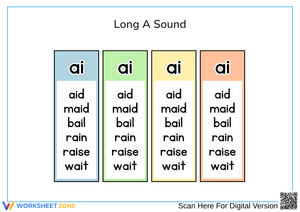
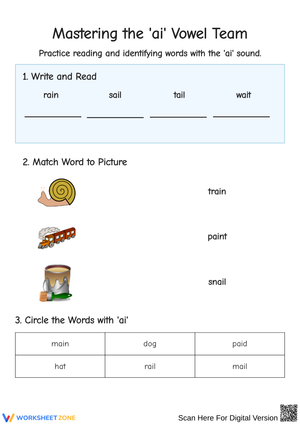
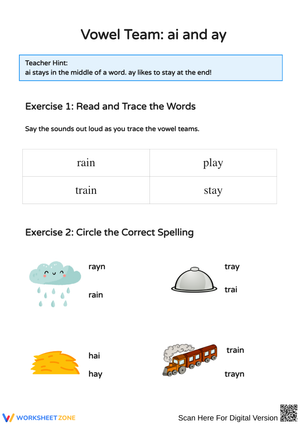
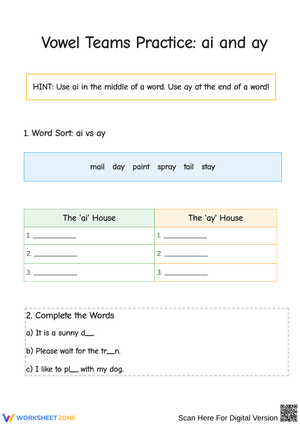
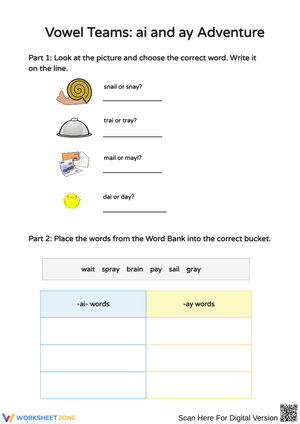
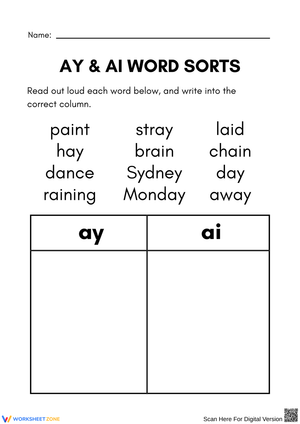
Teaching "ai" in isolation is only half the job. Students need the contrast with "ay" early — not later, after they've already formed a habit of choosing between the two arbitrarily. The positional rule is the anchor: "ai" appears in the middle of a syllable (rain, wait, paint, snail), while "ay" appears at the end (play, tray, day). Several worksheets in the set build this contrast directly — students sort words into two columns, mark where the long a sound falls in a word, and then decide which spelling applies. Without that comparison built into the practice, students spend weeks guessing rather than reasoning.
What Students Practice Across the Set
The worksheets move the "ai" vowel team from initial recognition through independent production. Activity types include:
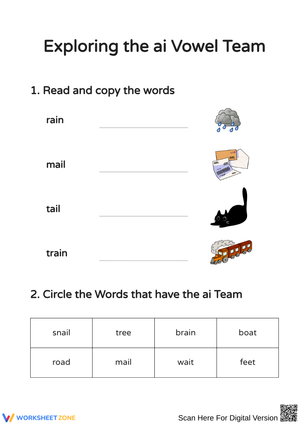
- Elkonin box spelling: Students segment spoken words into phonemes and write the graphemes in individual boxes — placing both letters of "ai" into a single box, which makes the digraph nature of the spelling visible and reinforces that the two letters act as one unit.
- Word sorts: Students categorize "ai" words against other long a patterns, building the habit of checking spelling position before selecting a vowel representation.
- Decodable sentences: Short, controlled sentences let students practice blending "ai" words in context, bridging isolated word recognition and smooth sentence reading.
- Cut-and-paste word building: Students assemble words from letter or letter-cluster cards, which slows their attention to sequence — useful for students who tend to glance at a word and approximate.
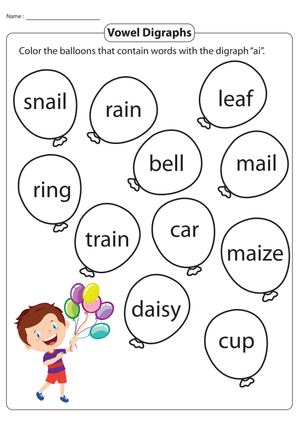
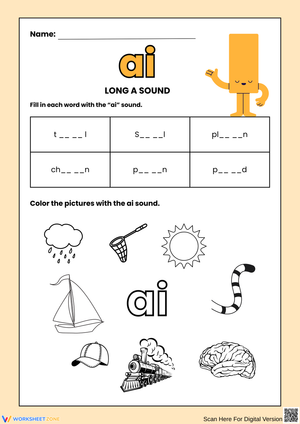
- Color-by-code: Students identify "ai" words to reveal a hidden picture, providing low-stakes repetition for students who need volume of practice without the pressure of production tasks.
Errors That Surface Early and Often
The most consistent error at this stage is pattern substitution. Students who read cake and gate without hesitation will often write trane instead of train because vowel-consonant-e is the long a spelling they know cold. They aren't confused about the sound — they're reaching for the tool they trust. Dictation surfaces this immediately: ask students to write brain, chain, and faint on their whiteboards. Students who write brane, chane, and fante are telling you they need more contrasting practice with the positional rule, not more isolated "ai" drilling.
A second error worth watching is vowel reversal — students write ia instead of ai. This isn't a phonemic issue; they know the sound. It's a visual sequencing problem, often connected to the order in which they learned to name the letters aloud. Having the student trace the printed "ai" left to right before writing it independently corrects this faster than re-explaining which letter comes first.
Fitting These Into Your Literacy Block
The 1st grade ai worksheets slot naturally into three places in the school day: morning warm-up, literacy centers, and the guided reading table. For warm-up, one Elkonin box worksheet gives students a focused independent task while attendance is taken and the room settles — around eight minutes of phonics work before the first transition. For literacy centers, laminating the word sort and color-by-code worksheets and providing dry-erase markers lets the same worksheet serve multiple students across several rotations without reprinting.
At the guided reading table, the decodable sentence worksheets support close observation. Watch where a student's eyes pause. If they blend "ai" words smoothly on a word list but slow down inside sentences, the issue is transfer to connected text — not the vowel team itself. The decodable passage worksheets work well for repeated reading over three sessions: the same passage on Monday, Wednesday, and Friday gives a clear picture of whether accuracy and reading rate on the target pattern are improving.
Standard Alignment
These worksheets address CCSS RF.1.3c, which requires first graders to know common vowel team conventions for representing long vowel sounds, and RF.1.3b, which covers decoding regularly spelled one-syllable words. In most pacing guides, RF.1.3c becomes the active focus in the second half of first grade — after CVC words and vowel-consonant-e are solid, typically between January and March. The 1st grade ai worksheets align to both standards and give teachers documentation for standards-based lesson plans without requiring separate cross-referencing.
Adjusting the Worksheets for Mixed-Ability Classrooms
Students still working through basic CVC decoding need a shorter ramp into "ai" words. Start them on three-phoneme words — sail, mail, rain, paid — before moving to four-phoneme words like train or brain, where an initial or final blend adds a separate demand. On Elkonin box worksheets, pre-filling the consonant graphemes and leaving only the "ai" box blank narrows the decision point without removing the core spelling practice.
Students who decode "ai" accurately in word lists but misspell in dictation need the sentence-level worksheets most. Have them read a sentence, fold the worksheet face-down, and write it from memory. That encoding task surfaces whether the pattern is stored or still being reconstructed sound by sound each time — a meaningful diagnostic distinction.
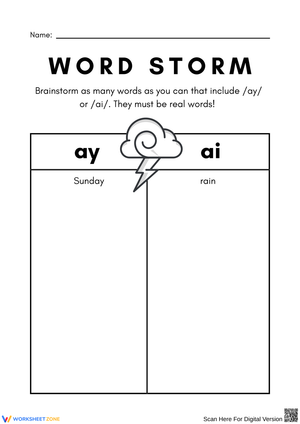
Students ahead of the sequence can treat any word sort as a generalization exercise: give them a blank two-column grid, a pile of word cards, and ask them to add one original word in each column that isn't already on the cards. That extension takes under five minutes and tells you immediately whether the positional rule has transferred beyond the words they've seen in practice.
Frequently Asked Questions
When in first grade does the "ai" vowel team typically get introduced?
Most structured phonics programs place vowel teams in the second half of first grade, after CVC words and vowel-consonant-e are secure. In practice that usually falls between January and March. If students can read and spell cake, bike, and name reliably, they're ready to move into vowel teams.
How does the set handle the "ai" versus "ay" distinction?
Several worksheets include side-by-side sorting tasks where students decide which spelling belongs based on where the long a sound sits in the word. The positional rule — "ai" in the middle, "ay" at the end — appears as a printed reference at the top of each sorting worksheet so students can consult it while they work rather than holding it in memory from a prior lesson.
Can these be used for phonics intervention with older students?
Second and third graders who missed this instruction — or who learned it but didn't retain it — can use the 1st grade ai worksheets without modification. The vocabulary and sentence complexity stay accessible, and the activity formats are direct enough that an older student working in a small-group intervention setting won't feel out of place with the material.












 Interactive Worksheet Maker
 Quiz Maker
 Word Search Maker
 Crossword Puzzle Maker
 Word Scramble Generator
 Sentence Scramble Generator
 Handwriting Worksheet Generator
 Name Tracing Generator
 Fill In The Blank Generator