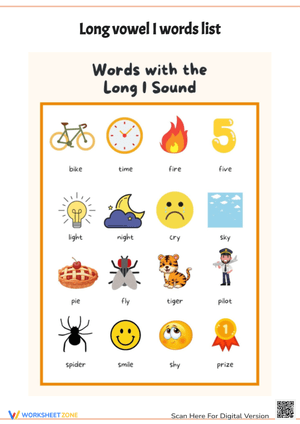
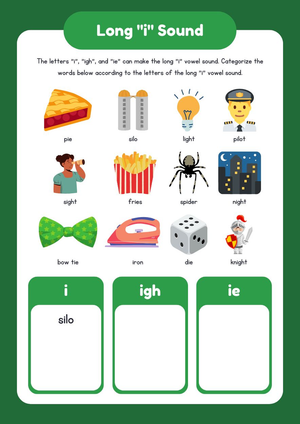
These long i worksheets for 1st grade give teachers a self-contained set of phonics practice covering the four most common long i spelling patterns — i_e, igh, y as a word-final vowel, and ie. Each worksheet isolates one pattern so students build clear recognition before encountering mixed review. The set runs the full progression from listening discrimination to sentence-level reading and short writing, which makes it usable at multiple points within a single phonics unit.
The Four Patterns These Worksheets Target
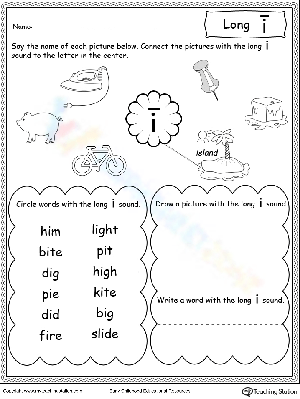
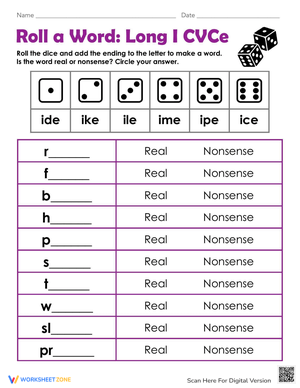
The i_e pattern comes first in most first-grade phonics sequences, and the reasoning holds: pairing it immediately against its short i counterpart — kit/kite, hid/hide, pin/pine — gives students the clearest available contrast. Each i_e worksheet asks students to underline the silent e, read the word aloud, and write it in a new column. That three-step sequence forces active attention to the spelling rather than passive recognition of a familiar word.
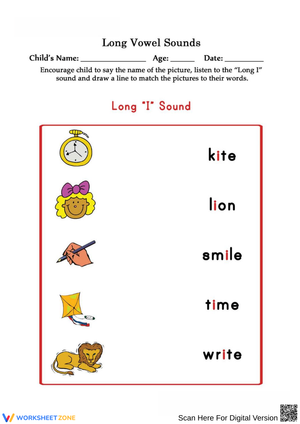
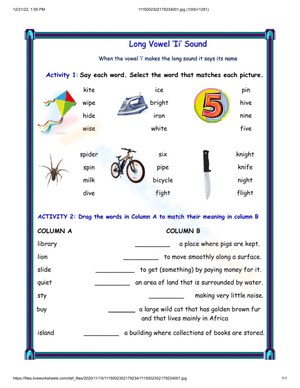
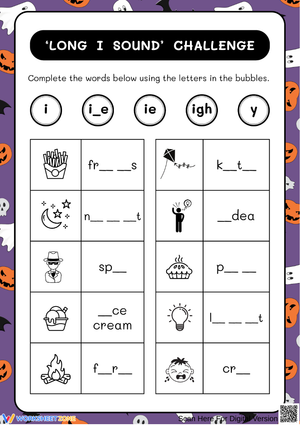
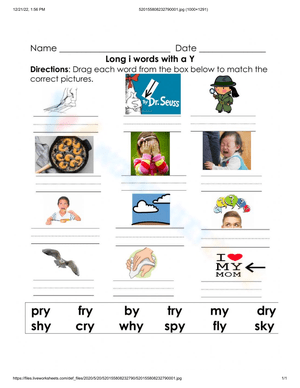
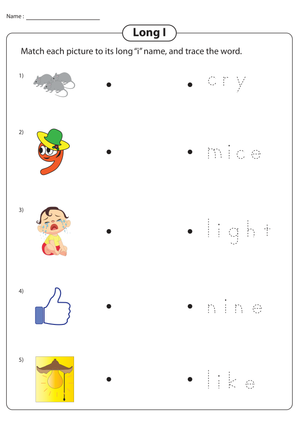
The igh pattern carries more visual complexity. Students often read light correctly as a whole-word sight item but cannot explain why it says long i — they have memorized the word without encoding the chunk. Worksheets that ask students to circle the igh unit and then generate rhyming words (night, right, tight) build the pattern awareness that transfer to unfamiliar words requires. The y pattern, appearing at the end of single-syllable words like my, try, and cry, needs explicit teaching because students who have learned that y says /y/ in yes resist accepting it as a vowel at word's end. A short matching worksheet pairing pictures with words makes that contrast clear. The ie pattern — pie, tie, die — has a smaller word family at the first-grade level, so those worksheets stay deliberately focused: five to eight words, two task types, no overreach.
Across all four patterns, each worksheet includes at least one of these task types:
- Circling or underlining the spelling chunk within a printed word
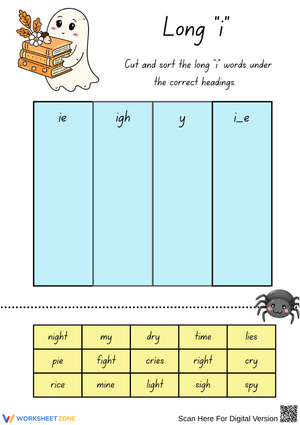
- Sorting words into two columns — short i versus long i
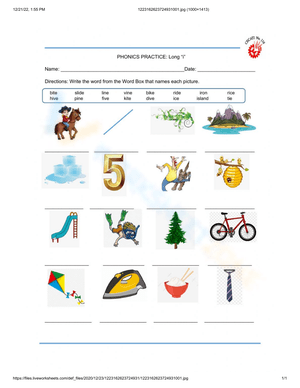
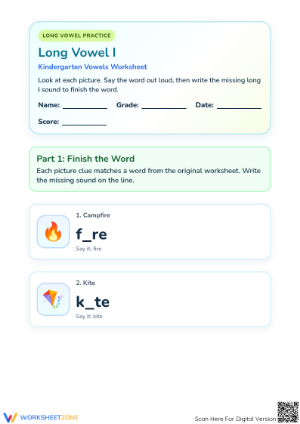
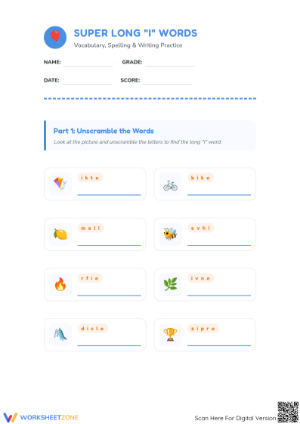
- Completing missing letters or writing the full word from a picture prompt
- Reading two or three short sentences and underlining every long i word
Mistakes First Graders Make That Surface With These Worksheets
The most consistent error across all four patterns is chunk blindness: students decode letter by letter rather than reading the spelling unit as a whole. A student who knows i, g, and h individually will still stall on night — often producing something like /nɪ-g-h/ — unless they have been explicitly taught that igh signals one sound as a unit. When you circulate during a worksheet and hear that sound-by-sound stall, the student is not ready for sentence-level igh tasks yet.
The y-as-long-i error is rooted in overgeneralization. Students who have recently drilled initial-consonant y words — yellow, yell, yarn — frequently read my as /mɪ/ or guess from the picture. Because the error comes from applying an earlier rule, repeating the correct pronunciation does not fix it. A contrast sort — initial y words on one side, word-final long i y words on the other — makes the distinction visible in a way that pronunciation modeling alone cannot.
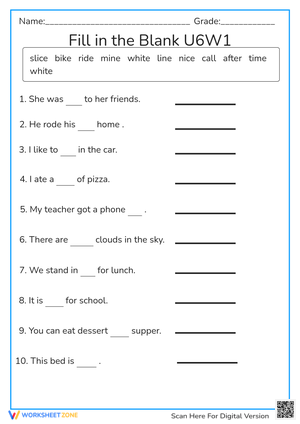
The i_e encoding error appears constantly in written work: students read kite correctly but write kit or kigt when asked to spell from memory. Decoding accuracy and encoding accuracy do not develop at the same pace in first grade — a student who reads the pattern fluently may have no reliable memory representation of it for spelling. The fill-in-the-blank and picture-prompt writing tasks in this set surface that gap early, before it shows up on a unit assessment.
How to Slot These Worksheets Into a Typical Phonics Week
The most productive placement for a new-pattern worksheet is the five to eight minutes immediately after a mini-lesson — not the end of the period and not the following day. Introduce the pattern, model two or three words on the board, and then put the worksheet in front of students while the teaching is still warm. A tightly focused, single-skill task earns its time here: students are primed, the worksheet matches the lesson, and the teacher can circulate for a quick formative read before the class moves on.
Later in the week, the same worksheets function differently. A sorting worksheet used during literacy centers on Wednesday or Thursday becomes independent reinforcement rather than introduction — students who completed it with teacher support earlier are now applying the pattern cold, which is a basic spaced-retrieval move that first-grade phonics benefits from considerably. Friday morning work — five long i words to read, five to write from a picture prompt — gives a clean data point without cutting into whole-group time. Teachers working through a long i unit tend to use long i worksheets for 1st grade in exactly this sequenced way: new pattern introduced Monday, guided application mid-week, independent review by Friday.
Adjusting the Work for Your Full Range of Learners
For students still shaky on CVC short i words, the i_e contrast worksheets serve as both target lesson and review anchor. Seat those students at a small-group table and ask them to read both word columns aloud before marking anything — the oral step slows down guessing and makes the vowel difference audible. Reducing the item count by crossing out every other row keeps the worksheet from feeling overwhelming while preserving the pattern-contrast structure that makes it instructionally useful.
Students who have already internalized i_e move efficiently through the igh and y worksheets when given one generative anchor word before they begin — offer light and ask how many -ight rhymes they can produce in sixty seconds. That front-load accelerates the rest of the task because students bring their own word set rather than waiting for the worksheet to supply all the vocabulary. For the highest-performing readers, the most demanding adjustment is sentence-level: ask them to write two original sentences using long i words drawn from two different spelling patterns. Holding the same vowel sound while shifting the visual spelling form is a more rigorous transfer task than anything the worksheet itself requires.
Standard Alignment
These worksheets address CCSS.ELA-LITERACY.RF.1.3b, which requires students to decode regularly spelled one-syllable words. In practical classroom terms, RF.1.3b is where long vowel patterns enter the assessed phonics sequence in first grade. Most structured literacy frameworks introduce long i patterns in the second semester — typically January through May — after students have solid short-vowel CVC and CCVC decoding. That placement puts this set squarely in the instructional window for on-grade first-grade readers and positions it cleanly before the vowel-team work that second grade introduces.
Frequently Asked Questions
Which long i pattern should I introduce first?
Start with i_e. The silent-e contrast — pin/pine, bit/bite, hop/hope — is the most transparent long i spelling and the easiest to sort and assess. Once students read and spell ten to twelve i_e words reliably, move to igh, then y, then ie. Keeping that sequence consistent with your classroom scope and sequence matters more than any particular starting choice.
Are these appropriate for students reading below grade level?
Yes, with one precondition: confirm that students decode short i CVC words reliably before using long i worksheets for 1st grade with below-grade readers. A student who reads sit with uncertainty will not get traction on site. Use the contrast worksheets — those that place short and long i words in adjacent columns — as the entry point, and prioritize oral word-reading before any written task.
How long should one worksheet take to complete?
For most first graders, a focused single-skill worksheet runs eight to twelve minutes. If a student needs significantly longer for a ten-item task, that is diagnostic information: either the pattern is not yet automatic, or the task format is adding confusion. Pulling that student for three to five minutes of oral word-reading before the written task usually resolves the bottleneck faster than additional independent time on the same worksheet.
Can I send these home for homework?
Matching, circling, and fill-in-the-blank formats travel well. Cut-and-sort worksheets are better kept at school — a cut-sort sent home Tuesday has a way of arriving back Wednesday as crumpled strips in a backpack. When you send long i worksheets for 1st grade home, choose worksheets that require only a pencil so the phonics skill stays in focus rather than the logistics of paper and scissors.












 Interactive Worksheet Maker
 Quiz Maker
 Word Search Maker
 Crossword Puzzle Maker
 Word Scramble Generator
 Sentence Scramble Generator
 Handwriting Worksheet Generator
 Name Tracing Generator
 Fill In The Blank Generator