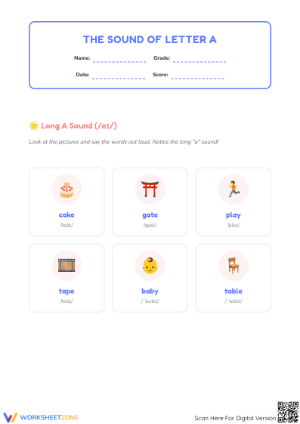
Long a printable worksheets for 1st grade land in the phonics sequence at a critical juncture: most students enter first grade with short vowel CVC words fairly solid, and the long a sound is where they first confront the idea that a single letter can behave differently depending on how a word is spelled. The question "why does cap have a short vowel but cape does not?" sits at the heart of what these worksheets are built to answer through structured, repeatable practice.
Three Patterns, One Sound
Long a instruction in Grade 1 centers on three spelling patterns that account for the overwhelming majority of long a words students encounter in decodable texts and independent reading. Sequencing them deliberately matters more than teaching them simultaneously.
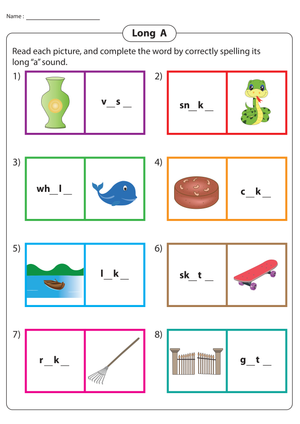
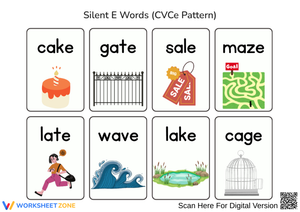
- Silent e (a_e): Words like cake, made, and tape follow the consonant-vowel-consonant-e structure. This pattern typically comes first because students build directly on existing CVC knowledge — adding one letter changes the vowel sound entirely.
- Vowel team ai: Rain, mail, and train place the digraph in the middle of the word. Most scope-and-sequence guides introduce ai after a_e words because it demands recognizing a two-letter unit rather than inferring a vowel change from a distant final letter.
- Vowel team ay: Play, day, and say carry the sound at the word's end. Teaching ay alongside ai — not after — lets students internalize the positional rule: ai goes in the middle, ay goes at the end.
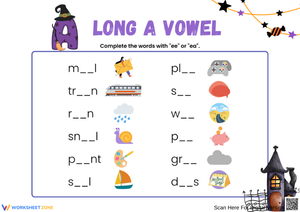
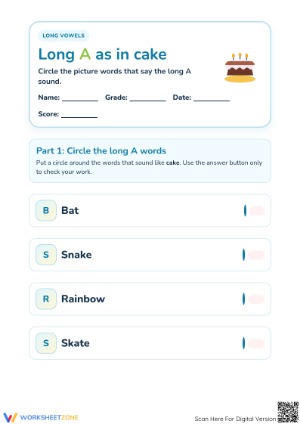
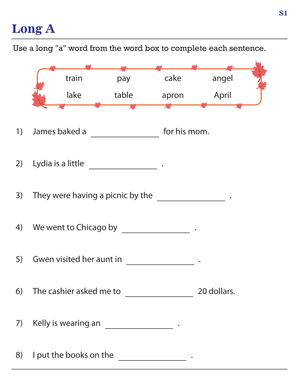
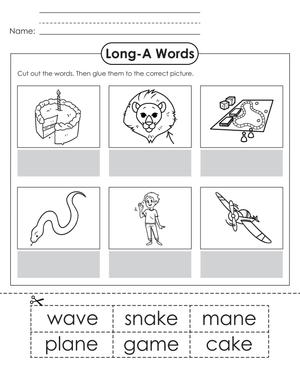
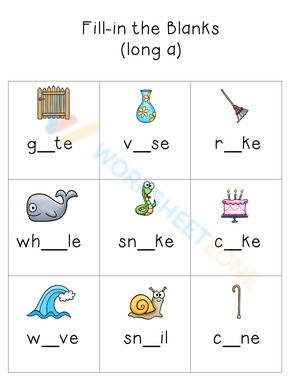
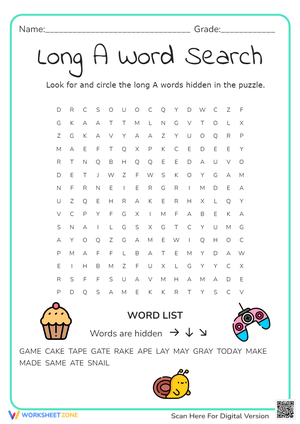
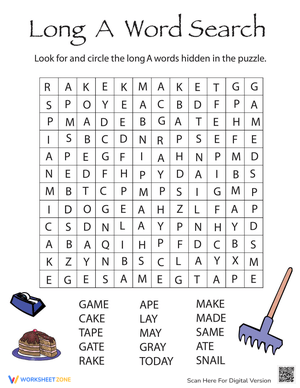
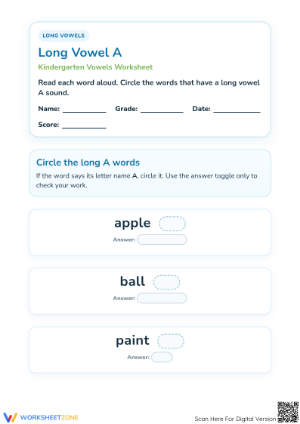
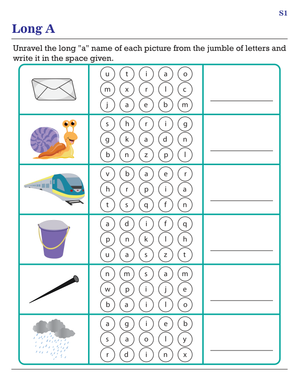
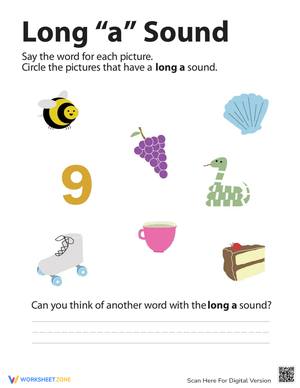
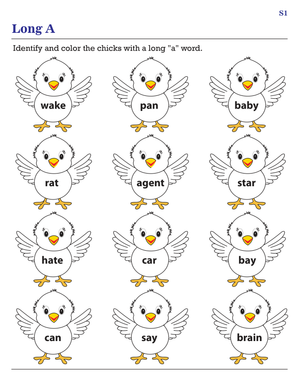
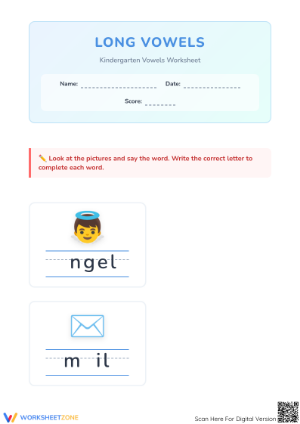
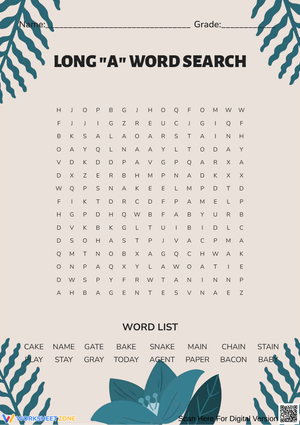
Each worksheet in the set targets one or more of these patterns through distinct activity types: cut-and-paste word sorts, silent e transformations, picture-word matching, and decodable sentence completion. Offering variety across activity formats reduces cognitive monotony while keeping the phonics target consistent across every task.
Error Patterns That Show Up Reliably in Student Work
The most predictable confusion is between ai and ay position. Students who correctly write rain on a sorting task will often write rayn three days later because the positional rule has not yet consolidated. What looks like carelessness is usually incomplete pattern internalization — the two vowel teams feel interchangeable until students have enough repetitions to notice where each one sits inside a word.
The silent e pattern produces a different category of error. Students who read cape fluently will sometimes write caep or caip in their journals, importing vowel-team logic into a word that actually uses a final e. This cross-pattern interference is most visible in writing samples from the week after vowel teams are introduced. Mixed-pattern sorting worksheets surface that confusion directly rather than letting it persist unnoticed until a composition assignment.
A third error is subtler: students who master decoding long a words before they master encoding them. A student reads cake instantly but writes cak, dropping the silent e entirely. Worksheets that require students to produce spellings — rewriting words, completing sentences, composing from a word bank — address that gap in a way that pure recognition tasks do not.
Building These Worksheets Into Your Literacy Block
Long a printable worksheets for 1st grade fit most naturally into a literacy block that already includes whole-group phonics instruction, small-group rotations, and an independent station. They work as transfer and reinforcement practice, not as the site of initial teaching.
During the five minutes before a whole-group phonics lesson wraps up, a word-sort worksheet makes an efficient formative check. Students work individually, then compare answers with a partner while the teacher circulates. A two-minute scan of completed sheets tells you exactly who needs a small-group follow-up — and saves you from re-teaching a full pattern to students who already have it.
At the teacher table, differentiated versions of the same worksheet keep the focus tight without requiring separate lesson plans. Students reading below grade level work through a single-pattern sort with picture cues while on-level students complete a mixed-pattern sort at their seats. Above-level students extend any worksheet by writing two original sentences on the back using words from that session's sort.
One habit that pays off over several weeks: after completing any sorting or matching worksheet, have each student choose two long a words to add to a personal word list tucked inside their writing folder. By mid-year, that list becomes a working reference students actually consult during journal writing — a direct line between phonics practice and authentic composition.
Standard Alignment
These worksheets address CCSS.ELA-LITERACY.RF.1.3.C, which requires Grade 1 students to know the spelling-sound correspondences for common vowel teams. In classroom terms, this standard belongs to the mid-to-late first grade phonics sequence — after short vowel CVC patterns are secure and before students move into r-controlled vowels and vowel diphthongs. Long a printable worksheets for 1st grade sit squarely in that instructional window, providing the targeted repetition this standard calls for across all three core spelling patterns.
Adapting Each Worksheet Across Reading Levels
Long a printable worksheets for 1st grade are most effective when teachers make deliberate adjustments for the range of readers in the room, rather than assigning every student the same worksheet at the same point in the sequence. Below-level readers benefit from single-pattern tasks — confirm accuracy on a_e across two or three sessions before introducing ai. Adding picture cues and reducing the item count from twelve to six limits cognitive load to a level where pattern recognition can actually form without students guessing from pictures alone.
On-level students handle mixed-pattern sorts and sentence completion tasks once individual patterns are accurate. Above-level students extend any worksheet by writing a short paragraph — three to five sentences — that includes at least one word from each of the three long a pattern categories. That constraint is specific enough to push word-choice decisions without requiring a separately designed task.
What Completed Worksheets Tell You
Collecting worksheets functions as informal assessment when teachers read them deliberately rather than checking completion and moving on. A simple grid — student names down the left, patterns (a_e, ai, ay) across the top — lets you log accuracy after each session and spot trends fast. A student showing 90% accuracy on a_e items but dropping to 60% on ai items does not have a general phonics gap; that is a pattern-specific need, and a targeted five-minute reteaching pull is more efficient than repeating the entire long a unit.
Keeping completed worksheets across the marking period also produces visible evidence of growth. Showing a parent the September sorting sheet alongside the February one makes the trajectory concrete in a way that a reading level number cannot.
Frequently Asked Questions
What spelling patterns do the worksheets cover?
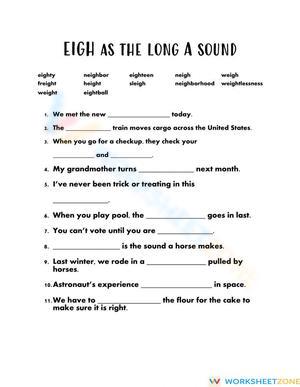
The set addresses the three primary long a patterns: silent e (a_e), vowel team ai, and vowel team ay. These cover the long a words that appear most frequently in Grade 1 decodable texts and leveled readers. Less common patterns — such as ei or eigh — appear in later grades and are not included here.
Should silent e be taught before the vowel teams?
Yes — most phonics scope-and-sequence guides place a_e first because students already know CVC words and need only to learn how a final e alters the medial vowel. Once a_e accuracy is solid, ai and ay are typically introduced together so students immediately learn the positional rule: ai in the middle, ay at the end. Separating them into two distinct teaching units risks students applying one pattern where the other belongs.
How do I help a student who cannot reliably tell short a from long a?
Start with minimal pairs — say cap and cape side by side, asking the student to stretch the vowel in each. A physical gesture helps anchor the contrast: a short tap on the desk for short a, a slow arm sweep for long a. Follow that contrast work with a sorting task before returning to mixed-pattern practice. Students who skip this step tend to guess from initial consonants rather than attending to the vowel, which makes later pattern work much harder to untangle.
How do these fit into small-group rotations without eating up too much time?
Assign one activity type per rotation day — word sorts on Monday, silent e transformations on Wednesday, sentence completion on Friday — rather than a different worksheet every session. Keeping the format consistent within a week lets students direct their effort toward the phonics target rather than toward decoding new directions. Each task runs 10–12 minutes, which leaves room for a quick decodable text read or oral word-reading drill within the same rotation slot.












 Interactive Worksheet Maker
 Quiz Maker
 Word Search Maker
 Crossword Puzzle Maker
 Word Scramble Generator
 Sentence Scramble Generator
 Handwriting Worksheet Generator
 Name Tracing Generator
 Fill In The Blank Generator