


























Views
Downloads


Save the Polar Bears! Printable Reading Worksheet | Grade 2
Paste this activity's link or code into your existing LMS (Google Classroom, Canvas, Teams, Schoology, Moodle, etc.).
Students can open and work on the activity right away, with no student login required.
You'll still be able to track student progress and results from your teacher account.
This Grade 2 informational reading worksheet helps students master key details about Arctic wildlife. By engaging with a focused passage on polar bears, learners practice identifying facts, defining domain-specific vocabulary, and applying critical thinking to environmental challenges. It provides a complete instructional cycle from reading to evidence-based response.
At a Glance
- Grade: 2 · Subject: ELA
- Standard:
CCSS.ELA-LITERACY.RI.2.1— Ask and answer such questions as who, what, where, when, why, and how- Skill Focus: Informational Text Comprehension
- Format: 3 pages · 7 problems · Answer key included · PDF
- Best For: Independent practice or sub plans
- Time: 20–30 minutes
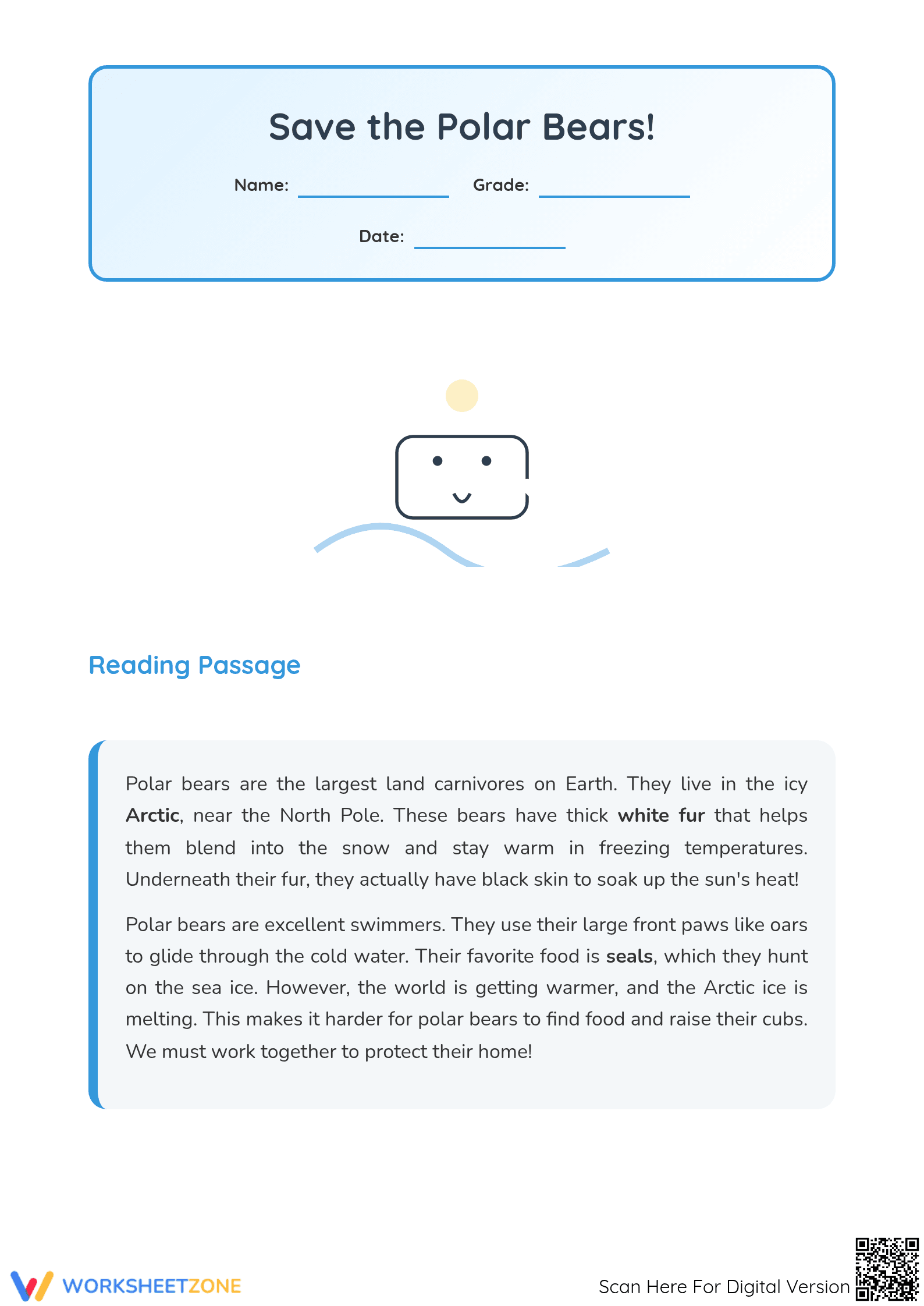
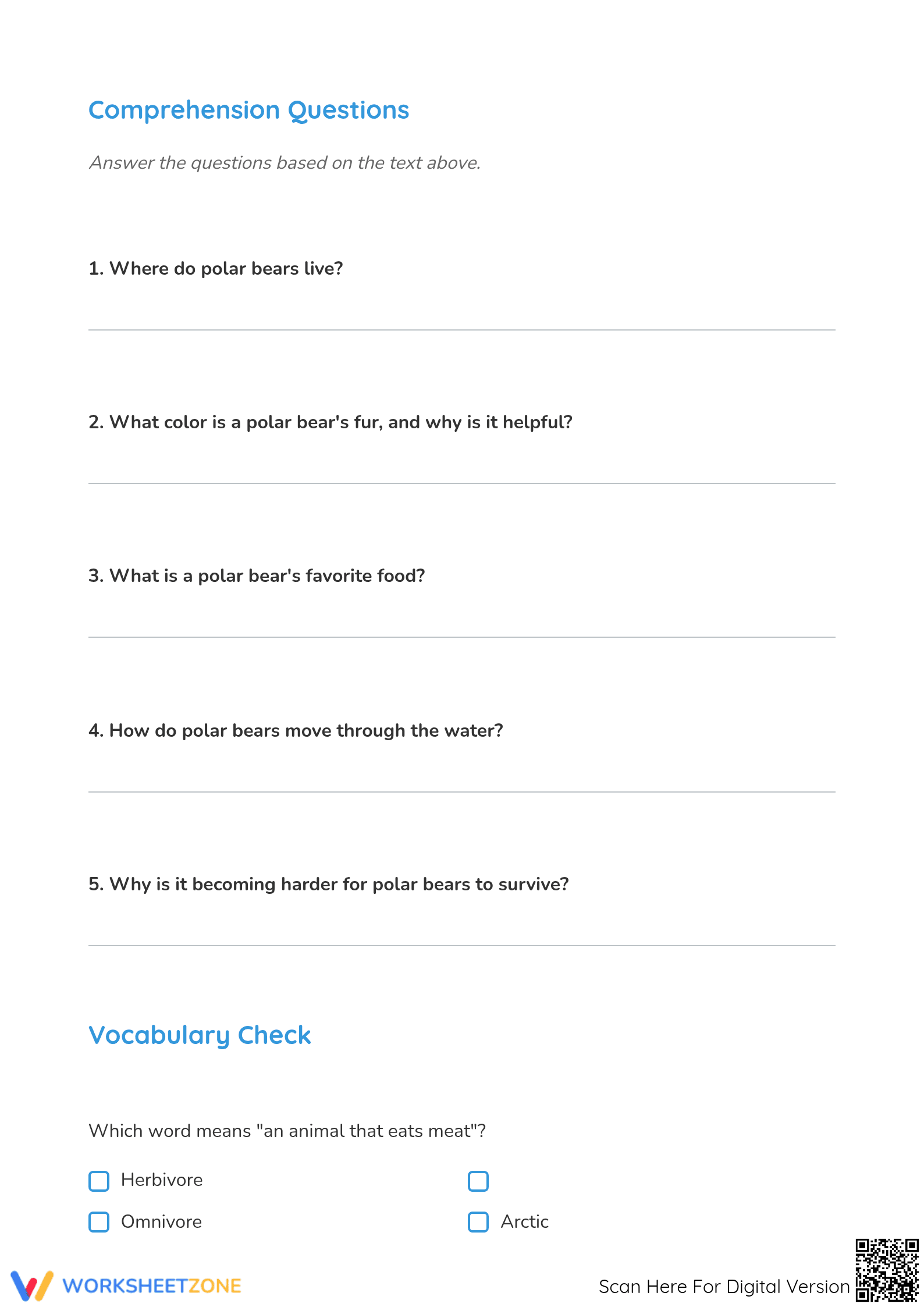
The packet contains a three-page structured layout designed for student independence. Page one features a high-interest reading passage with bolded vocabulary terms to assist with word recognition. Page two provides five open-ended comprehension questions and a multiple-choice vocabulary check. Page three concludes with a critical thinking prompt requiring students to list conservation actions. A full answer key is included for quick grading.
Zero-Prep Workflow
- Print: Generate the three-page PDF in under 60 seconds for your entire class.
- Distribute: Hand out the packets for independent morning work or a literacy center rotation.
- Review: Use the provided answer key for immediate feedback or student-led peer-grading sessions.
Total teacher preparation time is less than 2 minutes, making this an ideal emergency sub plan or supplemental resource for busy classrooms.
Standards Alignment
This resource is aligned to `CCSS.ELA-LITERACY.RI.2.1`, which requires students to ask and answer questions to demonstrate understanding of key details in a text. It also supports RI.2.4 by focusing on context-specific vocabulary like "carnivore" and "Arctic." Both standard codes can be copied directly into lesson plans, IEP goals, or district curriculum mapping tools.
How to Use It
Use this worksheet during the independent practice phase of a lesson on informational text features. It works effectively as a formative assessment to check if students can locate specific evidence within a paragraph. Expect students to spend 20 to 30 minutes completing all three sections, depending on their reading fluency. For a collaborative approach, have students highlight the evidence in the text before writing their answers.
Who It's For
This is designed for second-grade students but serves as an excellent scaffolded resource for third graders or an enrichment activity for advanced first graders. It pairs naturally with an anchor chart about "Wh- questions" or a science unit on animal adaptations and habitats. It is particularly useful for students who benefit from clear, uncluttered page layouts.
According to the RAND AIRS 2024 report, structured informational text practice is essential for developing the stamina required for upper-elementary literacy. This worksheet targets CCSS.ELA-LITERACY.RI.2.1 by requiring students to extract literal facts and inferential meanings from a non-fiction passage. By integrating vocabulary checks with open-ended comprehension questions, the resource mirrors the multi-modal assessment strategies recommended by Fisher & Frey (2014) for gradual release of responsibility. Research indicates that students who engage with high-interest topics, such as Arctic conservation, show higher rates of task persistence and better retention of domain-specific terminology. This 3-page packet provides the necessary scaffolding to move students from basic recall to critical evaluation of environmental themes, ensuring they meet grade-level benchmarks for evidence-based writing and reading comprehension.


