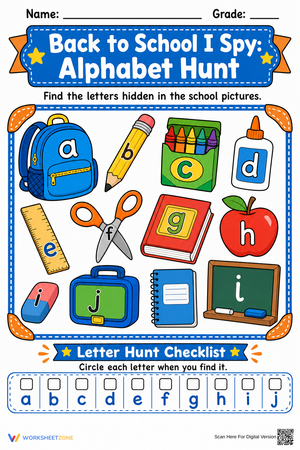
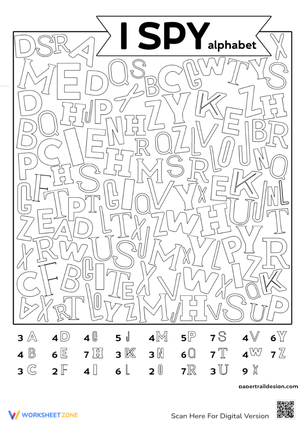
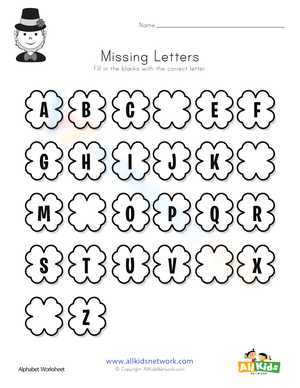
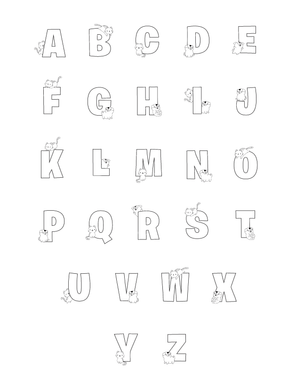
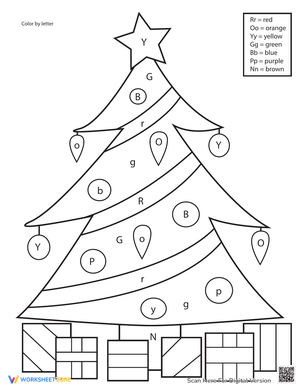
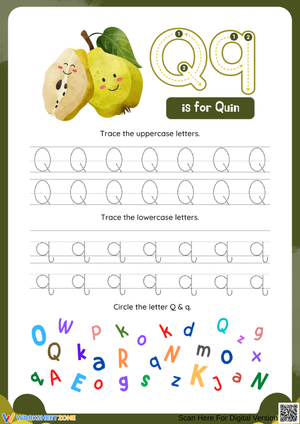
These 1st grade alphabetical order letters printable worksheets give teachers a ready-to-use collection of focused practice activities built around one non-negotiable readiness skill: retrieving the A–Z letter sequence on demand, independent of the alphabet song. The set includes fill-in-the-blank sequences, cut-and-paste sorting tasks, scrambled letter groups, connect-the-dots, and alphabet maze formats — each one placing a slightly different cognitive demand on students working toward automatic letter recall. Print individual worksheets for morning work, pull the whole collection for a literacy center rotation, or use one worksheet as a quick formative check before moving students to word-level alphabetizing.
The Cognitive Case for Sequencing Letters Before Words
First graders who can sing the alphabet from A to Z still frequently freeze when asked, in isolation, what comes after Q. The song encodes the sequence as a melodic chunk, not as a set of individually retrievable units. When a student needs to decide whether F or H comes first in a sorting task, they often have to restart the song from the beginning and count forward — which is slow, effortful, and error-prone under mild pressure. These worksheets interrupt that dependency by requiring students to retrieve letter order without the musical anchor.
The underlying principle is retrieval practice: actively pulling information out of memory strengthens it more than passively reviewing it. Asking a student to write the letter that falls between T and V, or to reorder a scrambled cluster of six random letters, forces active recall in a way that chanting or copying does not. Students who master letter sequencing through this kind of deliberate practice retrieve it automatically when they later need to alphabetize words — which is exactly what second-grade reference-material tasks will demand of them.
The Letter Sequence Errors That Surface Most in First Grade Work
The middle stretch of the alphabet — roughly L through Q — is where first grade students make the most mistakes, and the reason is almost always the rhythm of the song. The "elemenopee" cluster compresses five letters into what sounds like one or two syllables. Students who place A–G and T–Z correctly will misorder M, N, O, and P, or swap Q and R, because they have never had to treat those letters as discrete, individually positioned items.
A second error pattern involves letter pairs with visual similarity. Students who reverse b and d in their writing also tend to misplace those letters in sequencing tasks — not because they don't know the order, but because recognition of the letter itself is still unstable. Spotting this on a fill-in-the-blank worksheet tells you something that a letter-naming fluency probe alone may not: the student's confusion is about letter identity, not about sequence, and that distinction shapes what you address next.
Less obvious but consistent across classrooms: first graders handle forward retrieval faster than backward retrieval for most of the year. "What comes after N?" takes significantly less time than "What comes before P?" for most students in the fall and winter. Fill-in-the-blank worksheets that place gaps on both sides of a missing letter expose this directional asymmetry quickly and surface it in a way that classroom observation rarely catches in time.
What Each Worksheet Targets
The worksheets in this set distribute practice across five task types, each targeting the same underlying sequence knowledge through a different cognitive lens:
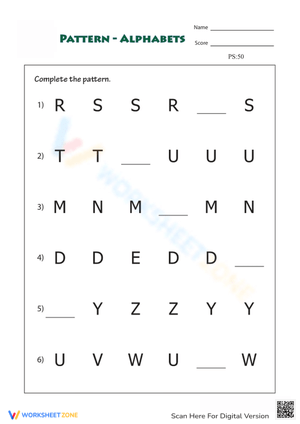
- Fill-in-the-blank sequences present a stretch of letters with one to three gaps. Students write the missing letter. The surrounding context provides directional cues, making this the most accessible format and the right starting point early in a unit.
- Scrambled letter groups give students five to eight non-consecutive letters to reorder from first to last. No surrounding context exists, so students rely entirely on retrieval — making this format better suited to mid-unit assessment or challenge work for students who have already moved past the basic fill-in tasks.
- Cut-and-paste tiles present letters on a strip that students cut apart and glue in order. The physical handling — cutting, comparing, repositioning — slows impulsive responses and tends to improve accuracy for students who rush through written tasks.
- Connect-the-dots replaces the standard numeral sequence with letters, so students trace a path from A to Z to reveal a simple image. The picture reveal gives struggling students a clear, self-generated signal that they have sequenced correctly.
- Alphabet mazes require students to draw a path following the correct letter order, navigating around dead ends. Wrong turns dead-end naturally, so self-correction is built into the format rather than dependent on teacher feedback.
How to Fit These Worksheets Into Your Weekly Lesson Plans
The 8 to 10 minutes after morning meeting, before the first reading block begins, is one of the most underused instructional windows in first grade. Students are seated, transitions are complete, and attention is available — but launching into phonics instruction before housekeeping tasks finish wastes that focus. Placing a single 1st grade alphabetical order letters printable worksheets face-down at each seat before students arrive converts that window into deliberate letter-sequence practice without any setup time during the lesson itself.
For literacy center rotations, cut-and-paste and scrambled-letter formats require only scissors, glue sticks, and a flat surface. They run without teacher facilitation, which makes them practical during small-group guided reading time when your attention is elsewhere. Alphabet mazes work particularly well here because students self-assess through the dead-end structure — completed mazes need no scoring to be informative.
On Fridays, connect-the-dots worksheets function as a light formative review that students experience as a reward rather than an assessment. For early finishers on any other day, keep a folder of maze worksheets accessible — students who complete their primary assignment quickly get a meaningful continuation of the same skill rather than a pivot to something unrelated.
One practical detail worth adding to any lesson that uses these worksheets: tape a desktop alphabet strip to each student's workspace before distributing anything. Tell students to try first without looking, then use the strip only if they're stuck. Informally track who reaches for it and when — that observation gives a faster read on individual letter-sequence fluency than collecting and scoring every paper.
Adjusting the Set Across Ability Levels
For students still building confidence with the full sequence, restrict cut-and-paste and scrambled-letter tasks to the first half of the alphabet (A–M) before introducing the second half. The two halves require different retrieval strategies: A–M anchors around familiar early letters, while N–Z tends to require backward counting from Z. Combining both halves before students are ready merges two separate challenges into a single task and makes it harder to pinpoint where the gap actually is.
Students who move through worksheets quickly benefit most from the scrambled-letter format with a constraint: no desktop strip allowed, and letter groups drawn specifically from the L–Q range, which is the zone most likely to reveal residual gaps even in strong students. Asking those students to write one sentence explaining why they placed a specific letter where they did adds a metacognitive layer without requiring additional materials.
For students whose handwriting mechanics slow down written production disproportionately, cut-and-paste tiles remove the production barrier entirely. A student who is consistently accurate on cut-and-paste but inconsistent on fill-in-the-blank is almost certainly dealing with retrieval fluency rather than sequence knowledge — and that distinction changes what comes next instructionally. Any 1st grade alphabetical order letters printable worksheets in this collection can also serve students with stronger letter knowledge as a peer-explanation task: complete the worksheet, then justify one placement decision aloud to a partner. That brief verbal exchange reveals whether sequence knowledge is genuinely internalized or still dependent on counting forward from A each time.
Standard Alignment
The letter-sequence knowledge these worksheets build is foundational to CCSS.ELA-LITERACY.RF.1.1, which covers understanding of the organizational and basic structural features of print — including the order and directionality of the writing system. Knowing where each letter sits in the alphabet is a prerequisite for students to meaningfully use any print reference organized A–Z, from classroom word walls to picture dictionaries.
The explicit alphabetizing standard arrives in grade 2 with CCSS.ELA-LITERACY.L.2.2.G, which asks students to consult reference materials using alphabetical order to locate entries. First grade letter-sequence practice is the direct instructional predecessor to that standard. Using a 1st grade alphabetical order letters printable worksheets alongside explicit print-concepts instruction — rather than treating it as isolated drill — gives students the spaced retrieval repetition needed to move from slow, song-dependent counting to fluid, automatic sequencing before second grade begins.
Frequently Asked Questions
When should first graders stop relying on a desktop alphabet strip during these tasks?
Alphabet strips are reference tools, not obstacles to eliminate prematurely. Students should use them freely while the sequence is still being internalized. Begin pulling back the strip for timed, low-stakes tasks — a 90-second fill-in challenge where students complete as many letters as they can without looking — once a student has shown consistent accuracy across multiple sessions with the strip available. Most first graders reach that point by late fall or early winter, depending on their entering alphabet knowledge in September.
Should uppercase and lowercase letters be sequenced on separate worksheets?
Yes, at least initially. Uppercase letters are more visually distinct from one another, so sequencing uppercase-only worksheets first lets students focus on order without also managing recognition uncertainty. Once uppercase sequencing is solid, introduce lowercase-only practice, then mixed sets. A student who sequences uppercase accurately but struggles on a mixed worksheet is almost always running into recognition problems with specific letters — typically a, g, q, or y — rather than an ordering problem. Knowing that distinction prevents misdirected re-teaching.
How many letters belong in a scrambled-group task for early first graders?
Start with groups of three consecutive or near-consecutive letters — C, D, E — and build toward groups of five non-consecutive letters across the year. Groups of more than five letters introduce a working memory load that obscures what you're actually measuring. When a student can't reorder seven scrambled letters, the difficulty might be sequence knowledge, working memory capacity, or letter recognition — and you can't tell which from the result alone. Smaller groups isolate the skill and make your assessment conclusions more reliable.












 Interactive Worksheet Maker
 Quiz Maker
 Word Search Maker
 Crossword Puzzle Maker
 Word Scramble Generator
 Sentence Scramble Generator
 Handwriting Worksheet Generator
 Name Tracing Generator
 Fill In The Blank Generator