


























Views
Downloads

Grade 1 Letter Ww — Essential Printable Worksheet
Paste this activity's link or code into your existing LMS (Google Classroom, Canvas, Teams, Schoology, Moodle, etc.).
Students can open and work on the activity right away, with no student login required.
You'll still be able to track student progress and results from your teacher account.
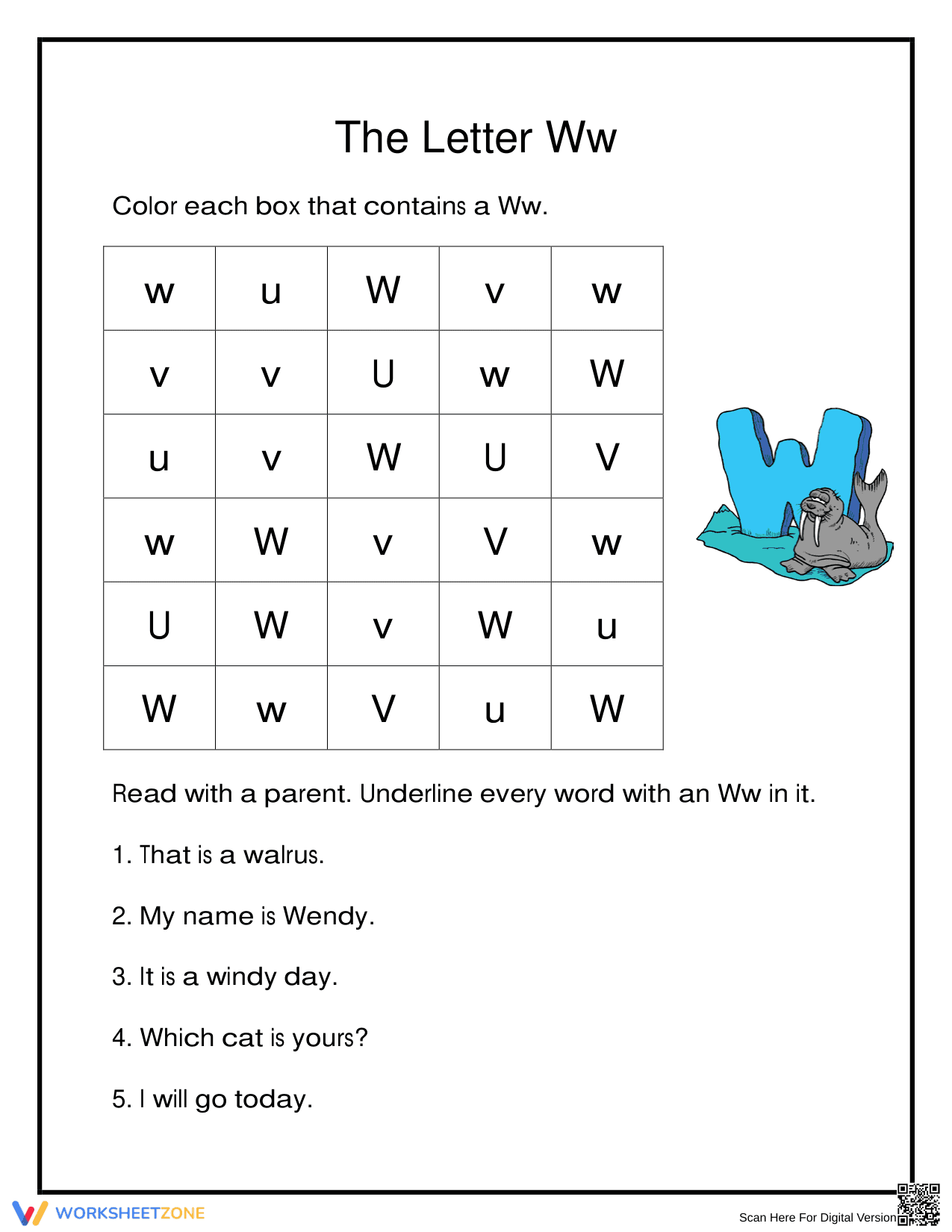
This printable Letter Ww worksheet helps Grade 1 students master alphabet recognition through interactive visual discrimination and contextual reading tasks. By identifying uppercase and lowercase "W" in isolation and within complete sentences, learners build the foundational phonics skills necessary for early literacy success. It provides immediate practice with zero teacher preparation required.
At a Glance
- Grade: 1 · Subject: Alphabet
- Standard:
CCSS.ELA-LITERACY.RF.1.1— Recognize the basic features of a sentence and letter patterns- Skill Focus: Letter Ww Recognition
- Format: 1 page · 2 tasks · Answer key included · PDF
- Best For: Literacy centers and independent morning work
- Time: 10–15 minutes
What's Inside
This single-page PDF features two distinct learning modalities to reinforce letter mastery. The top half contains a 30-cell letter grid where students visually scan and color boxes containing the target letter. The bottom half transitions to application, presenting 5 sentences for students to read and underline words containing "W." This dual-mode structure ensures students move from simple identification to seeing the letter function within real text.
Zero-Prep Workflow
Implementing this resource takes less than two minutes of teacher time. First, print the single-page document (30 seconds). Second, distribute the worksheet to your literacy centers or individual desks with the necessary coloring supplies (30 seconds). Third, review student work using the included answer key or via a quick visual check during independent reading time (45 seconds). Its straightforward design makes it an ideal choice for emergency sub plans or quick transitions.
Standards Alignment
The primary alignment is CCSS.ELA-LITERACY.RF.1.1, which requires students to demonstrate understanding of the organization and basic features of print. This worksheet specifically addresses letter identification and word boundaries. Both standard codes can be copied directly into lesson plans, IEP goals, or district curriculum mapping tools.
How to Use It
Assign this worksheet during the "Independent Practice" portion of a phonics lesson after introducing the "W" sound. For a formative assessment, observe students during the coloring task to identify any common letter reversals or confusion with similar-looking characters like "V" or "M." It typically takes students 12 minutes to complete both sections accurately.
Who It's For
Designed for first-grade students, this resource is also valuable for kindergarten learners ready for a challenge or second-graders requiring remedial support. It pairs naturally with an alphabet anchor chart or a decodable text focused on initial "W" sounds.
Research from Fisher & Frey (2014) emphasizes that the gradual release of responsibility—moving from isolated letter recognition to identifying characters within meaningful sentences—is critical for developing automaticity in early readers. This worksheet facilitates that progression by shifting the student's cognitive load from pure visual discrimination in the grid task to contextual analysis in the reading section. According to current NAEP data, students who master foundational letter identification early in the primary grades show significantly higher reading comprehension scores by third grade. By providing 30 distinct letter identification opportunities and 5 contextual sentences, this resource offers the high-repetition practice necessary to move "W" recognition into long-term memory. Educators can confidently integrate this standards-aligned tool into their curriculum, knowing it supports evidence-based literacy instruction and provides measurable data on student mastery of the CCSS.ELA-LITERACY.RF.1.1 standard.


