


























Views
Downloads
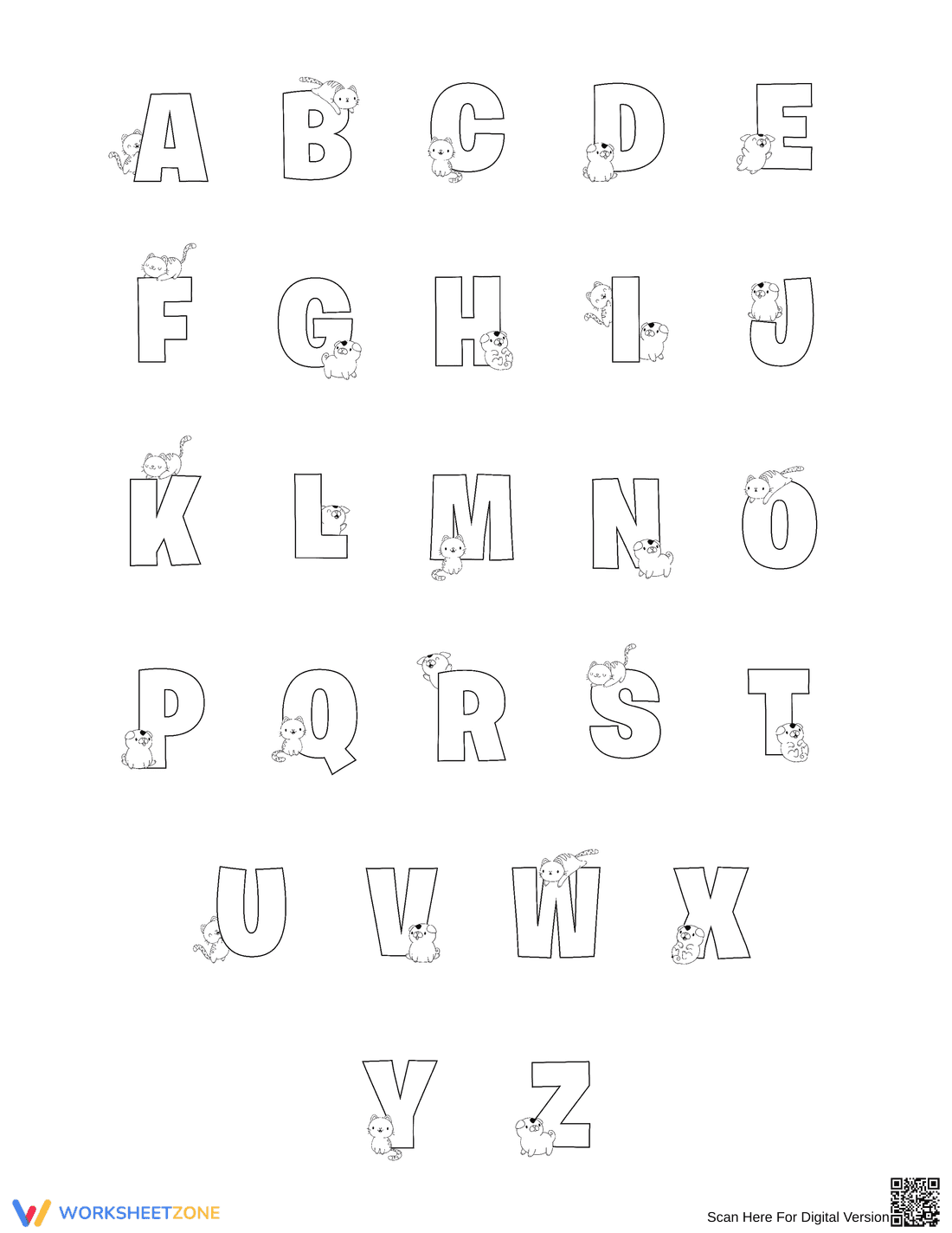

Printable Pet Bubble Letters | Grade K ELA
Paste this activity's link or code into your existing LMS (Google Classroom, Canvas, Teams, Schoology, Moodle, etc.).
Students can open and work on the activity right away, with no student login required.
You'll still be able to track student progress and results from your teacher account.
This engaging alphabet worksheet helps early learners recognize uppercase letters while developing fine motor skills. Students interact with twenty-six pet-themed bubble letters, reinforcing foundational print concepts through creative coloring. This resource provides a calming, focused activity that builds letter familiarity and prepares young students for early reading success.
At a Glance
- Grade: K · Subject: ELA
- Standard:
CCSS.ELA-LITERACY.RF.K.1.D— Recognize and name all uppercase letters- Skill Focus: Alphabet Recognition
- Format: 1 page · 26 problems · No answer key · PDF
- Best For: Morning work or centers
- Time: 15–20 minutes
This single-page printable features the complete uppercase alphabet from A to Z. Each letter is designed in a clear, bold bubble font, accompanied by an adorable pet illustration, such as a cat or dog, interacting with the letter. The spacious bubble design allows ample room for coloring, tracing, or decorating, making it an ideal canvas for multi-sensory letter practice. Because it is an open-ended creative task, no answer key is required.
This resource is designed for a seamless, zero-prep classroom workflow:
- Print: Generate class sets in under one minute. The black-and-white design is highly ink-efficient.
- Distribute: Hand out immediately as students enter the room or transition between activities. No complex instructions are needed.
- Review: Monitor students as they work, asking them to identify the letters they are coloring. Total teacher prep time is under two minutes.
This page is highly suitable for emergency sub plans, requiring no specialized ELA background for a substitute teacher to facilitate effectively.
This activity aligns directly with CCSS.ELA-LITERACY.RF.K.1.D: Recognize and name all upper- and lowercase letters of the alphabet. By isolating the uppercase letters and pairing them with engaging visual cues, students build the visual discrimination skills necessary for fluent letter identification. Both standard codes can be copied directly into lesson plans, IEP goals, or district curriculum mapping tools.
Teachers can utilize this worksheet during morning arrival to establish a calm, productive routine before direct instruction begins. Alternatively, it serves as an excellent independent literacy center activity while the teacher conducts small-group guided reading. As a formative assessment tip, observe students while they color and ask them to name the letter and its corresponding phonetic sound. Expected completion time ranges from fifteen to twenty minutes depending on the student's fine motor pacing.
This resource is primarily designed for Kindergarten students mastering their uppercase alphabet. It also serves as a helpful intervention tool for first-grade students who need additional letter recognition reinforcement. For differentiation, teachers can ask advanced students to write a word starting with each letter on the back of the page. It pairs naturally with an alphabet anchor chart or a read-aloud focusing on pets.
Mastering the alphabet is a critical predictor of future reading achievement. According to Fisher & Frey (2014), early and consistent exposure to letter forms through varied, multi-sensory activities significantly improves long-term phonics acquisition and reading fluency. This resource targets CCSS.ELA-LITERACY.RF.K.1.D, requiring students to recognize and name all uppercase letters. By combining visual letter identification with the fine motor task of coloring, students engage multiple cognitive pathways, reinforcing their memory of letter shapes. The inclusion of pet illustrations provides a thematic anchor that maintains student interest during independent practice. Regular interaction with these foundational print concepts ensures that early learners build the automaticity required to transition from letter recognition to decoding words. This targeted practice supports comprehensive literacy development in early childhood education settings.


