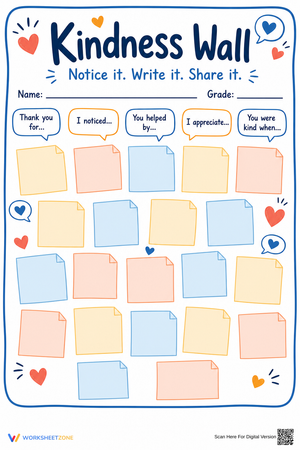
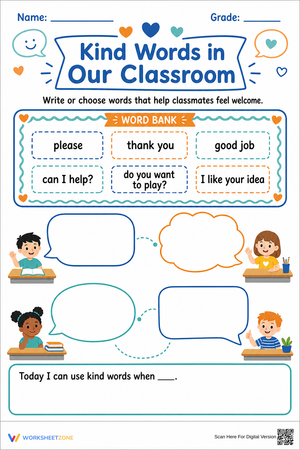
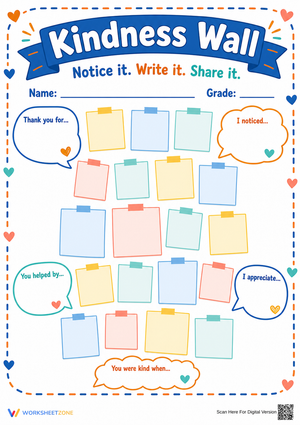
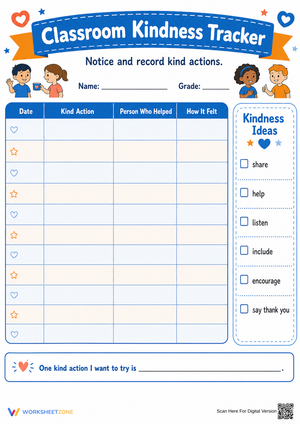
These kindness worksheets pdf for 1st grade give teachers a concrete anchor for SEL conversations that too often stay abstract — printed activities where six- and seven-year-olds sort images of social scenarios, complete sentence starters, and reason through illustrated situations that connect empathy to the real friction points of their classroom day. Each worksheet targets a discrete, manageable skill so students build genuine social understanding rather than simply recite expected answers.
Why Grade 1 Is the Right Moment for Explicit Kindness Instruction
First graders sit in the middle of a real developmental shift. The egocentric reasoning that dominated their preschool years is loosening — they are becoming genuinely curious about other people's inner states — but they do not yet have reliable language or frameworks to interpret what they observe. That gap is where explicit instruction earns its keep. Telling a six-year-old to "be kind" carries almost no instructional weight; showing them an illustrated scenario of two students arguing over the last pair of scissors and asking what the kind choice looks like gives them something to actually reason through. Printed activities work for this skill specifically because they slow the moment down — no peer audience, no time pressure — just the scenario and the student working through it, which is where honest social reflection tends to happen at this age.
This is also developmentally distinct from kindergarten, where social norms instruction leans heavily on teacher modeling and whole-class routines. By first grade, students are ready to apply a general principle — kind actions help others feel safe and valued — to novel situations they have not encountered before. The scenario-response format takes advantage of exactly that readiness.
What Each Worksheet Practices
The set covers several entry points into the kindness concept, which matters because "kindness" is not a single skill — it is a cluster of related social behaviors that students develop unevenly and at different rates.
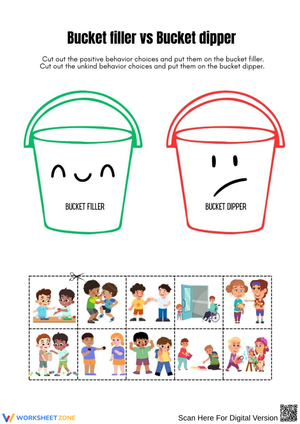
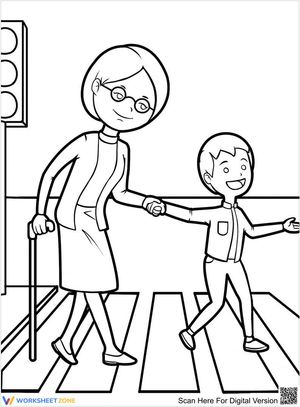
- Visual sorting: Students examine illustrated pairs — sharing crayons versus grabbing a book, waving hello versus walking past someone who fell — and place each into a labeled column. This builds categorical thinking about social behavior before students are expected to generate original ideas in writing.
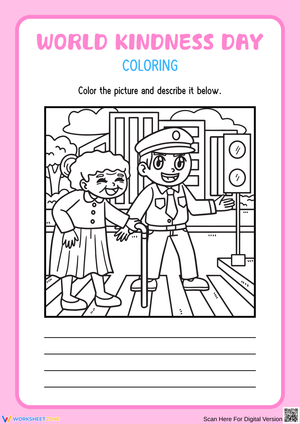
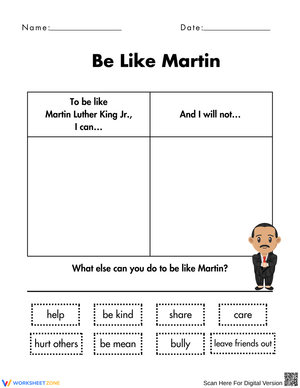
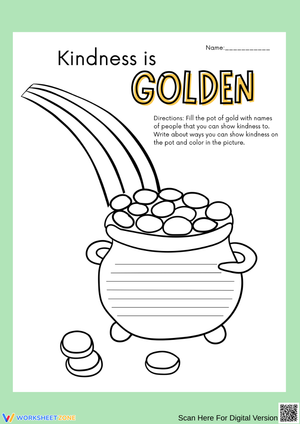
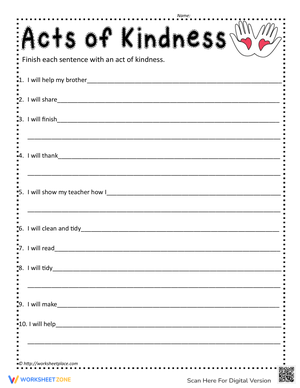
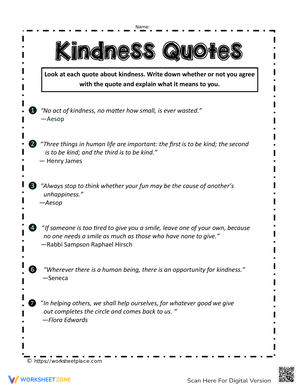
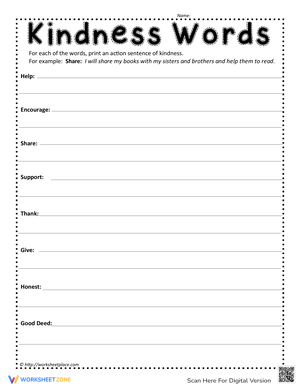
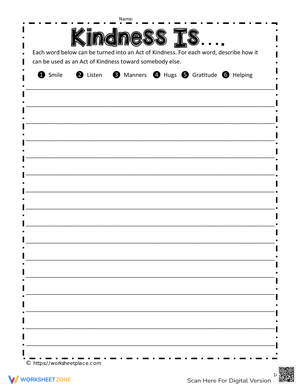
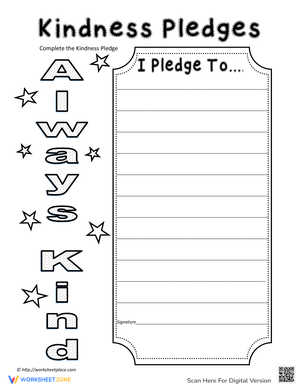
- Sentence-completion prompts: Frames like One way I can help someone feel better is ___ or I showed kindness today when I ___ give students a productive starting point. A drawing space below each prompt lets students who are not yet fluent writers illustrate their response before or instead of writing it.
- Social vocabulary tracing: Words like please, sorry, thank you, and I understand appear in tracing lines students read aloud before tracing — brief, functional, and connected directly to language they use the same day.
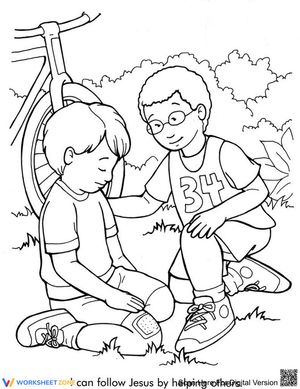
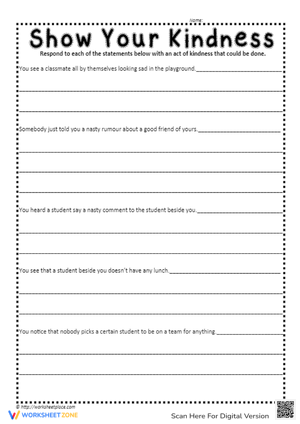
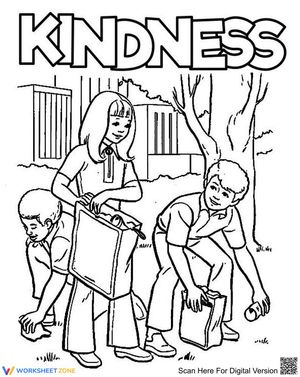
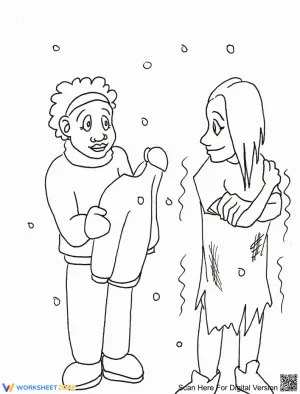
- Scenario-response activities: A two-sentence classroom situation — "Maya spilled paint on Leo's drawing. Leo felt upset." — is followed by three illustrated response options. Students circle the kind choice and, on some versions, write or draw a brief explanation of their reasoning.
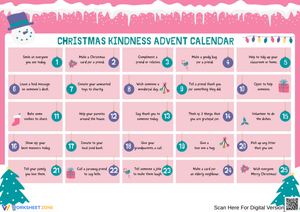
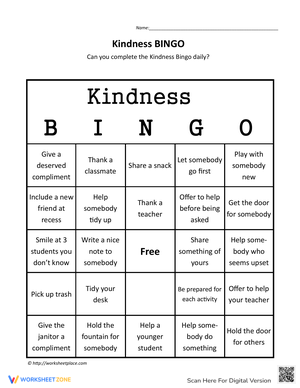
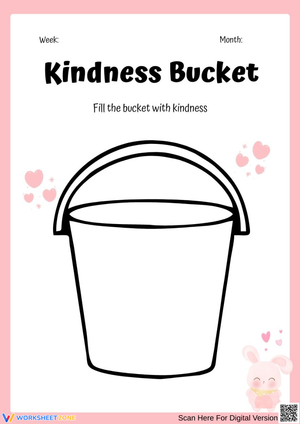
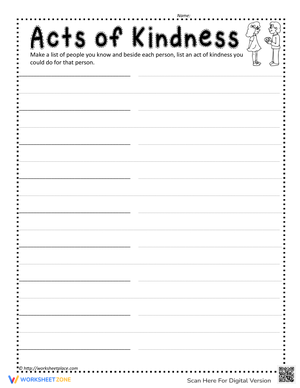
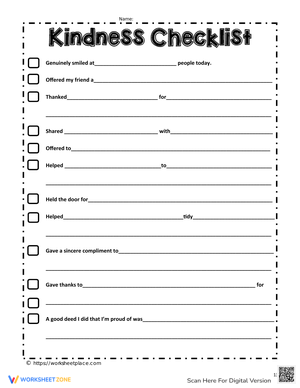
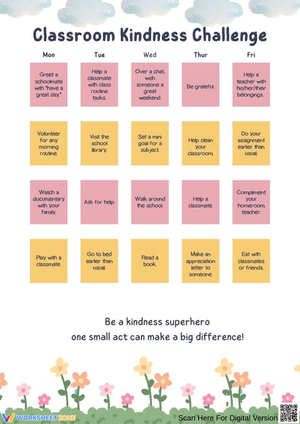
- Weekly kindness tracking: Students record one kind action per day across the week, formatted to slip into a homework folder or morning journal. This creates a record across five days rather than a single snapshot of one moment.
The Errors That Show Up in Student Work — and Why They Matter
The most predictable error in sorting activities is what teachers sometimes call the honesty-kindness conflation. A student marks "telling someone their drawing doesn't look right" as a kind behavior, reasoning that truthfulness equals good character. That logic is developmentally coherent — it is not a random wrong answer — and it does not deserve a simple correction mark. The stronger instructional move is to pause and ask: "Does this choice help the other person feel safe? Does it help them want to try again?" That reframe shifts students from rule-following toward genuine perspective-taking, which is the actual target skill.
On scenario-response worksheets, watch for students who consistently select the option that advantages themselves while still appearing kind on the surface. They learn quickly which circled answer looks right. The most revealing diagnostic move is asking students to explain their answer aloud — the spoken reasoning exposes far more than the marked choice does. Teachers who use these worksheets during small-group time collect substantially more formative information than those who assign them as independent work and grade only the circled answers.
Fitting These Worksheets Into Your Week Without Disrupting Your Flow
Morning meeting is the most natural entry point. A two-minute sorting activity before transitioning to phonics instruction sets a social tone early — six-year-olds who arrive agitated from a hard morning genuinely settle when given a low-stakes visual task with no wrong-answer pressure. The sentence-completion worksheets fit equally well as a Friday end-of-day reflection: draw a kind act from this week, write one word, share one sentence with a partner before packing up.
For schools running PBIS frameworks, the weekly tracking sheets connect directly to existing behavior systems without requiring a separate program. Students who complete the tracking sheet and report a kind act during morning meeting can receive a token on the spot — the paper activity links immediately to the recognition structure teachers are already using. A kindness worksheets pdf for 1st grade also pairs naturally with read-alouds. After reading Each Kindness or Those Shoes, the scenario-response worksheet becomes a text-based extension: students circle where the character showed kindness and underline where a different choice could have changed the outcome. That sequence — concrete story to printed worksheet to abstract principle — moves in the direction of how six-year-olds actually consolidate new concepts.
Standard Alignment
These worksheets align with the CASEL Social Emotional Learning framework's Social Awareness and Relationship Skills competency clusters. Social Awareness includes perspective-taking and recognizing others' emotions — both addressed directly in the sorting and scenario activities, where students must reason about how a pictured character feels and what response would address that feeling. Relationship Skills include communication, cooperation, and constructive conflict resolution — the sentence-completion prompts and weekly tracking sheets target these by asking students to name and record prosocial actions they have taken or plan to take.
CASEL guidance on effective SEL implementation identifies three conditions: instruction should be explicit, integrated into regular routines, and developmentally sequenced. Each worksheet addresses all three. Skills are named in plain student-facing language, the formats fit daily routines without requiring a separate block of time, and the set moves from simpler visual sorting toward more cognitively demanding scenario-response work as students build experience with the concept across the year.
Adapting Each Worksheet Across Your Classroom's Range of Learners
Students who struggle with the sentence-completion tasks in September — because their phonemic awareness or letter-sound knowledge is not yet stable — can use the drawing space exclusively and dictate their sentence to a partner or to the teacher, who writes it in for them. This keeps every student participating without the frustration of being stuck on encoding when the lesson is about empathy. By March, many of those same students will be writing independently; the consistent format across the year lets them notice their own growth against a familiar task structure.
For students who move quickly through the core activities, the scenario-response worksheets extend naturally: instead of circling a provided option, they write or draw a fourth response that also shows kindness. Generating a novel response requires more cognitive effort than selecting one from three — a meaningful step up that does not require pulling different materials. Students who receive services for social-emotional skill development often benefit from having each item read aloud with a brief pause to physically act out the scenario before marking the page; the physical re-enactment removes the layer of abstraction that makes these paper tasks hard for some learners. When you download a kindness worksheets pdf for 1st grade, print extra copies of the scenario-response sheets — those are the worksheets most teachers return to across multiple instructional contexts throughout the year.
Frequently Asked Questions
How many worksheets should students complete in a single sitting?
One worksheet per instructional moment is right for most first graders. Six- and seven-year-olds have limited sustained attention for social reasoning tasks on paper; two worksheets back-to-back tends to produce rushed, unconsidered responses. Spread them across the week — one on Monday as a warm-up, one on Friday as a reflection — rather than clustering them into a single session where the thinking is less likely to stick.
Do these activities work for kindergarten or second grade students?
The visual sorting and vocabulary tracing worksheets work in kindergarten when the teacher reads the labels aloud and leads whole-group discussion. The scenario-response and sentence-completion formats are better matched to first grade, where students can access short text with support. Second graders use these worksheets effectively for review or for students who need additional practice with foundational empathy skills — the social situations depicted are realistic enough that the activities do not feel below grade level.
Can these worksheets go home for family engagement?
The weekly tracking sheet and sentence-completion prompts are the strongest choices for home use. The tracking sheet gives families a visible window into what the class is working on and a natural conversation prompt — "What was your kind act on Tuesday?" — without requiring families to understand SEL frameworks or terminology. Avoid sending the scenario-response worksheets home without context; the nuance in those activities is better addressed in classroom discussion than in a family review setting.
How do these fit into a classroom without a dedicated SEL block?
Most teachers who use the kindness worksheets pdf for 1st grade without a dedicated block fold them into morning meeting, transitions, or early finisher time. The activities are short enough — most take five to eight minutes — that they require no rescheduling. The tracking sheet works particularly well as part of an end-of-day routine: sixty seconds per student to fill in one line before dismissal, then a brief share-out the following morning before academic instruction begins.