


























Views
Plays
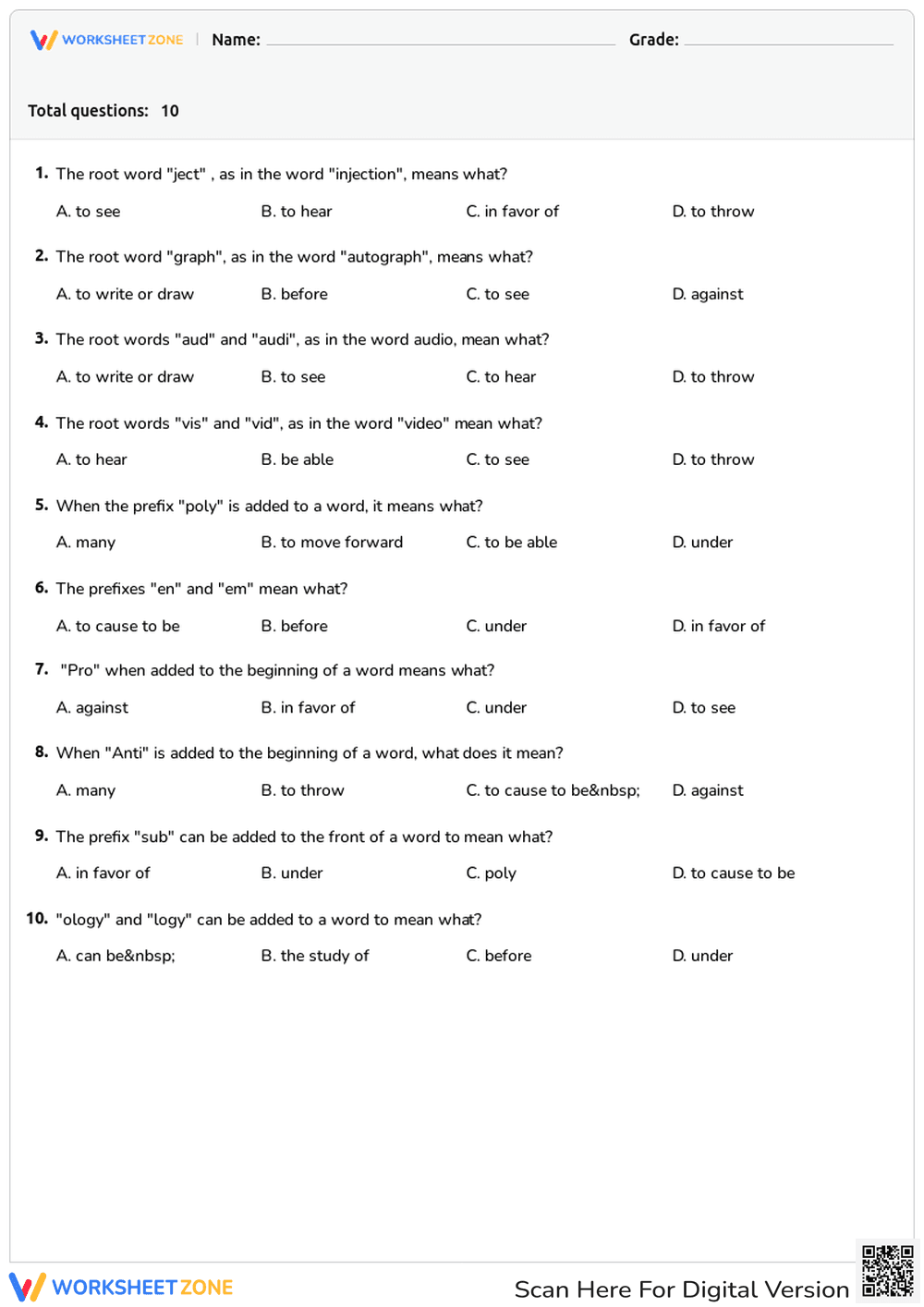

Essential Roots and Affixes Worksheet | Grade 4-6
Paste this activity's link or code into your existing LMS (Google Classroom, Canvas, Teams, Schoology, Moodle, etc.).
Students can open and work on the activity right away, with no student login required.
You'll still be able to track student progress and results from your teacher account.
This Grade 4-6 roots and affixes worksheet provides students with 10 targeted multiple-choice questions to strengthen their morphological awareness. By identifying the meanings of common Greek and Latin components like "ject," "graph," and "anti," learners develop the decoding skills necessary to tackle complex academic vocabulary across various subjects.
At a Glance
- Grade: 4-6 · Subject: ELA
- Standard:
CCSS.ELA-LITERACY.L.4.4.B— Use Greek and Latin affixes and roots as clues to word meaning- Skill Focus: Root words and affixes
- Format: 1 page · 10 problems · Answer key included · PDF
- Best For: Quick formative assessment or vocabulary review
- Time: 10–15 minutes
This single-page resource features 10 multiple-choice questions designed for clarity and focus. Each question presents a specific root or affix—such as "sub-," "pro-," or "-ology"—within the context of a familiar word example. The layout is clean and distraction-free, including a dedicated space for student names and grades, making it an ideal tool for data collection.
The zero-prep design allows teachers to integrate this activity into a busy schedule in under 2 minutes. Simply print the PDF, distribute it to students for a 10-minute exit ticket, and use the included answer key for immediate feedback. This streamlined workflow makes it an excellent choice for emergency sub plans or last-minute review sessions where instructional time is at a premium.
This resource is aligned with CCSS.ELA-LITERACY.L.4.4.B, which requires students to use common, grade-appropriate Greek and Latin affixes and roots as clues to the meaning of a word. It also supports vocabulary acquisition goals found in many state-specific frameworks. Both standard codes can be copied directly into lesson plans, IEP goals, or district curriculum mapping tools.
Use this worksheet as a formative assessment after a direct instruction lesson on word parts to gauge student retention. Alternatively, assign it as a pre-test to identify which specific roots (like "aud" or "vis") require more intensive focus. Students typically complete the 10 questions within 10 to 15 minutes, allowing for a quick transition to the next instructional block.
This activity is tailored for students in Grades 4, 5, and 6 who are building their linguistic foundations. It is particularly effective for English Language Learners (ELLs) and students receiving Tier 2 vocabulary intervention. Pair this worksheet with a root word anchor chart or a morphological word wall to provide visual support during the assessment.
According to the RAND AIRS 2024 report, explicit instruction in morphology, specifically focusing on Greek and Latin roots, significantly improves reading comprehension and vocabulary acquisition for upper elementary students. This worksheet targets CCSS.ELA-LITERACY.L.4.4.B by requiring students to identify the meanings of 10 essential word parts, including "ject," "graph," and "anti." By isolating these components, the resource helps students build a transferable skill set for decoding unfamiliar academic texts. Research from Fisher & Frey (2014) emphasizes that frequent, low-stakes formative assessments of word parts lead to higher mastery levels compared to isolated vocabulary lists. This 10-question tool provides the structured practice necessary for students to internalize these linguistic building blocks, ensuring they can independently determine word meanings in complex literature and informational texts across the Grade 4-6 curriculum.


