




























Views
Downloads
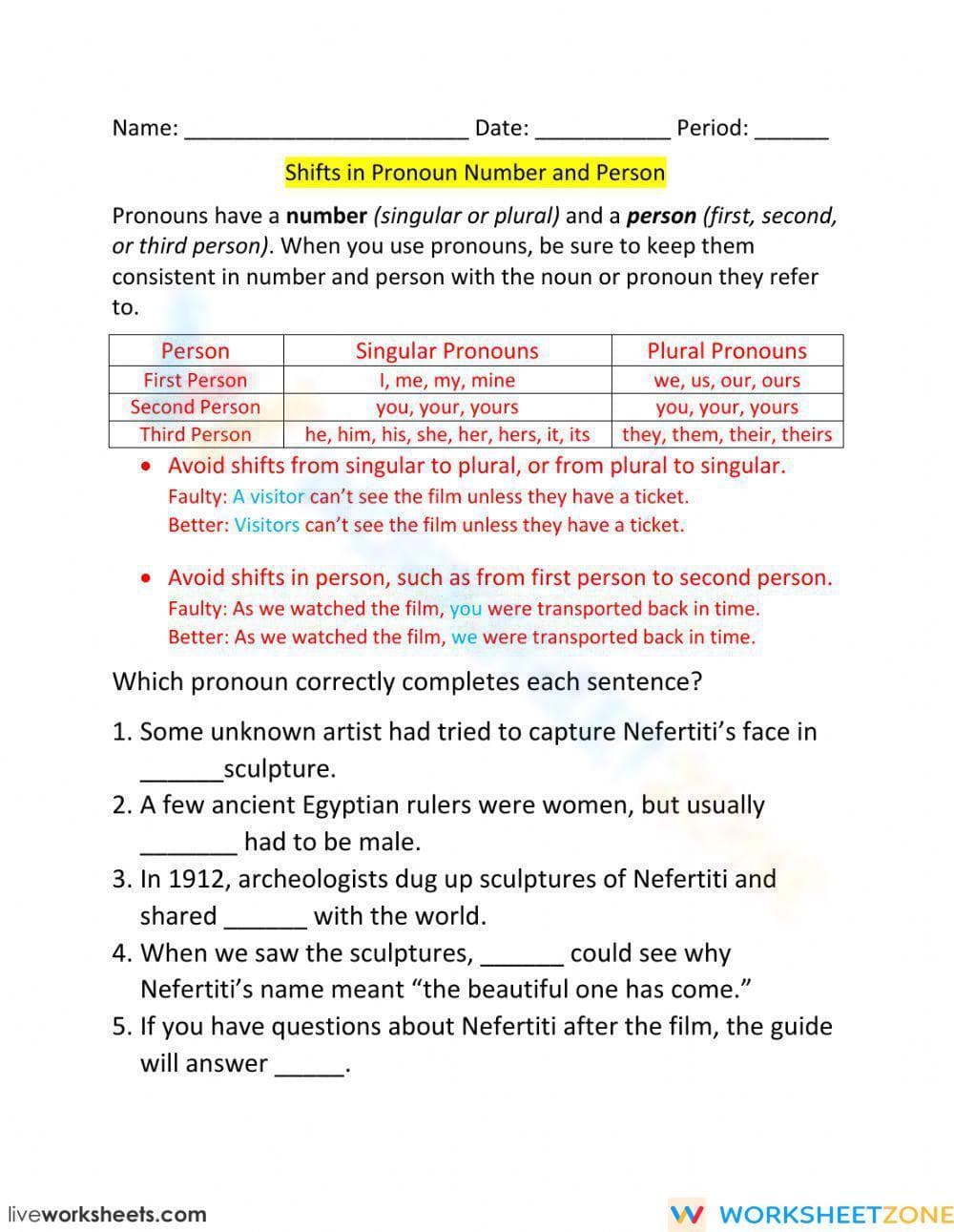

Essential Shifts in Pronoun Number and Person Worksheet

Paste this activity's link or code into your existing LMS (Google Classroom, Canvas, Teams, Schoology, Moodle, etc.).
Students can open and work on the activity right away, with no student login required.
You'll still be able to track student progress and results from your teacher account.
Mastering pronoun consistency is a fundamental skill for middle and high school writers. This worksheet helps students identify and correct inappropriate shifts in pronoun number and person, ensuring their writing remains clear and professional. By practicing with these targeted exercises, learners gain the confidence needed to maintain a consistent point of view and numerical agreement throughout their compositions.
At a Glance
- Grade: 6–10 · Subject: ELA
- Standard:
CCSS.ELA-LITERACY.L.6.1.C— Correct inappropriate shifts in pronoun number and person in writing- Skill Focus: Pronoun Consistency
- Format: 1 page · 5 problems · Answer key included · PDF
- Best For: Grammar review and quick formative assessment
- Time: 15–20 minutes
What's Inside
This resource features an instructional header defining pronoun number and person, with a reference table for all three persons. Students review rules for avoiding shifts in number and person, supported by "Faulty" and "Better" examples. The practice section contains five sentences themed around ancient Egyptian history, where students must select the correct pronoun to maintain consistency.
Skill Progression
The worksheet follows a structured progression: Guided instruction via the pronoun table and rules, followed by Supported practice through contrasting examples. Finally, students engage in Independent practice by completing five targeted sentences. This gradual-release model ensures students move from conceptual understanding to successful application in one session, following the proven "I Do, We Do, You Do" instructional framework.
Standards Alignment
Directly aligned to CCSS.ELA-LITERACY.L.6.1.C, this worksheet targets the recognition and correction of inappropriate shifts in pronoun number and person. It focuses on the mechanics necessary for effective communication. This standard code can be copied directly into lesson plans, IEP goals, or district curriculum mapping tools to ensure instructional activities remain focused on grade-level mastery.
How to Use It
Ideal for the "We Do" or "You Do" phase, use this as a quick formative assessment after direct instruction. Teachers can observe students completing the five sentences to identify misconceptions regarding person shifts. Taking 15–20 minutes to complete, it works perfectly as a bell-ringer or exit ticket to verify students can maintain pronoun consistency in their writing.
Who It's For
Designed for grades 6–10, this is perfect for learners needing focused grammar practice. It serves as remediation for older students or an introduction for middle schoolers. It pairs well with informational passages about ancient Egypt or peer-editing sessions where students check their own writing for pronoun shifts, providing a clear path toward improved compositional clarity.
The ability to maintain pronoun consistency is a hallmark of sophisticated academic writing, as emphasized in the CCSS.ELA-LITERACY.L.6.1.C standard. According to the RAND AIRS 2024 report on literacy instructional materials, targeted practice in grammar fundamentals like pronoun-antecedent agreement significantly improves student writing clarity across disciplines. This worksheet provides the essential scaffolding required to bridge the gap between recognizing grammar rules and applying them in complex sentence structures. By focusing on both number and person shifts, the resource addresses the two most common errors students make in pronoun usage. Research from the NAEP suggests that consistent reinforcement of these "language mechanics" prevents the erosion of writing quality in higher grades. This printable provides a high-leverage opportunity for students to practice corrections in a controlled environment before transferring those skills to their original compositions.


