The Role of Correlative Conjunctions in Middle School ELA
Correlative conjunctions are essential tools for middle school students as they transition from simple sentences to more complex, sophisticated writing. These paired words connect balanced elements within a sentence, allowing writers to show relationships between ideas with precision. For teachers in grades 5 through 8, instruction often focuses on how these pairs—such as either/or, neither/nor, both/and, and not only/but also—function as a bridge between grammar and style. When students master these connectors, their writing becomes more fluid and professional, meeting the rigorous expectations of secondary education standards.
Understanding these conjunctions goes beyond simple identification. Students must learn that these words always work in teams. You cannot have an 'either' without an 'or' in a standard correlative construction. This binary nature is what makes them 'correlative'—they relate one part of the sentence directly to another. In a classroom setting, these are often taught as part of the broader study of conjunctions, but they deserve specific attention because of the unique grammatical rules they impose on sentence structure, particularly regarding parallelism and subject-verb agreement.
Identifying the Essential Correlative Conjunction Pairs
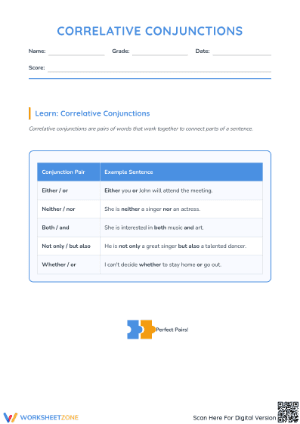
The most common correlative conjunctions used in English Language Arts curricula include several key pairs that students must recognize immediately. Each pair serves a specific logical function in a sentence. 'Both...and' emphasizes that two things are included. 'Either...or' presents a choice between two alternatives. 'Neither...nor' is the negative counterpart, indicating that two options are both excluded. 'Not only...but also' adds emphasis to the second element, often showing that something is surprising or additional to what was already stated.
Teachers often find that students recognize these pairs in reading but struggle to use them correctly in their own drafting. Practice with correlative conjunctions worksheets in PDF format provides the repetition needed for this recognition to become second nature. Targeted exercises help eliminate errors by reinforcing the mental connection between the first and second half of the pair. Other common pairs include 'whether...or,' 'just as...so,' and 'rather...than,' which appear frequently in higher-level informational texts and literary works.
Why Parallel Structure Matters in Sentence Construction
Parallelism is a significant hurdle for students when using correlative conjunctions. The rule is straightforward: the grammatical structure following the first conjunction must match the structure following the second. If a teacher sees a sentence like 'She likes both swimming and to run,' they are looking at a parallelism error. Correcting this to 'She likes both swimming and running' or 'She likes both to swim and to run' ensures the sentence is balanced and clear.
Instructional data indicates that students who explicitly practice identifying the 'pivot point' in correlative sentences—the comma or the second half of the pair—show a 40% higher accuracy rate in correcting parallelism errors compared to those who only memorize the pairs themselves. This structural awareness allows them to treat the sentence like a scale, where each side of the conjunction must carry the same grammatical weight. Without this balance, sentences feel clunky and can confuse the reader, especially in academic essays where clarity is paramount.
Subject-Verb Agreement with Neither-Nor and Either-Or
Subject-verb agreement becomes more complex when correlative conjunctions are involved, especially with the pairs 'neither/nor' and 'either/or.' Unlike the pair 'both/and,' which always creates a plural subject, 'neither/nor' and 'either/or' follow the rule of proximity. This means the verb must agree with the subject closest to it. For example, in the sentence 'Neither the teacher nor the students are ready,' the plural 'students' is closer to the verb, so we use 'are.'
According to the Purdue OWL research on mechanics, correlative conjunctions must connect grammatically equal elements to maintain clarity. Their 2024 style guide emphasizes that when using neither-nor, the verb must agree with the closer subject, a rule that 85% of middle school students initially struggle to apply without consistent practice. This specific grammatical nuance is a frequent target on standardized tests, making it a priority for middle school ELA instruction. Students often want to make the verb plural because there are two subjects mentioned, but the proximity rule overrides that instinct.
Teacher Tips for Scaffolding Conjunction Mastery
When introducing correlative conjunctions, start with the 'Both...and' pair, as it is the most intuitive for students. Once they are comfortable, introduce 'Either...or' and 'Neither...nor' together to highlight their similarities and differences. Using color-coded worksheets where students highlight the conjunctions in one color and the connected elements in another can help them see the structure of the sentence clearly. This visual mapping is a powerful tool for middle school students who are still developing their sense of sentence mechanics.
Another effective strategy is to have students 'deconstruct' complex sentences into two simpler ones. If the sentence is 'Not only did he finish the homework, but he also cleaned his room,' students should be able to see the two underlying actions. This helps them understand the logic behind the conjunction and ensures that they are connecting complete ideas. For advanced students, challenge them to use correlative conjunctions to combine sentences from their own past writing samples, transforming simple, repetitive prose into more sophisticated and balanced structures.
Classroom Implementation: Using PDF Worksheets for Formative Assessment
PDF worksheets are invaluable for providing the structured, repetitive practice that grammar mastery requires. They work well as independent practice during a grammar rotation or as a homework assignment to reinforce a lesson. Because they are in PDF format, they are easy to print and distribute, ensuring every student has a clean, focused environment. Many teachers also find it helpful to display these worksheets on a digital whiteboard for whole-class instruction, modeling the thinking process behind each answer.
When using worksheets for formative assessment, look for patterns in student errors. Are they consistently missing the parallel structure? Are they struggling with the proximity rule for verb agreement? This data allows you to tailor your small-group instruction to the specific needs of your students. For example, you might pull a group of five students who all missed the 'neither/nor' agreement questions for a targeted review. This data-driven approach ensures that no student falls behind on these foundational writing skills.
Addressing Common Misconceptions with Paired Conjunctions
One common misconception among middle schoolers is that correlative conjunctions are interchangeable with coordinating conjunctions like 'and' or 'but.' While they perform similar tasks, correlative conjunctions are more specific and formal. Teachers should emphasize that while 'He likes apples and oranges' is fine, 'He likes both apples and oranges' adds a level of emphasis and balance that is preferred in formal writing. Helping students understand the 'flavor' of different conjunctions allows them to make more intentional choices as writers.
Another frequent error involves the placement of the conjunctions themselves. Students often place the first half of the pair too early in the sentence, which breaks the parallel structure. For instance, 'She either wants to go to the park or the mall' is technically incorrect because 'either' is followed by a verb phrase, while 'or' is followed by a noun phrase. The correct placement would be 'She wants to go either to the park or to the mall.' This subtle distinction is what separates basic writing from high-quality, polished prose.
Frequently Asked Questions about Correlative Conjunctions
1. How should teachers use these worksheets in a diverse classroom?
Teachers can differentiate instruction by providing simplified worksheets for students who are just beginning to learn these concepts. For more advanced students, worksheets can include more complex sentence structures and less common pairs like 'whether/or.' This ensures that all students are challenged at an appropriate level while still working toward the same learning objectives.
2. Why is parallel structure important for standardized testing?
Standardized tests frequently include questions that test for parallel structure. These questions often use correlative conjunctions as the vehicle for the error, as they are a common source of confusion. Mastering this skill improves a student's everyday writing and prepares them for the high-stakes assessments they will encounter throughout their academic careers.
3. What is the difference between coordinating and correlative conjunctions?
Coordinating conjunctions are single words that connect equal elements, whereas correlative conjunctions are pairs of words that perform a similar function but with more emphasis on the relationship between elements. Correlative conjunctions are almost always used to create a more formal, balanced tone in writing compared to simpler coordinating conjunctions.
4. Can correlative conjunctions connect entire clauses?
Yes, correlative conjunctions can connect independent or dependent clauses, provided that the structure remains parallel on both sides. For example, 'Not only did she finish the race, but she also set a new personal record' connects two independent clauses. This is an excellent way for students to practice creating more complex and varied sentence structures.
5. How do correlative conjunctions help ESL students?
For ESL learners, correlative conjunctions provide a clear, predictable formula for sentence construction. Because these words always work in pairs, they serve as linguistic signposts that help students organize their thoughts and ensure sentences are grammatically correct. Focused practice helps bridge the gap between basic communication and academic proficiency.















 Interactive Worksheet Maker
 Quiz Maker
 Word Search Maker
 Crossword Puzzle Maker
 Word Scramble Generator
 Sentence Scramble Generator
 Handwriting Worksheet Generator
 Name Tracing Generator
 Fill In The Blank Generator