Understanding Coordination in English Grammar
Coordination is one of the most fundamental concepts in writing, allowing authors to build complex thoughts by joining simpler ideas together. At the heart of this process are the seven coordinating conjunctions, often remembered by the easy-to-learn acronym FANBOYS. When students use coordinating conjunctions worksheets, they are practicing more than just word placement; they are learning the architecture of the English sentence. These small but mighty words allow for the connection of nouns, verbs, adjectives, and entire clauses, provided they share the same importance within the sentence structure. Without these connectors, our writing would remain a series of short, disconnected statements that fail to show the logical relationships between thoughts.
The FANBOYS Acronym: A Teacher's Best Friend
The acronym FANBOYS stands for For, And, Nor, But, Or, Yet, and So. This mnemonic device has been a staple in grammar classrooms for decades because it effectively captures the 7 specific words listed by Cuyamaca College as the primary tools for coordination. Each word serves a distinct logical purpose, and understanding these nuances is necessary for any student looking to improve their writing style. By categorizing these words together, teachers can help students visualize a specific 'toolbox' of words that function under the same set of grammatical rules, particularly regarding punctuation and sentence balance.
The 'For' Conjunction
The word 'For' coordinator explains a reason or purpose. While often a preposition, its role as a conjunction is more formal. For example, 'The teacher stayed late, for she had papers to grade' connects independent ideas while providing cause. In classroom settings, students find this usage less common, making it a pivotal area for worksheet practice. It functions similarly to 'because,' but with a coordination requirement.
The 'And' Conjunction
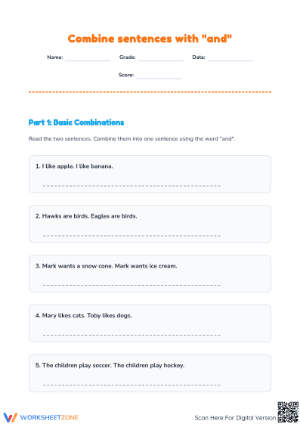
As the most common connector, 'And' signifies addition, bringing together similar ideas. Whether connecting two subjects ('The cat and the dog') or actions ('She ate lunch and she walked'), 'and' implies equal weight. Teachers should encourage students to use 'and' to reduce repetitive sentence starters and create fluid descriptions. It is the workhorse for building lists and sequences.
The 'Nor' Conjunction
The word 'Nor' presents a second negative idea following a first. It is unique because it often requires inversion: 'He does not like spinach, nor does he like kale.' The shift to 'does he' is a frequent point of confusion. Focusing on this inversion in worksheets helps solidify a student's grasp of advanced mechanics and prevents double negatives.
The 'But' Conjunction
Contrast is the primary function of 'But', allowing a writer to show a shift in direction. 'The sun was shining, but the wind was cold.' This word is essential for logical arguments that acknowledge conflicting details. Teachers should emphasize that 'but' connects things that are different but equally important, helping students move toward more nuanced observations.
The 'Or' Conjunction
When a choice is needed, 'Or' presents alternatives. 'Would you like tea or coffee?' On a complex level, it joins clauses: 'We can go to the park, or we can stay home.' It is vital for expressing possibilities in narrative and persuasive writing. On worksheets, 'or' exercises help students identify exclusive choices versus inclusive possibilities.
The 'Yet' Conjunction
Like 'but', 'Yet' shows contrast but implies the second part is surprising. 'The marathon was exhausting, yet the runner felt energized.' This subtle difference adds depth to storytelling, suggesting a contradiction that 'but' might not fully capture. It is a favorite for descriptive essays, helping students add sophistication to their writing.
The 'So' Conjunction
Finally, 'So' indicates a result or consequence. 'The alarm didn't go off, so I was late.' This cause-and-effect relationship is a building block for expository writing. Students must learn to distinguish between 'so' as a coordinator and 'so that' as a subordinator, a distinction frequently highlighted in advanced grammar drills.
Connecting Words, Phrases, and Independent Clauses
The power of these seven words lies in their ability to join elements of 'equal grammatical rank,' a definition emphasized by the writing resources at Cuyamaca College. This means that a coordinating conjunction can link a noun to another noun, an adjective to an adjective, or a complete sentence to another complete sentence. This symmetry is what makes the resulting sentence 'balanced.' If a student tries to connect a single word to a full clause using a coordinator, the sentence often feels 'off' or grammatically incorrect. Practicing with targeted coordinating conjunctions worksheets helps students recognize when they are successfully maintaining this balance, leading to clearer and more professional prose.
According to resources from Cuyamaca College, coordinating conjunctions connect words or phrases of equal grammatical rank. This guide explores the 7 specific words used in this process—For, And, Nor, But, Or, Yet, and So—to help students build balanced sentences and avoid common punctuation errors during writing exercises.
The Vital Comma Rule
One of the most frequent errors in student writing involves the punctuation used with FANBOYS. The rule is straightforward: a comma should be placed before the conjunction only when it joins two independent clauses. An independent clause is a group of words that contains a subject and a verb and can stand alone as a complete sentence. If the conjunction is only joining two words or two short phrases, no comma is needed. For example, 'I bought bread and milk' requires no comma, but 'I bought bread, and I also bought some milk' does. Visualizing this rule through sentence-diagramming and punctuation-focused worksheets can help students internalize the pattern and avoid common run-on errors.
While many grammar guides treat coordination as a simple task of 'glueing' sentences together, a deep analytical look reveals that it is actually an exercise in rhetorical weight. When a writer chooses a coordinating conjunction over a subordinating one, they are making a conscious decision to give both ideas equal status in the reader's mind. This prevents one idea from being perceived as secondary or less significant than the other. In instructional design, highlighting this 'equality' helps students move beyond simple sentence construction and toward intentional prose where the structure of the sentence actually reflects the logic of the argument itself. This level of awareness transforms grammar from a set of rules into a tool for persuasive communication.
Teacher Tips for Classroom Implementation
To support student growth, teachers should use a scaffolded approach when introducing coordinating conjunctions worksheets. Teachers can follow these steps:
- Identification: Start with tasks where students circle the FANBOYS in pre-written sentences.
- Logic Determination: Use 'fill-in-the-blank' exercises where the student must choose the correct conjunction based on the relationship (addition, contrast, choice).
- Sentence Combining: Encourage students to combine short, choppy sentences into longer, flowing ones using a coordinator and a comma.
- Punctuation Drills: Provide sentences where students must decide if a comma is necessary based on whether the clauses are independent.
This transition from passive recognition to active creation is where the most significant learning occurs. Teachers can also introduce color-coding—using one color for the clauses and another for the conjunction—to make the 'bridge' metaphor more concrete for visual learners.
Avoiding Common Pitfalls: Run-ons and Comma Splices
The improper use of coordinators is a leading cause of run-on sentences and comma splices in student essays. A comma splice occurs when a writer tries to join two sentences with only a comma, omitting the conjunction. A run-on occurs when they omit both. By focusing on the 7 specific words, students learn that a comma alone is not strong enough to hold two independent clauses together; it needs the 'muscle' of a FANBOYS word to complete the connection safely. Mastery of this concept is often the turning point between elementary and middle-school writing proficiency, allowing students to produce longer compositions without losing structural integrity.
Frequently Asked Questions
1. What are the 7 coordinating conjunctions?
The seven specific words are For, And, Nor, But, Or, Yet, and So. They are easily remembered using the acronym FANBOYS.
2. When do I need to use a comma with a coordinating conjunction?
You must place a comma before the conjunction when it connects two independent clauses. An independent clause is a part of a sentence that could stand alone as its own complete sentence. If you are only joining words or short phrases, the comma is generally not required.
3. Can I start a sentence with a coordinating conjunction?
Yes, it is grammatically acceptable to start a sentence with a coordinating conjunction like 'But' or 'And.' While some traditional rules discouraged this, modern writing often uses it to create emphasis or a rhythmic break in the text. However, students should be taught to use this technique sparingly to avoid fragmented writing.
4. Is 'because' a coordinating conjunction?
No, 'because' is classified as a subordinating conjunction. It does not follow the same rules as the FANBOYS group and is used to create dependent relationships between ideas rather than joining equal grammatical ranks.
5. How does the acronym FANBOYS help in writing?
The acronym serves as a memory aid to help students quickly recall the 7 specific words that can join independent ideas. This prevents them from confusing these coordinators with transitions like 'however' or 'therefore,' which require different punctuation (usually a semicolon).















 Interactive Worksheet Maker
 Quiz Maker
 Word Search Maker
 Crossword Puzzle Maker
 Word Scramble Generator
 Sentence Scramble Generator
 Handwriting Worksheet Generator
 Name Tracing Generator
 Fill In The Blank Generator