


























Views
Downloads
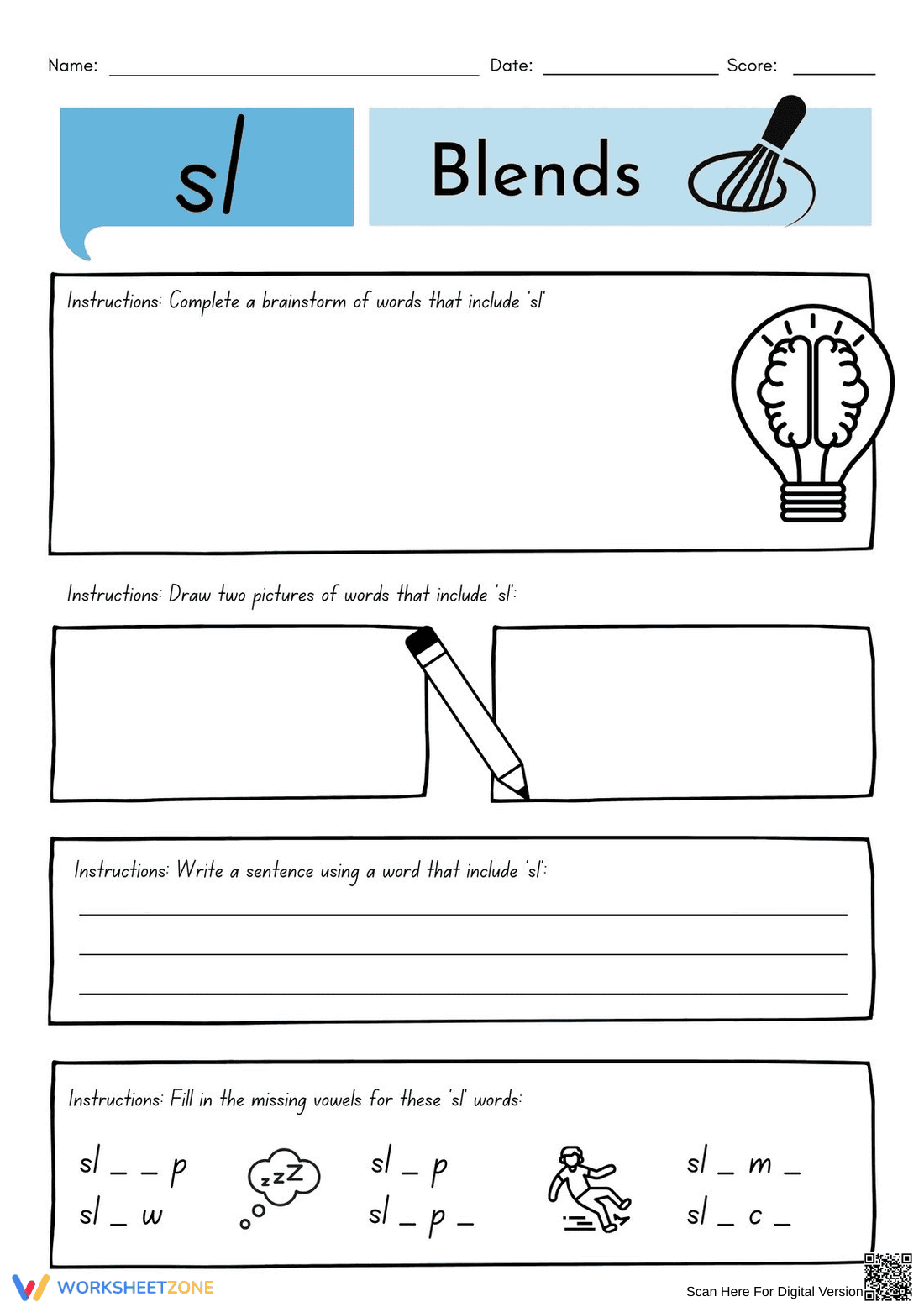

Grade 1 sl Blends — Printable No-Prep Worksheet
Paste this activity's link or code into your existing LMS (Google Classroom, Canvas, Teams, Schoology, Moodle, etc.).
Students can open and work on the activity right away, with no student login required.
You'll still be able to track student progress and results from your teacher account.
This Grade 1 phonics worksheet helps students master the initial consonant 'sl' blend through varied, engaging activities. By brainstorming, drawing, writing, and spelling, early readers build essential phonemic awareness and vocabulary skills. This targeted practice ensures students can confidently decode and encode words starting with 'sl'.
At a Glance
- Grade: 1 · Subject: ELA
- Standard:
CCSS.ELA-LITERACY.RF.1.3— Apply phonics and word analysis skills- Skill Focus: Consonant 'sl' blends
- Format: 1 page · 4 tasks · Answer key included · PDF
- Best For: Independent practice
- Time: 10–15 minutes
This single-page resource features four task types to reinforce the 'sl' blend. Students begin with an open-ended brainstorm, followed by a drawing activity to visualize 'sl' words. The worksheet then transitions to sentence construction, requiring learners to apply vocabulary in context. Finally, a fill-in-the-blank spelling section with visual cues challenges students to identify missing vowels in words like sleep and slide. An answer key is provided.
This resource is designed for a zero-prep workflow:
- Print (1 minute): The layout is optimized for standard printing, ensuring clear text.
- Distribute (1 minute): Hand out directly to students with no extra materials needed.
- Review (2 minutes): Use the answer key to quickly check the fill-in-the-blank section.
With a total teacher prep time under two minutes, this worksheet is excellent for sub plans.
This worksheet is strictly aligned to CCSS.ELA-LITERACY.RF.1.3, requiring students to know and apply grade-level phonics and word analysis skills in decoding words. By focusing on the 'sl' consonant blend, the activities support foundational reading fluency. It also touches upon early writing standards as students construct complete sentences using targeted vocabulary. Both standard codes can be copied directly into lesson plans, IEP goals, or district curriculum mapping tools.
Integrate this worksheet during independent practice after direct instruction on consonant blends. Teachers can use the brainstorming section as a quick formative assessment to gauge prior knowledge before students move on to the drawing and writing tasks. Alternatively, assign this page as morning work to reinforce phonics skills learned the previous day. Students typically complete all four sections within a 10 to 15-minute timeframe.
This resource is primarily designed for Grade 1 students developing their phonemic awareness and spelling skills. The visual cues in the fill-in-the-blank section provide built-in differentiation for visual learners and English Language Learners who might need extra support with vocabulary. Pair this worksheet with a phonics anchor chart or a read-aloud book that heavily features 'sl' blend words to maximize student comprehension.
Mastering initial consonant blends is a critical milestone in early literacy development. This resource directly supports CCSS.ELA-LITERACY.RF.1.3, helping students apply phonics and word analysis skills to decode and encode text accurately. According to Fisher & Frey (2014), providing students with varied, multimodal opportunities to interact with new phonics patterns significantly increases retention and reading fluency. By combining brainstorming, drawing, writing, and spelling into a single activity, this worksheet aligns with evidence-based practices for early reading instruction. The structured progression from open-ended recall to specific vowel placement ensures that learners build a robust understanding of the 'sl' blend. Consistent practice with these foundational skills reduces cognitive load during independent reading, allowing young learners to focus on comprehension rather than decoding. This targeted approach ensures that students develop the automaticity required for long-term academic success.


