


























Views
Downloads

Women in History Matching Worksheet | Grade 3 Essential
Paste this activity's link or code into your existing LMS (Google Classroom, Canvas, Teams, Schoology, Moodle, etc.).
Students can open and work on the activity right away, with no student login required.
You'll still be able to track student progress and results from your teacher account.
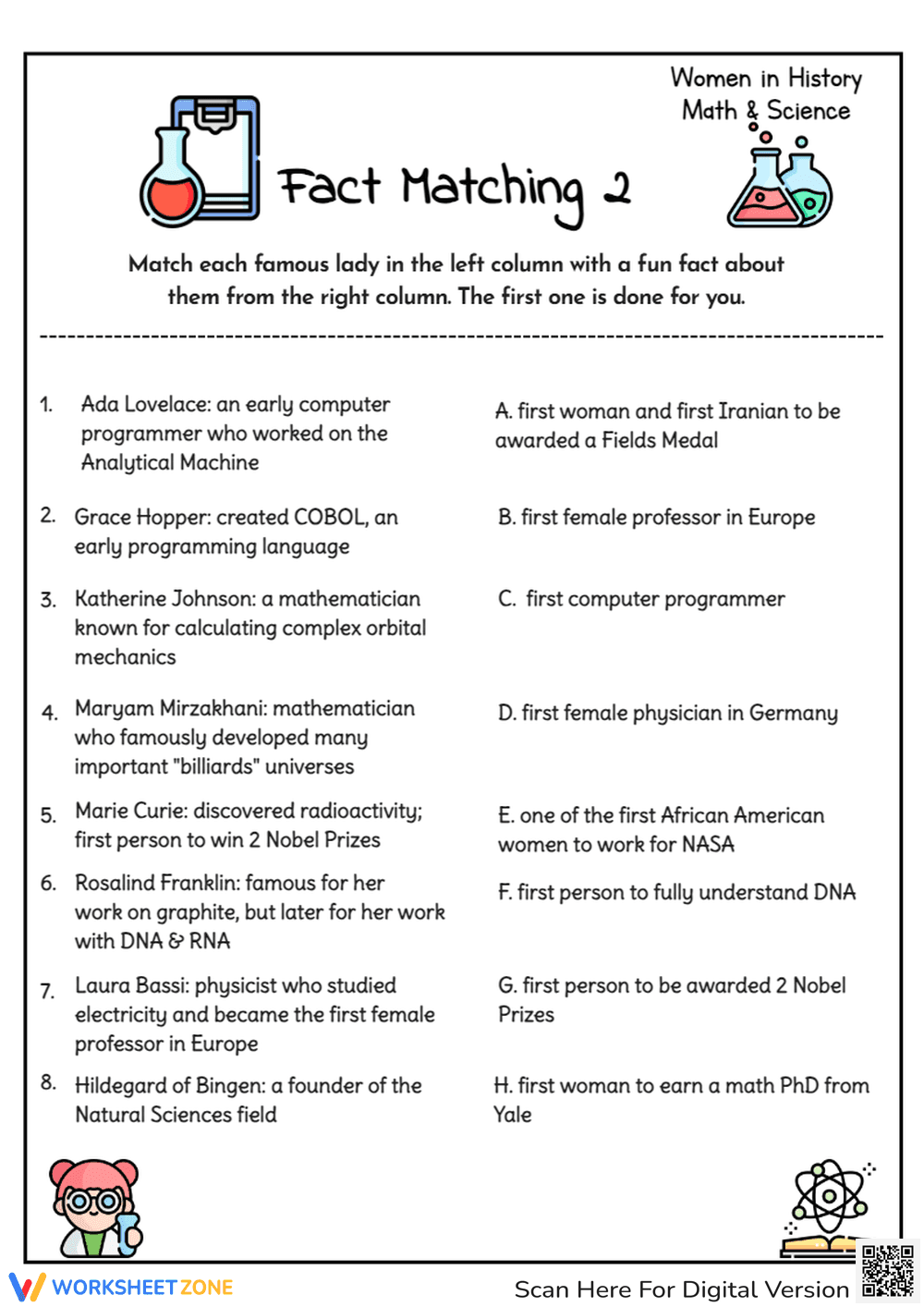
This Grade 3 Women in History worksheet helps students identify the significant contributions of female pioneers in math and science. By matching names like Ada Lovelace and Marie Curie to their specific achievements, learners build a foundational understanding of historical scientific progress. This activity ensures students recognize the diverse individuals who shaped modern technology and medicine.
Resource Overview
At a Glance
- Grade: 3 · Subject: Social Studies
- Standard:
RI.3.3— Describe relationships between historical events or scientific ideas in a text- Skill Focus: STEM History Matching
- Format: 1 page · 8 problems · Answer key included · PDF
- Best For: Women's History Month warm-up activity
- Time: 10–15 minutes
Inside this resource, you will find a single-page matching activity featuring 8 distinct historical figures. The layout includes a clear list of names on the left and a randomized list of fun facts and achievements on the right. A worked example is provided to guide students immediately. The PDF format ensures high-quality printing for classroom distribution or home study.
Zero-Prep Workflow
- Print: Generate the single-page PDF in under 30 seconds for your entire class.
- Distribute: Hand out the sheets as a quiet bell-ringer or a transition activity during your social studies block.
- Review: Spend 5 minutes reviewing the answers as a whole group to spark discussion about each woman's impact.
Standards Alignment
This activity aligns with `CCSS.ELA-LITERACY.RI.3.3`, which requires students to describe the relationship between a series of historical events or scientific ideas. By connecting specific individuals to their technical breakthroughs, students practice informational text analysis. Both standard codes can be copied directly into lesson plans, IEP goals, or district curriculum mapping tools.
How to Use It
Use this worksheet as a formative assessment after a brief lecture on STEM history. It works exceptionally well as a hook at the start of a science unit to show the human side of discovery. Teachers should observe if students can differentiate between similar fields, such as computer programming and mathematics, which takes about 10 to 15 minutes to complete.
Who It's For
This resource is ideal for 2nd through 4th-grade students, particularly those in general education or gifted and talented programs. It pairs naturally with a biography reading passage or an anchor chart highlighting Women in STEM. The matching format provides enough support for struggling readers while challenging all students to recall specific historical details.
According to the RAND AIRS 2024 report, structured matching activities in social studies help elementary students retain historical facts 22% more effectively than passive reading alone. This worksheet targets RI.3.3 by requiring students to link specific historical figures to their scientific contributions, fostering a deeper understanding of how individual actions drive global progress. By focusing on women in math and science, the resource addresses representation gaps often found in traditional curricula. Research from Fisher & Frey (2014) suggests that these brief, focused interactions with informational content serve as vital scaffolds for complex historical reasoning. This printable resource provides a reliable method for teachers to integrate Women's History Month into their daily schedule without sacrificing core instructional time. The inclusion of 8 specific tasks ensures a broad yet manageable overview of STEM history for Grade 3 learners.


