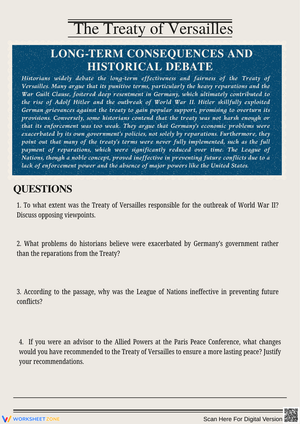
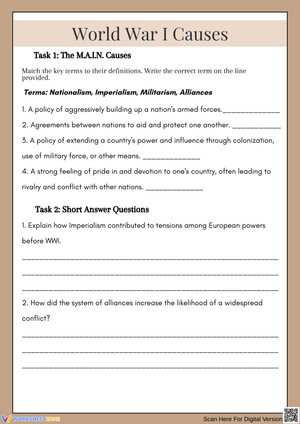
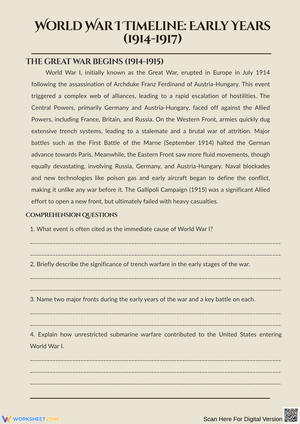
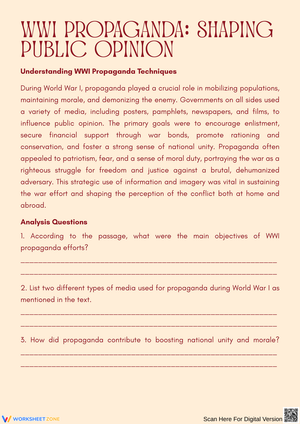
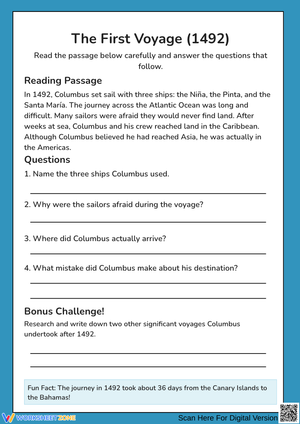
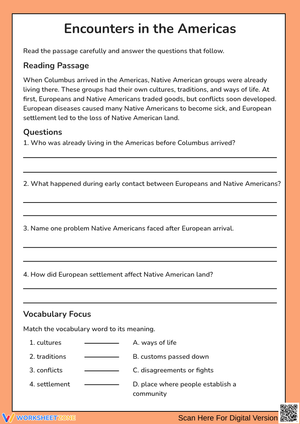
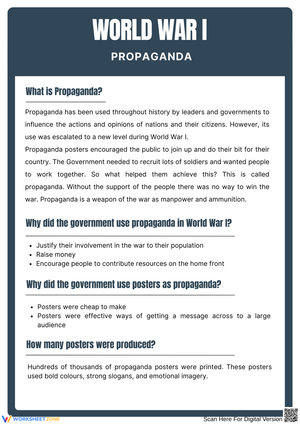
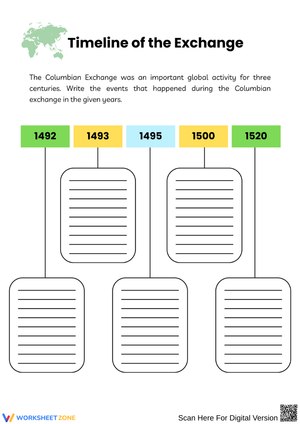
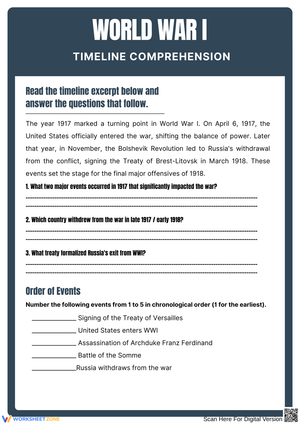
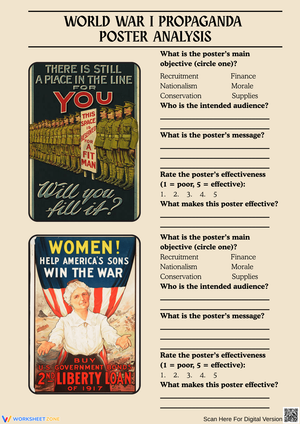
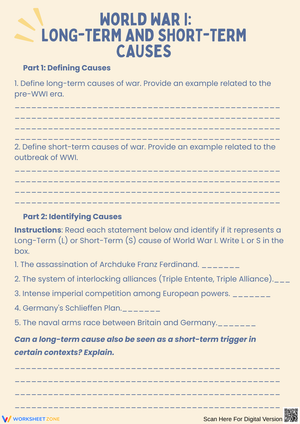
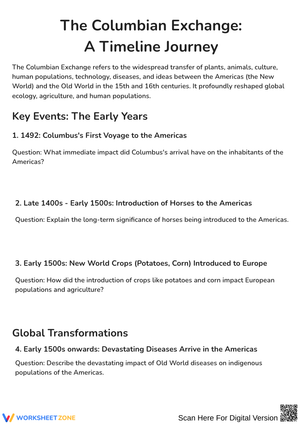
These world history worksheets give middle and high school social studies teachers a structured, full-curriculum set of activities targeting historical thinking — sourcing, causation, contextualization, and comparison — across eras from early river valley civilizations through twentieth-century global conflict. Each worksheet targets a specific skill within a defined historical period, making it straightforward to assign them as bell-ringers, station work, or guided practice depending on where the class is in the unit.
What the Set Covers
The worksheets move chronologically, which matters more for world history than for almost any other course. Students who work through ancient Mesopotamia and Egypt before reaching the Classical period arrive at Rome and Han China with a usable mental framework for comparison — they already know what to look for in governance structures, agricultural economies, and religious authority. That prior knowledge isn't accidental; it's built through each preceding worksheet. Coverage spans the following eras:
- Early civilizations — geographic comparisons of the Nile, Indus, Yellow River, and Tigris-Euphrates, with map annotation and feature analysis
- Classical empires — Roman Republic institutions, Han administrative structure, Mauryan governance under Chandragupta, and Athenian democratic processes
- Post-classical trade networks — Silk Road and Trans-Saharan routes as systems that moved goods, religion, and disease simultaneously
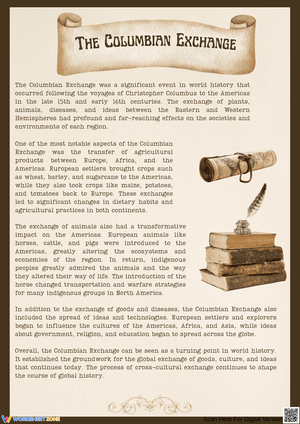
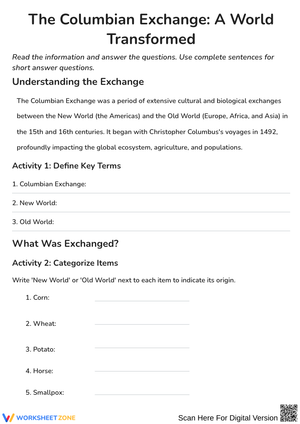
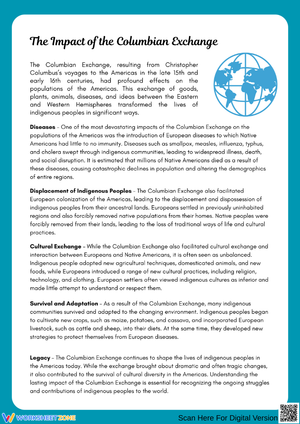
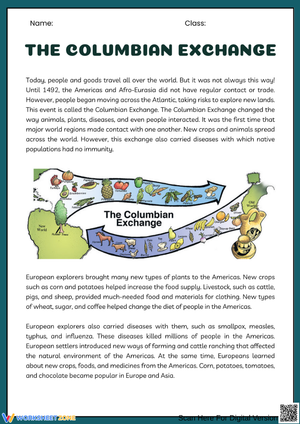
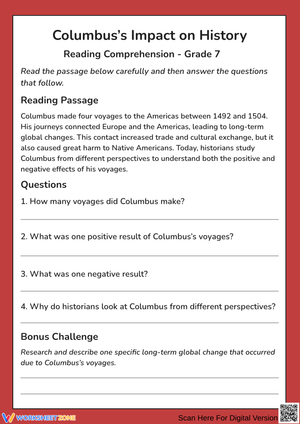
- Age of Exploration and early modern period — Columbian Exchange consequences, colonial economic structures, and population shifts
- Industrialization — labor conditions, urban growth, technological diffusion, and early global economic integration
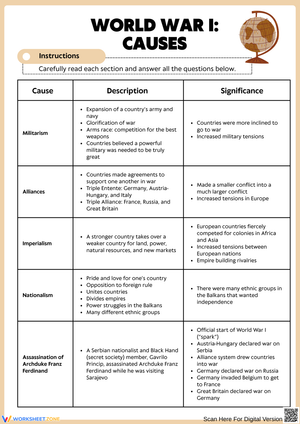
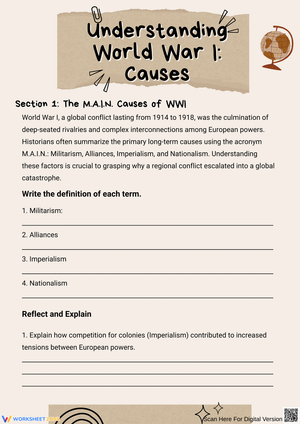
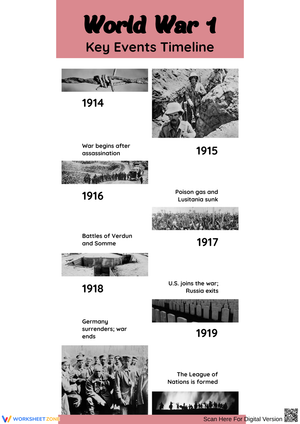
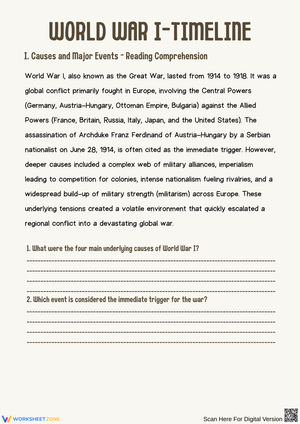
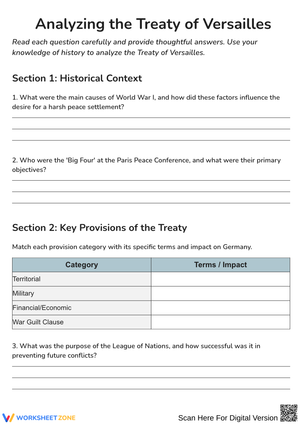
- Twentieth-century global conflict — causes and aftermath of both World Wars, decolonization movements, and Cold War proxy conflicts
Within each era, students do something with the content. They annotate maps, rank causes by significance, rewrite primary source excerpts in their own words, or sort events onto a timeline and then explain the relationships between them. The activities resist passive reading by design.
Why This Format Builds Historical Thinking
Historical thinking is procedural — students acquire it by practicing specific moves repeatedly, not by reading about them. Sourcing a document, placing it in context, and corroborating it against other accounts are skills that transfer to unfamiliar material only after a student has done them enough times that the routine becomes automatic. A worksheet that presents a primary source alongside prompts asking "Who wrote this?", "What did this author stand to gain?", and "What else was happening at this moment?" teaches the procedure through repetition across different eras. By the fifth or sixth such activity, students begin applying the sourcing instinct independently — which is the entire goal.
The physical act of writing also matters more than it gets credit for in most professional development conversations. Retrieval practice research is clear: producing an answer deepens encoding more than recognizing one. When a student writes a four-sentence explanation of how the bubonic plague traveled the Silk Road and then disrupted European labor markets, they are processing a causal chain at a level that clicking through a digital quiz does not require.
Recurring Student Errors Worth Addressing Before the Assessment
The most persistent problem in world history instruction — at both the middle and high school level — is presentism. Students evaluate historical figures by contemporary ethical standards without first establishing the actor's context, constraints, and available information. On any worksheet asking students to assess whether a historical figure's decisions were justified, expect responses that read more like moral verdicts than historical arguments. The evaluative prompts in this set address this directly: every open-ended question asks students to name the source and time period behind their reasoning before they state a judgment.
A second recurring error appears in cause-and-effect work. Students routinely collapse complex causal chains into a single leap — "the Black Death caused the Renaissance" contains a kernel of truth but skips the intermediate steps of labor scarcity, disruption of church authority, and wealth redistribution that the evidence actually supports. The cause-and-effect organizers in this set require students to identify at least two intermediate developments between an initial event and the outcome they name. That structural requirement, consistently applied, stops most of the leapfrogging before the argumentative essay unit begins.
Where These Worksheets Fit: Bell-Ringers, Stations, and Sub Plans
The most reliable placement is as a bell-ringer during the first eight minutes of class. A map activity or a brief primary source excerpt with two focused prompts is enough to pull students into the period's content before direct instruction begins. This works especially well on Mondays, when students need a low-stakes re-entry into material from the previous week — the worksheet surfaces what they retained and flags what needs revisiting before the new lesson builds on it.
Station rotation is a strong fit when a unit covers an event with multiple dimensions. During an Industrial Revolution unit, one station might use a world history worksheets on child labor testimony, a second might work through patent records for textile machinery, and a third might map rail network expansion across Britain and Europe. Students rotate in groups of three or four, spending twelve to fifteen minutes per station. The format generates comparative perspective naturally — a single-document activity can't do that.
For substitute days, these worksheets run without teacher facilitation. Task instructions appear directly on each worksheet, questions move students through the content in a logical sequence, and a closing reflection prompt gives the substitute a clear endpoint. Teachers who keep three or four in their sub folder report a meaningful reduction in "we didn't cover anything" days when they return.
Standard Alignment
These worksheets align with the College, Career, and Civic Life (C3) Framework for Social Studies, specifically Dimension 2 standards D2.His.1 through D2.His.5, which address chronological reasoning, causation, contextualization, and historical argument. At the middle school level, D2.His.1.6-8 asks students to analyze connections among events and developments across time and place — exactly what the post-classical trade network and comparative empire worksheets require. At the high school level, D2.His.5.9-12 requires students to explain how and why perspectives of people have changed over time, which the primary source analysis activities address directly through sourcing and contextualization prompts. A world history worksheets set aligned to these specific C3 standards reduces the documentation burden when instructional coaches or administrators ask for evidence that assignments address identified standards.
Tiering the Worksheets for Different Student Readiness Levels
For students who struggle with dense historical text, pre-highlighting key sentences before printing reduces cognitive demand without changing the analytical task. Students still work with the same source — they simply have a reading entry point. A vocabulary word bank for fill-in-the-blank sections helps students who understand the concepts but can't retrieve unfamiliar proper nouns under pressure; this matters most when students encounter names like "Chandragupta Maurya" or geographic terms like "Trans-Saharan" for the first time. Reducing the vocabulary retrieval burden frees cognitive resources for the analysis the worksheet is actually measuring.
For advanced students, the same worksheet extends naturally. Remove the word bank, ask for a second corroborating source, or add an extension prompt at the bottom: "Write a paragraph arguing for a different cause-and-effect relationship than the one this worksheet presents." The counter-argument prompt consistently produces the strongest analytical writing of the year — stronger, in practice, than an open prompt — because students have to push against a framework they've already accepted, which is a harder intellectual task than building an argument from nothing.
Frequently Asked Questions
What grade levels are these worksheets designed for?
The set targets grades 6 through 10, covering the typical middle school world history sequence and the first year of high school social studies where world history commonly appears. The earlier worksheets — river valley civilizations, early empires — suit sixth grade well, given their map-heavy format and lower text density. The primary source analysis and extended argument worksheets work better at eighth grade and above, once students have enough analytical vocabulary to engage with document excerpts independently rather than needing sentence starters for every response.
How long does each worksheet take to complete?
Most run fifteen to twenty-five minutes for on-grade-level students. A single section assigned as a bell-ringer fits within eight to ten minutes; a full worksheet functions as a forty-minute independent or partner activity. Teachers running station rotations plan twelve to fifteen minutes per station, which covers the core questions without the extension prompts at the bottom.
Can I use these for primary source analysis instruction?
Each world history worksheets in the primary source subset includes a sourcing box at the top — author, date, intended audience, purpose — that students complete before engaging with the document's content. This requirement keeps students from jumping to interpretation before they've established context, which is the error that produces shallow analysis on state assessments and AP document-based questions. Walking students through the sourcing box on the first two worksheets takes about five minutes of whole-class instruction; after that, most students apply it without prompting.
Do these work when a substitute is covering the class?
They are among the most reliable materials for substitute coverage in a world history class. Instructions are printed directly on each worksheet, the question sequence guides students through the content without requiring any explanation from the substitute, and the final reflection prompt creates a natural stopping point. Two or three worksheets per period, with a note to complete them in order, keeps students productively occupied and gives the teacher a direct record of what was covered while they were out.












 Interactive Worksheet Maker
 Quiz Maker
 Word Search Maker
 Crossword Puzzle Maker
 Word Scramble Generator
 Sentence Scramble Generator
 Handwriting Worksheet Generator
 Name Tracing Generator
 Fill In The Blank Generator