


























Views
Downloads
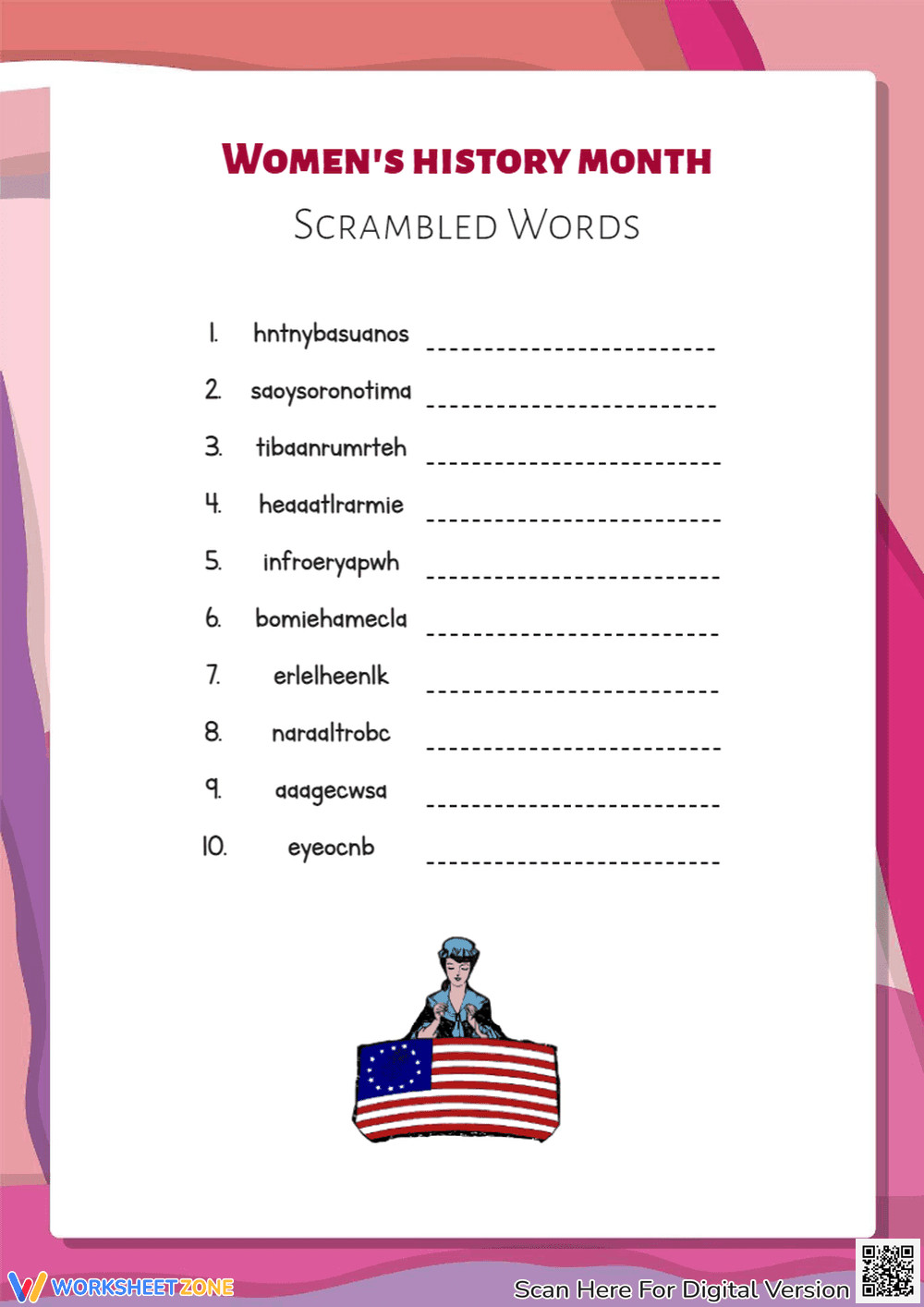

Essential Women's History Month Scrambled Words Worksheet
Paste this activity's link or code into your existing LMS (Google Classroom, Canvas, Teams, Schoology, Moodle, etc.).
Students can open and work on the activity right away, with no student login required.
You'll still be able to track student progress and results from your teacher account.
This Women's History Month scrambled words worksheet helps students recognize and correctly spell the names of influential historical figures. By unscrambling 10 specific names, learners strengthen their orthographic awareness while engaging with important cultural themes. This activity serves as a perfect bridge between literacy development and social studies curriculum during the month of March.
At a Glance
- Grade: 3 · Subject: ELA & Social Studies
- Standard:
CCSS.ELA-LITERACY.L.3.2— Use conventional spelling for high-frequency and other studied words- Skill Focus: Spelling and Historical Figure Recognition
- Format: 1 page · 10 problems · Answer key included · PDF
- Best For: Seasonal morning work or early finishers
- Time: 10–15 minutes
The worksheet contains a single-page layout featuring 10 scrambled names of famous women, such as Amelia Earhart and Betsy Ross. Each item includes a clear line for students to write the corrected name. The document is designed with a clean, thematic aesthetic that includes a historical illustration to provide visual context. A comprehensive answer key is provided to facilitate quick grading.
Zero-Prep Workflow
The zero-prep workflow for this resource is designed for maximum teacher efficiency. First, print the single-page PDF (30 seconds). Second, distribute the copies to students as they enter the classroom or finish a primary task (1 minute). Third, review the answers as a whole group to spark a brief discussion about each woman's historical contribution (5 minutes).
Standards Alignment
This resource is primarily aligned with `CCSS.ELA-LITERACY.L.3.2`, which focuses on using conventional spelling for high-frequency and studied words. It also supports `CCSS.ELA-LITERACY.RI.3.1` by encouraging students to identify key individuals mentioned in historical texts. Both standard codes can be copied directly into lesson plans, IEP goals, or district curriculum mapping tools.
How to Use It
Use this worksheet as a formative assessment during the first week of March to gauge students' prior knowledge of historical figures. It works exceptionally well as a "hook" before a deeper research project on women's history. Teachers should observe if students recognize the names phonetically or if they require a word bank for support. Expect students to complete the 10 items within 10 to 15 minutes.
Who It's For
This activity is tailored for students in Grades 2 through 5, with varying levels of support provided by the teacher. It is particularly effective for English Language Learners who are building their academic vocabulary. Pair this worksheet with a Women's History Month anchor chart or a short biographical passage to provide students with the necessary context to solve the more challenging scrambles.
According to the RAND AIRS 2024 report on supplemental instructional materials, high-quality vocabulary exercises that integrate thematic content—such as Women's History Month—significantly improve student engagement and retention of historical facts. This worksheet aligns with CCSS.ELA-LITERACY.L.3.2 by requiring students to apply spelling patterns and recognize the names of influential figures like Susan B. Anthony and Harriet Tubman. Research from Fisher & Frey (2014) suggests that word-level tasks, including anagrams and scrambles, support orthographic processing and lexical development in intermediate elementary learners. By connecting linguistic practice with social studies themes, educators provide a multi-disciplinary approach that reinforces both literacy and cultural awareness. This resource offers a structured, low-stakes environment for students to practice letter-sound correspondences while honoring the contributions of women throughout history. It serves as a reliable tool for reinforcing spelling conventions within a meaningful context.


