


























Views
Downloads

Mother Teresa Drawing Worksheet | Grade 1 Essential
Paste this activity's link or code into your existing LMS (Google Classroom, Canvas, Teams, Schoology, Moodle, etc.).
Students can open and work on the activity right away, with no student login required.
You'll still be able to track student progress and results from your teacher account.
This Mother Teresa biography worksheet provides early elementary students with a focused reading and creative expression activity. By combining a short informational text with a dedicated drawing space, students process historical facts while developing fine motor skills. It serves as a perfect introduction to humanitarian figures during Women's History Month or social studies units.
At a Glance
- Grade: 1 · Subject: Social Studies
- Standard:
CCSS.ELA-LITERACY.RI.1.1— Ask and answer questions about key details in a text- Skill Focus: Reading Comprehension & Drawing
- Format: 1 page · 1 task · No answer key · PDF
- Best For: Women's History Month morning work
- Time: 15–20 minutes
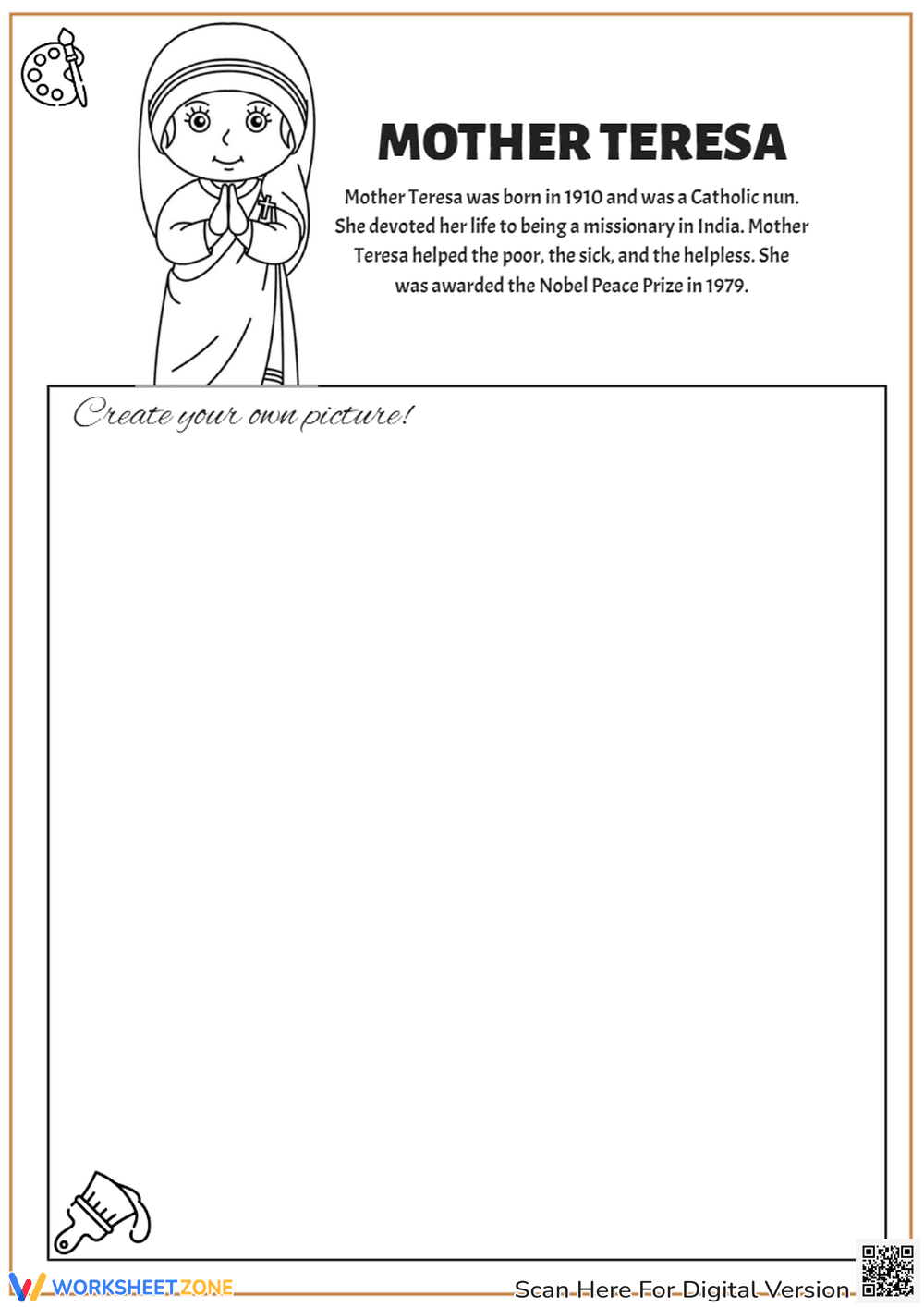
The worksheet features a concise biography of Mother Teresa, highlighting her birth year, her role as a Catholic nun, her missionary work in India, and her 1979 Nobel Peace Prize. Below the text, a large, framed "Create your own picture!" box invites students to illustrate what they have learned. The clean layout includes thematic icons like a paint palette and brush to signal the creative nature of the task.
This resource is designed for a zero-prep classroom workflow. First, print the single-page PDF (30 seconds). Second, distribute the sheets to students along with crayons or colored pencils (1 minute). Third, review the key facts as a group or allow students to share their drawings to reinforce the biographical details (5-10 minutes). Total teacher preparation time is under 2 minutes, making it an ideal sub plan or transition activity.
This activity aligns with `CCSS.ELA-LITERACY.RI.1.1`, which requires students to ask and answer questions about key details in a text. By translating the written word into a visual representation, students demonstrate their understanding of Mother Teresa's life and impact. This standard code can be copied directly into lesson plans, IEP goals, or district curriculum mapping tools.
Use this worksheet during a direct instruction lesson on "Helpers in History" or as a standalone Women's History Month activity. It works well as a formative assessment; observe whether students' drawings reflect the "helping" or "missionary" themes mentioned in the text. Expect students to complete the reading and drawing within a 15 to 20-minute window.
This resource is tailored for Kindergarten through Grade 2 students, particularly those who benefit from visual-spatial learning. It is an excellent pairing for a read-aloud biography of Mother Teresa or a classroom anchor chart about Nobel Peace Prize winners. The simple text supports emerging readers while the drawing task engages all ability levels.
According to Fisher & Frey (2014), the integration of visual representation with informational text significantly enhances the retention of key details in early childhood education. This Mother Teresa worksheet utilizes the "dual coding" theory, where students process information through both verbal and non-verbal channels. By identifying specific facts—such as her work in India or her Nobel Prize—and then visualizing those concepts, students build a more robust mental model of historical figures. Research from the NAEP suggests that early exposure to biographical texts helps develop the foundational literacy skills necessary for complex historical analysis in later grades. This printable resource provides a structured yet flexible environment for students to engage with `CCSS.ELA-LITERACY.RI.1.1` while celebrating the contributions of significant women in history. It is a practical tool for any primary classroom seeking to balance rigorous standards with age-appropriate creative engagement.


