


























Views
Downloads

Winter Calligraphy Practice P-T | Essential Grade 3-4
Paste this activity's link or code into your existing LMS (Google Classroom, Canvas, Teams, Schoology, Moodle, etc.).
Students can open and work on the activity right away, with no student login required.
You'll still be able to track student progress and results from your teacher account.
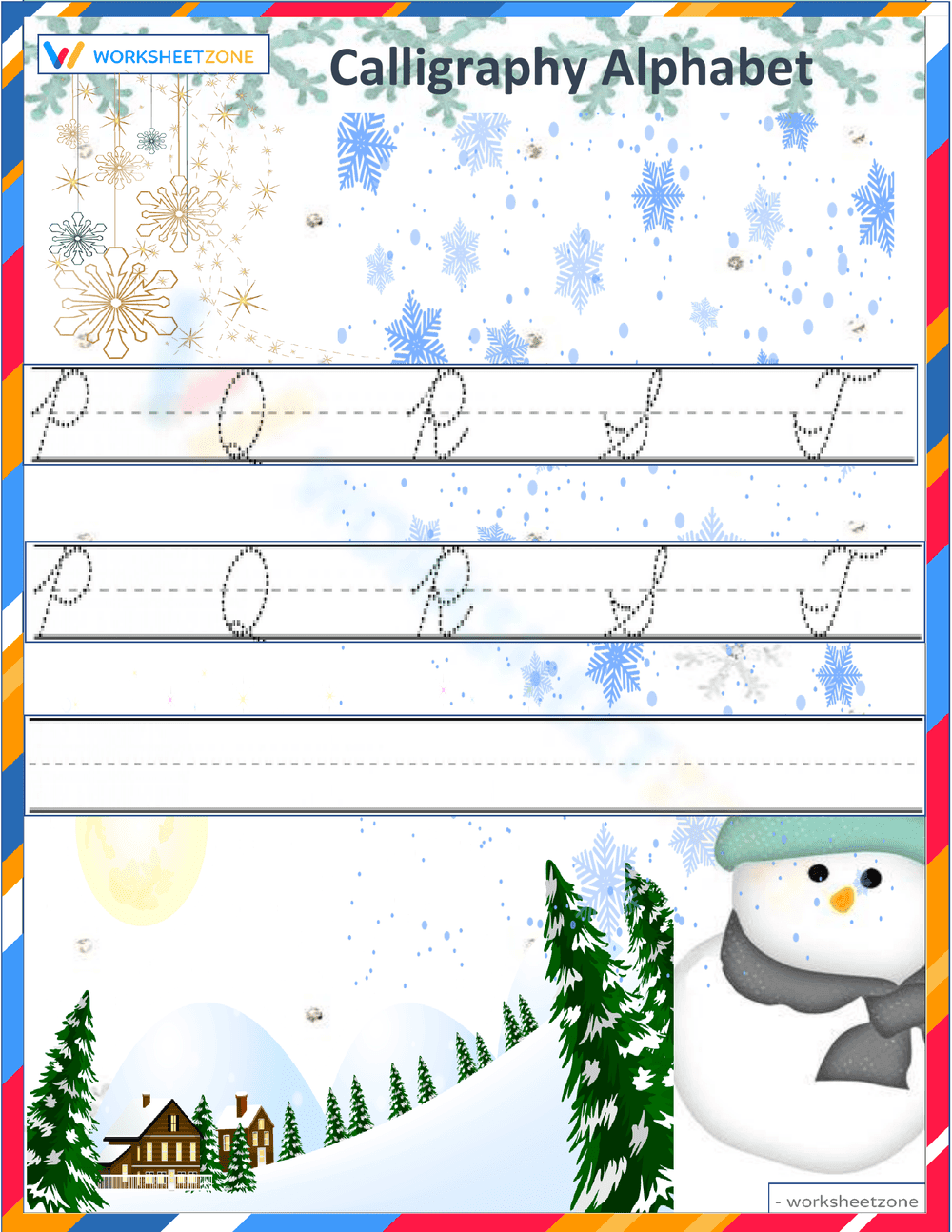
This Grade 3-4 winter-themed handwriting worksheet provides focused practice for mastering the calligraphy forms of letters P, Q, R, S, and T. By combining seasonal engagement with structured tracing, students develop the fine motor control necessary for legible cursive writing. This resource ensures students transition from guided tracing to independent letter production with confidence.
At a Glance
- Grade: 3-4 · Subject: Handwriting
- Standard:
CCSS.ELA-LITERACY.L.3.1.J— Write legibly in cursive, focusing on specific letter connections and formation- Skill Focus: Calligraphy letter formation for uppercase and lowercase P through T
- Format: 1 page · 15 tasks · Answer key N/A · PDF
- Best For: Seasonal morning work, literacy centers, or occupational therapy practice
- Time: 10–15 minutes
The worksheet features two rows of dotted-line tracing for each letter, providing 10 guided opportunities for formation. Below the guided rows, a blank primary-ruled line allows for 5 independent attempts, totaling 15 tasks. The page is decorated with high-quality winter graphics, including snowflakes and a snowman, to maintain student interest during repetitive practice. No additional teacher setup is required beyond printing the PDF.
The zero-prep design of this worksheet allows for immediate classroom implementation. Step 1: Print the single-page PDF (30 seconds). Step 2: Distribute to students as a warm-up or seasonal activity (1 minute). Step 3: Review letter formation by circulating the room or using a document camera for a quick demonstration (2 minutes). This is an ideal solution for morning work or emergency sub plans during the winter months.
This resource is aligned with CCSS.ELA-LITERACY.L.3.1.J, which requires students to "Write legibly in cursive." This standard remains a critical component of the Language strand for third grade. The worksheet also supports fine motor development relevant to occupational therapy goals. This standard code can be copied directly into lesson plans, IEP goals, or district curriculum mapping tools.
Use this worksheet during the "You Do" phase of a handwriting lesson after demonstrating the stroke order for letters P-T. It is particularly effective as a quiet morning work activity or as a station in a literacy rotation. Teachers should observe students' grip and stroke direction as a formative assessment, noting which students require additional intervention. Completion typically takes 10-15 minutes.
This resource is designed for third and fourth-grade students who are learning or refining their cursive skills. It is also highly appropriate for students receiving occupational therapy services or those needing extra fine motor practice. For a complete lesson, pair this worksheet with a cursive anchor chart or a short winter-themed reading passage to provide context for the letters being practiced.
Handwriting instruction remains a foundational component of literacy development, particularly as students transition from print to cursive in the upper elementary years. This worksheet aligns with CCSS.ELA-LITERACY.L.3.1.J, focusing on the specific motor patterns required for the letters P through T. According to Fisher & Frey (2014), the gradual release of responsibility model is most effective when students move from highly scaffolded tracing to independent production. This resource provides exactly that progression within a single page. Research from the NAEP suggests that students who develop fluent handwriting can devote more cognitive resources to higher-level composition tasks. By integrating seasonal themes, this worksheet increases student engagement during repetitive motor practice. The inclusion of 15 distinct tasks ensures that students receive sufficient repetition to build muscle memory without causing fatigue. This resource serves as a reliable tool for teachers seeking to maintain handwriting standards within a busy curriculum.


