


























Views
Downloads
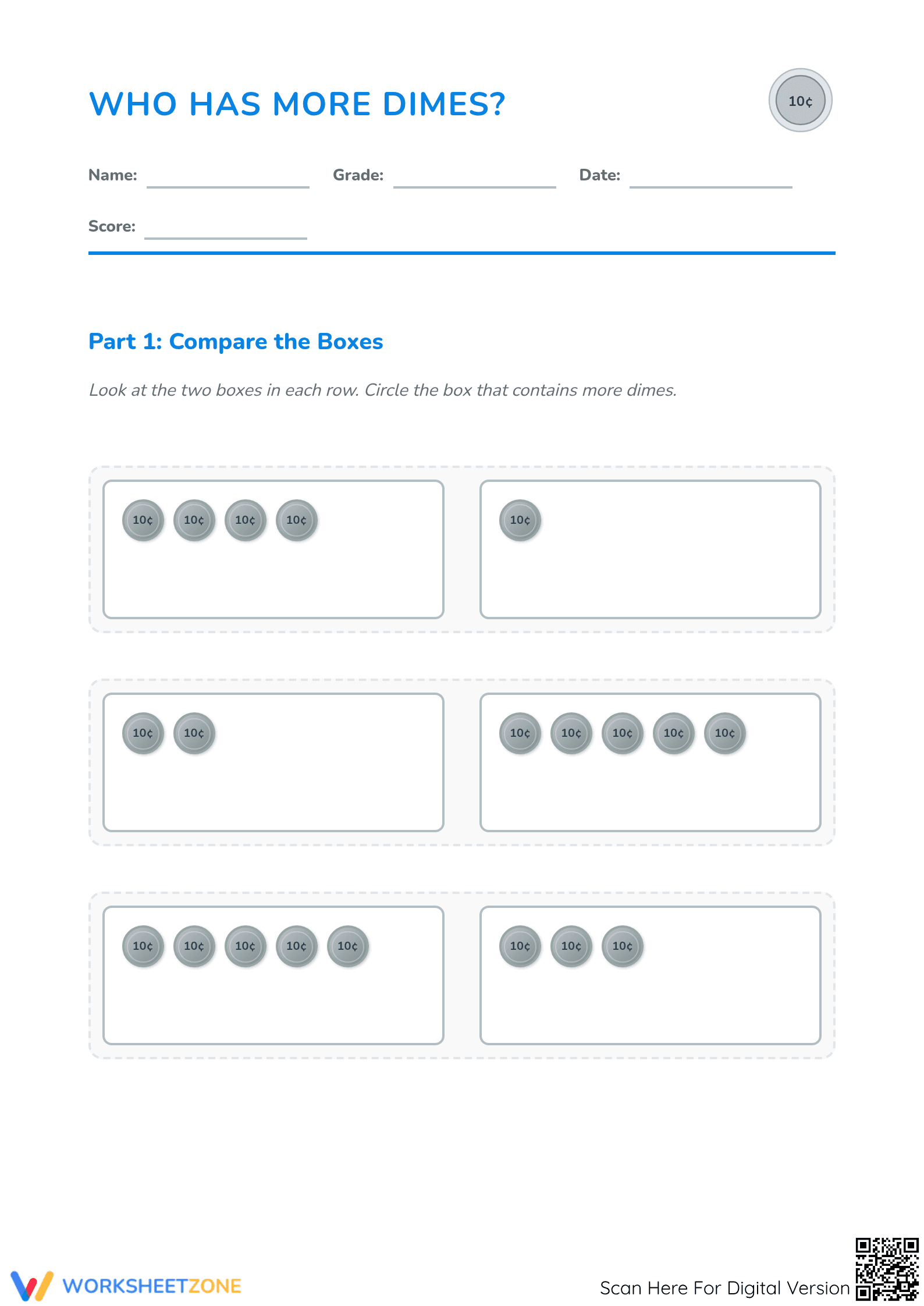



Grade 1-2 Who Has More Dimes — Printable No-Prep Worksheet
Paste this activity's link or code into your existing LMS (Google Classroom, Canvas, Teams, Schoology, Moodle, etc.).
Students can open and work on the activity right away, with no student login required.
You'll still be able to track student progress and results from your teacher account.
This printable math worksheet focuses on comparing quantities and values of dimes, helping students master "more," "fewer," and "equal" concepts. Through five structured pages, learners count coins, apply comparison symbols, and solve realistic word problems. It is an essential resource for building early financial literacy and numerical fluency in primary classrooms.
At a Glance
- Grade: 1–2 · Subject: Math
- Standard:
CCSS.MATH.CONTENT.1.NBT.B.3— Compare two two-digit numbers using the symbols >, =, and <- Skill Focus: Comparing dime quantities and values
- Format: 5 pages · 17 problems · Answer key included · PDF
- Best For: Early elementary money and comparison practice
- Time: 25–35 minutes
This 5-page PDF contains four sections designed to scaffold understanding. Part 1 features visual comparisons where students identify the box with more dimes. Part 2 transitions to counting and writing symbols. Part 3 requires "Draw to Compare" tasks, while Part 4 provides five multi-step word problems. A full answer key is included for efficient grading.
Zero-Prep Workflow
Implementing this worksheet requires minimal teacher effort, making it perfect for busy mornings.
- Print: Select the 5-page PDF and print copies for your group.
- Distribute: The clear "Part" headings allow students to work independently.
- Review: Use the answer key for quick checks.
Total preparation time is under two minutes, allowing you to focus on instruction rather than paperwork.
Standards Alignment
The primary focus is CCSS.MATH.CONTENT.1.NBT.B.3: "Compare two two-digit numbers based on meanings of the tens and ones digits, recording the results of comparisons with the symbols >, =, and <." By using dimes, students visually grasp place value comparison. Supporting standard CCSS.MATH.CONTENT.2.MD.C.8 is addressed via word problems. Both codes can be copied into lesson plans or IEP goals.
How to Use It
Use this resource during independent practice after a lesson on money. Assign the first two pages as a formative check. The word problems in Part 4 serve as an excellent assessment for mastery. Teachers should observe students during Part 2 to ensure they correctly orient comparison symbols. Completion typically takes between 25 and 35 minutes depending on student level.
Who It's For
Designed for Grade 1-2 students, this is also suitable for Kindergarteners or students needing remedial money support. It pairs naturally with physical coin manipulatives. The clear visual layout supports English Language Learners and students with IEPs by providing structured frames. It works well as a center activity or a homework reinforcement packet.
The "Who Has More Dimes?" worksheet integrates evidence-based pedagogical strategies for early mathematical development. Research from Fisher & Frey (2014) emphasizes the importance of scaffolding, which this packet achieves by moving from concrete visual comparisons to abstract symbolic representation and eventually to complex word problems. By grounding number comparison in the familiar context of money, students develop a more robust mental number line and better prepare for future multi-digit operations. The inclusion of Part 4's word problems aligns with NAEP recommendations for increasing cognitive demand in elementary mathematics tasks. This structured progression ensures that learners do not just memorize symbols but understand the underlying logic of relative magnitude. Educators can confidently integrate this tool into their curriculum, knowing it supports the developmental shift from perceptual to conceptual subitizing as described in the ScienceDirect TpT Analysis of high-performing elementary resources.


