


























Views
Downloads


Printable Community Helpers Matching Worksheet | Grade 1-2
Paste this activity's link or code into your existing LMS (Google Classroom, Canvas, Teams, Schoology, Moodle, etc.).
Students can open and work on the activity right away, with no student login required.
You'll still be able to track student progress and results from your teacher account.
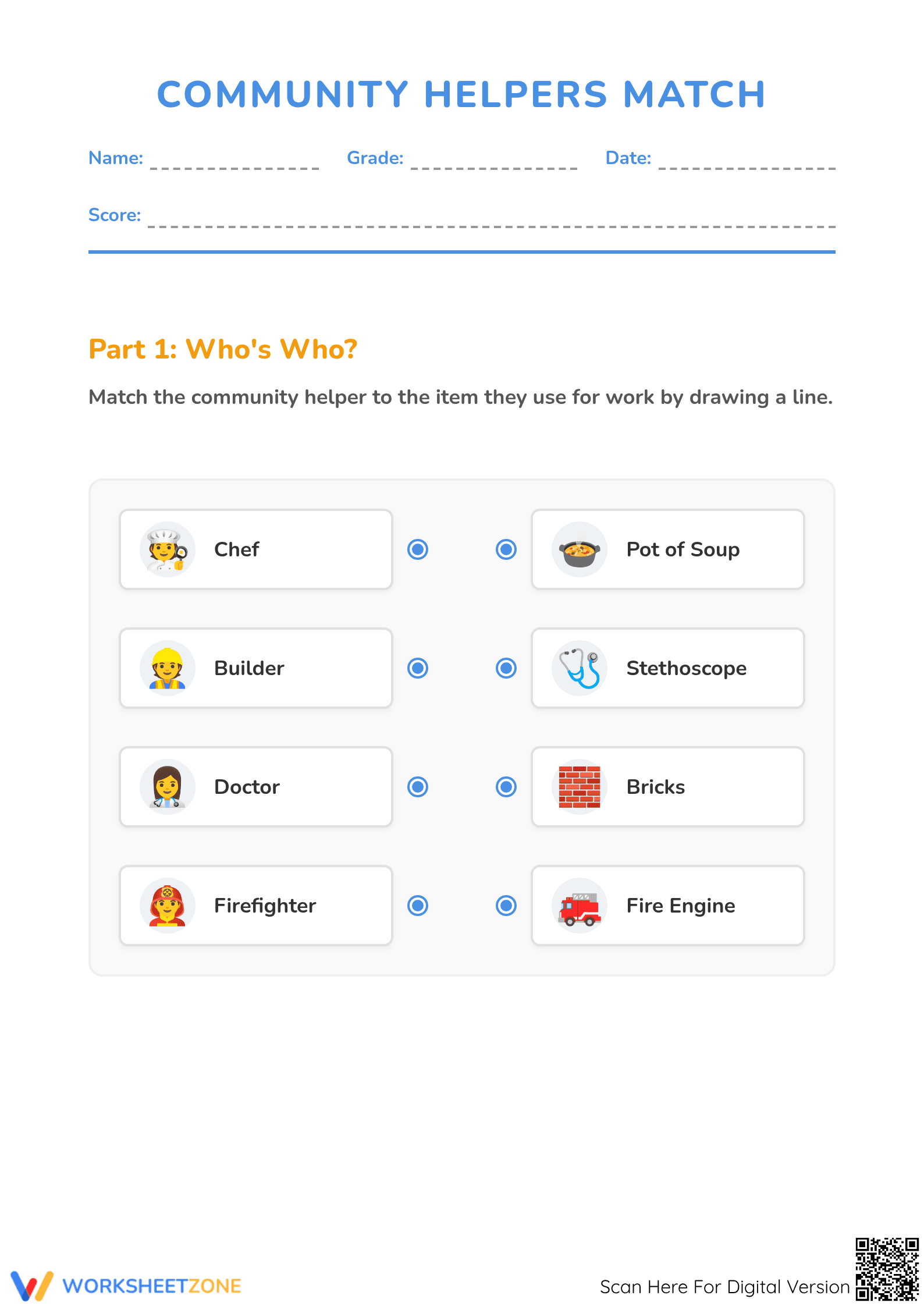
Introduce your young learners to the essential roles within their neighborhood with this engaging matching activity. This worksheet helps students identify various community helpers and associate them with the specific tools and environments that define their daily work. By drawing connections between people and their vocations, students build foundational social studies knowledge and descriptive vocabulary simultaneously.
At a Glance
- Grade: 1–2 · Subject: English Language Arts
- Standard:
CCSS.ELA-LITERACY.RI.1.3— Describe the connection between two individuals, events, ideas, or pieces of information- Skill Focus: Vocational association and logic
- Format: 2 pages · 8 problems · Answer key included · PDF
- Best For: Social studies integration or literacy centers
- Time: 10–15 minutes
This comprehensive two-page PDF includes eight distinct matching tasks. The first page focuses on "Who's Who," challenging students to link helpers like chefs and doctors to their primary tools, such as pots or stethoscopes. The second page expands the scope to "More Helpers," where students match police officers and farmers to their workplaces and machinery. Each task features clear icons and legible text to support early readers and English language learners.
Zero-Prep Workflow
- Print (30 seconds): Download the two-page PDF and print enough copies for your whole group or literacy center rotation.
- Distribute (1 minute): Hand out the worksheets alongside pencils or colorful markers for the matching lines. No scissors or glue required.
- Review (2 minutes): Use the included answer key to quickly grade the associations or project it for a whole-class self-correction session.
This efficient design makes the resource an ideal choice for emergency substitute plans, morning work, or a quick formative assessment during a community-themed unit.
The primary alignment for this resource is `CCSS.ELA-LITERACY.RI.1.3`, which focuses on making connections between pieces of information. It also supports `CCSS.ELA-LITERACY.L.1.6` by encouraging students to acquire and use new domain-specific words. Both standard codes can be copied directly into lesson plans, IEP goals, or district curriculum mapping tools to ensure instructional compliance.
Use this worksheet as a wrap-up activity after reading a book about neighborhood heroes or as an independent station during ELA rotations. For a formative assessment, observe if students can explain *why* a firefighter belongs with a fire engine; this verbal component confirms their logical reasoning beyond simple visual matching. Most Grade 1 students will complete the full set in under 15 minutes.
This resource is specifically tailored for first and second-grade students who are beginning to explore community structures. The inclusion of visual icons makes it highly accessible for students with IEPs or those in English Language Development programs. It pairs naturally with common primary passages about service workers or direct instruction lessons using community helper anchor charts.
Research by Fisher & Frey (2014) emphasizes that building background knowledge through categorized vocabulary is essential for long-term reading comprehension success. This Community Helpers Match worksheet operationalizes this principle by requiring students to utilize the standard code CCSS.ELA-LITERACY.RI.1.3 to make logical connections between individuals and their tools. By engaging in these association tasks, students move beyond simple memorization toward a functional understanding of how different roles interact within a societal system. The structured format ensures that the plain-English skill of describing connections between individuals and their tools is practiced with high fidelity. As highlighted in recent educational analysis, such foundational literacy exercises are critical for bridging the gap between decoding and deep informational text analysis in early elementary settings. This resource provides a reliable, evidence-based method for reinforcing these essential cognitive links.


