


























Views
Downloads
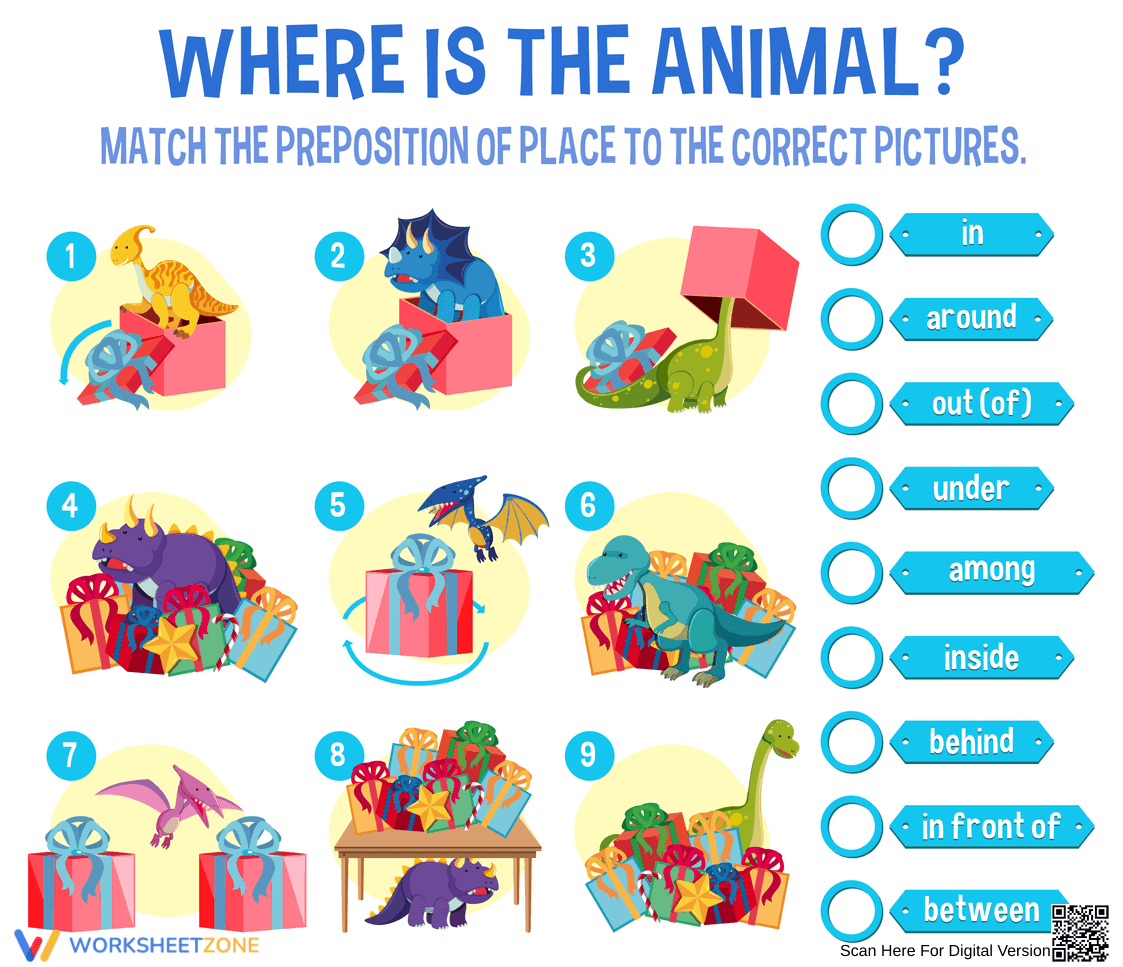

Prepositions of Place Printable | Preschool ELA Worksheet
Paste this activity's link or code into your existing LMS (Google Classroom, Canvas, Teams, Schoology, Moodle, etc.).
Students can open and work on the activity right away, with no student login required.
You'll still be able to track student progress and results from your teacher account.
This preschool English Language Arts worksheet helps early learners master spatial relationships by matching prepositions of place to visual cues. Students observe colorful dinosaur illustrations and connect them to the correct positional words, building foundational vocabulary and reading comprehension skills essential for early literacy development.
At a Glance
- Grade: Preschool · Subject: ELA
- Standard:
CCSS.ELA-LITERACY.L.K.1.E— Use frequently occurring prepositions- Skill Focus: Prepositions of Place
- Format: 1 page · 9 problems · Answer key included · PDF
- Best For: Independent practice and centers
- Time: 10–15 minutes
This single-page resource features nine distinct matching tasks. Each problem presents a vibrant illustration of a dinosaur interacting with a gift box, demonstrating a specific spatial concept. Students draw lines to connect these images with a word bank of nine prepositions, including terms like "under," "behind," and "between." A complete answer key is provided to ensure accurate grading and immediate feedback.
This resource is designed for immediate classroom implementation with a streamlined workflow:
- Print (1 minute): Generate copies of the single-page PDF for the entire class.
- Distribute (1 minute): Hand out the worksheets along with pencils or crayons.
- Review (3 minutes): Briefly explain the matching instructions and read the preposition word bank aloud for non-readers.
Total teacher preparation requires under two minutes, making this an excellent option for morning work, literacy centers, or emergency substitute plans.
This worksheet aligns with CCSS.ELA-LITERACY.L.K.1.E, requiring students to use the most frequently occurring prepositions. It also supports early visual discrimination and vocabulary acquisition. Both standard codes can be copied directly into lesson plans, IEP goals, or district curriculum mapping tools.
Deploy this worksheet during small group literacy centers after a direct instruction lesson on positional words. Teachers can use physical objects, like a toy dinosaur and a box, to demonstrate the concepts before assigning the page. As a formative assessment tip, observe whether students can verbally describe the dinosaur's location before they draw the matching line. Expected completion time ranges from 10 to 15 minutes depending on the child's reading level.
This activity is primarily designed for preschool and kindergarten students developing foundational language skills. It serves as an effective intervention tool for first graders needing a review of basic spatial vocabulary. English Language Learners (ELLs) will benefit significantly from the clear visual supports paired with the text. Pair this worksheet with a read-aloud book focused on prepositions or a classroom anchor chart illustrating positional words.
Mastering spatial vocabulary is a critical milestone in early childhood education. This resource targets CCSS.ELA-LITERACY.L.K.1.E, focusing on the ability to use frequently occurring prepositions. According to Fisher & Frey (2014), explicit vocabulary instruction paired with strong visual representations significantly improves retention and comprehension in young learners. By connecting abstract positional words to concrete, engaging illustrations of dinosaurs, this worksheet bridges the gap between oral language and early reading skills. Students who confidently understand spatial relationships are better equipped to follow complex multi-step directions and decode descriptive texts as they progress through primary grades. This targeted practice ensures that foundational grammar concepts are solidified through active, visually supported matching tasks, providing educators with a reliable, evidence-based tool for measuring early language acquisition and supporting long-term academic success.


