


























Views
Downloads

What is a Friend? Worksheet | Grade K Essential Guide
Paste this activity's link or code into your existing LMS (Google Classroom, Canvas, Teams, Schoology, Moodle, etc.).
Students can open and work on the activity right away, with no student login required.
You'll still be able to track student progress and results from your teacher account.
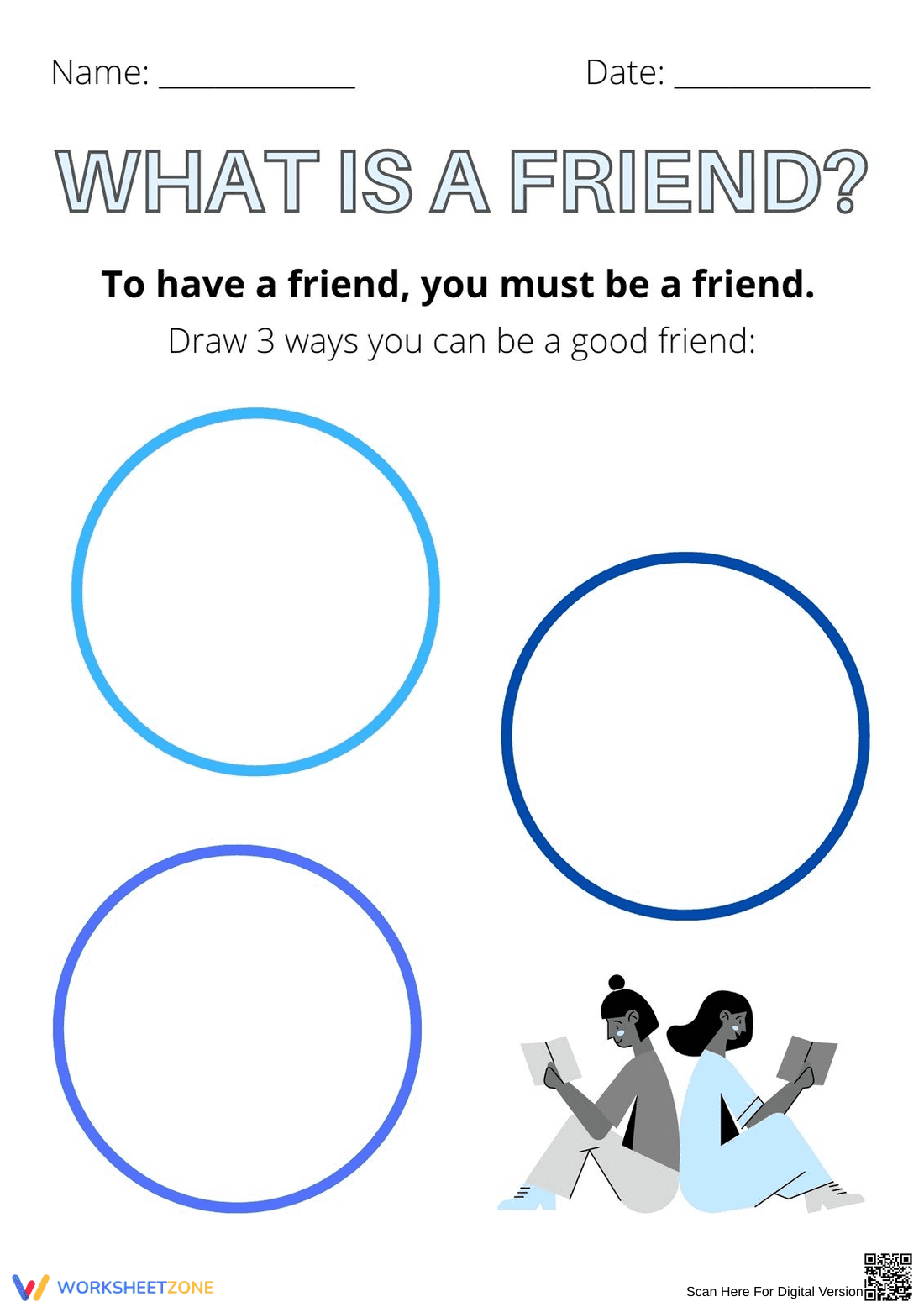
This Grade K social-emotional learning worksheet helps young learners define positive social interactions by identifying specific friendly behaviors. By asking students to visualize and draw three distinct ways to be a good friend, the activity reinforces the reciprocal nature of healthy relationships and builds foundational interpersonal skills essential for a positive classroom environment.
At a Glance
- Grade: K · Subject: Social Emotional Learning
- Standard:
CCSS.ELA-LITERACY.SL.K.1— Participate in collaborative conversations with diverse partners about kindergarten topics- Skill Focus: Friendship and Social Skills
- Format: 1 page · 3 problems · Answer key included · PDF
- Best For: Morning meeting or social skills lesson
- Time: 10–15 minutes
Inside this single-page PDF, you will find a clean, student-friendly layout featuring a central prompt and three large circular frames for drawing. The worksheet includes a motivational quote to anchor the lesson and clear instructions that minimize teacher explanation. The visual format is specifically designed for pre-writers and early learners to express complex social concepts through illustration.
This resource is designed for a zero-prep workflow. First, print the single-page PDF in about 30 seconds. Next, distribute the sheets to students during a morning meeting or SEL block which takes roughly 1 minute. Finally, review the drawings as a group to share ideas for 5 to 10 minutes. Total teacher preparation time is under 2 minutes, making it an ideal sub-plan or transition activity.
This activity aligns with CCSS.ELA-LITERACY.SL.K.1, focusing on the ability to follow agreed-upon rules for discussions and continue a conversation through multiple exchanges. While primarily an SEL tool, it supports the oral language development required by the standard. Both standard codes can be copied directly into lesson plans, IEP goals, or district curriculum mapping tools.
Use this worksheet as a follow-up to a read-aloud about kindness or during a dedicated "Friendship Week" unit. It serves as an excellent formative assessment to observe which students can identify prosocial behaviors versus those who may need more direct social coaching. Expect completion in 10 to 15 minutes depending on the detail of the drawings.
This resource is perfect for Kindergarten and early Grade 1 students, including those with developmental delays or English Language Learners who benefit from non-verbal expression. It pairs naturally with a "Kindness Jar" activity or an anchor chart listing "Friendly Words" to provide additional vocabulary support during the drawing process.
According to the RAND AIRS 2024 report, integrating social-emotional learning into early childhood curriculum significantly improves long-term academic outcomes and classroom management. This worksheet addresses the core competency of relationship skills by prompting students to reflect on their own actions as a friend. By utilizing the CCSS.ELA-LITERACY.SL.K.1 framework, educators can bridge the gap between social development and communicative standards. Research from Fisher & Frey (2014) emphasizes that visual representation, such as drawing, allows younger students to process abstract concepts like "friendship" before they have the linguistic complexity to write about them. This 1-page printable provides a structured yet open-ended environment for students to demonstrate their understanding of social reciprocity. It is a practical tool for teachers seeking to foster a culture of empathy and cooperation within their primary grade classrooms while meeting essential developmental milestones.


