




























Views
Downloads

Wetland Bird Life Cycle Worksheet | Grade 3 Essential

Paste this activity's link or code into your existing LMS (Google Classroom, Canvas, Teams, Schoology, Moodle, etc.).
Students can open and work on the activity right away, with no student login required.
You'll still be able to track student progress and results from your teacher account.
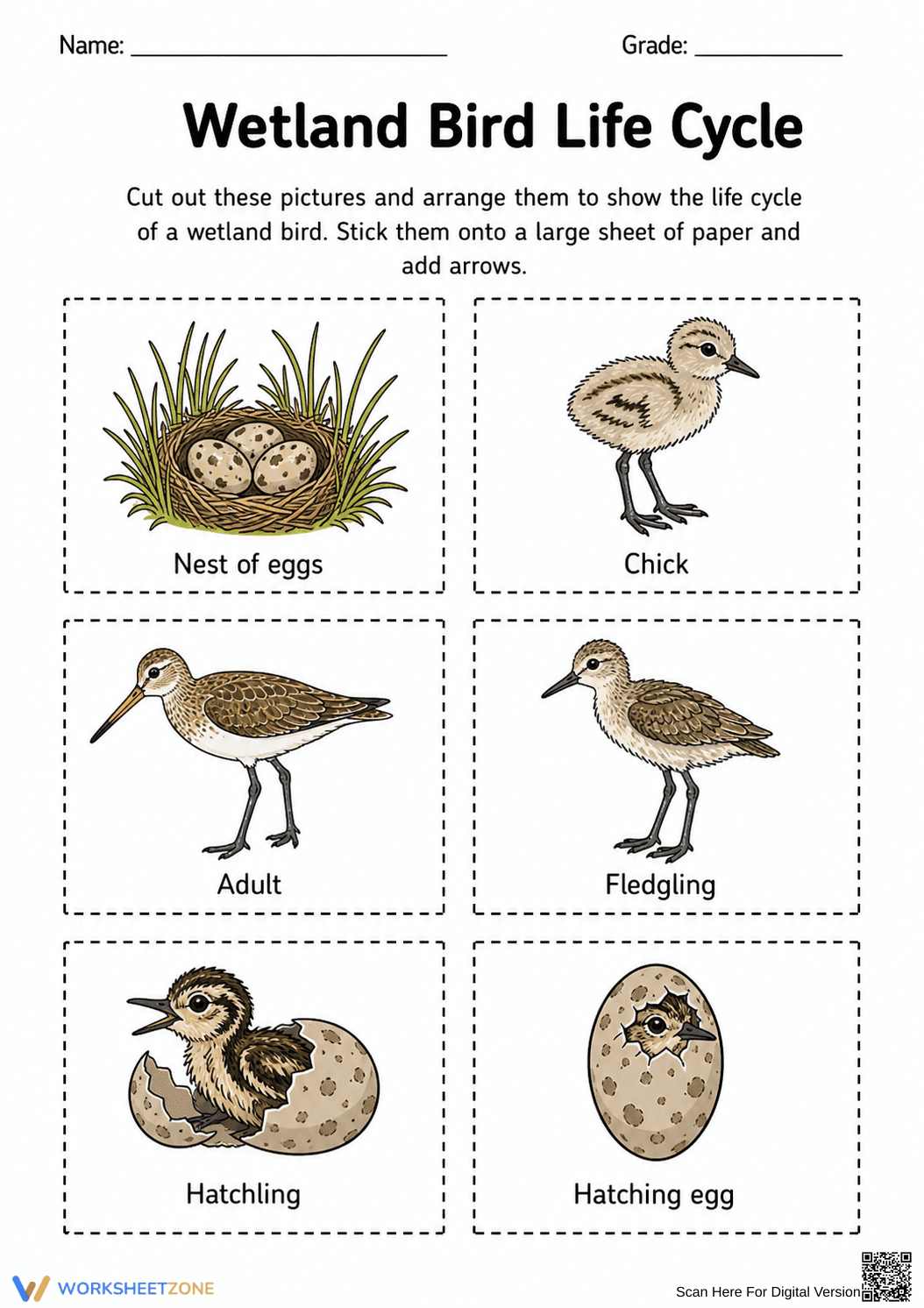
This Grade 3 bird life cycle worksheet provides a hands-on sequencing task where students identify and order the developmental stages of a wetland bird. By physically manipulating the stages from egg to adult, learners internalize biological progression and ecological concepts. It transforms abstract scientific cycles into a concrete, visual learning experience.
At a Glance
- Grade: 3 · Subject: Science
- Standard:
3-LS1-1— Develop models to describe that organisms have unique and diverse life cycles- Skill Focus: Biological sequencing and modeling
- Format: 1 page · 6 tasks · Answer key included · PDF
- Best For: Science centers and formative assessment
- Time: 15–20 minutes
The resource features a single-page layout containing six high-quality illustrations of a wetland bird's life stages. Students work with images of a nest of eggs, a hatching egg, a hatchling, a chick, a fledgling, and an adult. The worksheet includes clear dotted lines for cutting and a dedicated space for student identification. A teacher answer key is provided to ensure accurate sequencing of the six distinct phases.
This activity follows a zero-prep workflow designed for busy educators. First, print the single-page PDF for your class (1 minute). Second, distribute the sheets along with scissors and glue (1 minute). Third, review the completed cycles as a whole group or through peer-checking (5 minutes). The total teacher preparation time is under 2 minutes, making it an ideal choice for emergency sub plans or last-minute science block additions.
The primary alignment is `3-LS1-1`, which requires students to develop models to describe that organisms have unique and diverse life cycles but all have in common birth, growth, reproduction, and death. This activity specifically addresses the growth and development phases. This standard code can be copied directly into lesson plans, IEP goals, or district curriculum mapping tools.
Use this worksheet during the "Explore" phase of a 5E lesson model to allow students to discover the order of bird development before formal instruction. Alternatively, assign it as a formative assessment after a lesson on avian biology to check for understanding of the fledgling and hatchling distinctions. Expected completion time ranges from 15 to 20 minutes depending on fine motor speed.
This resource is designed for elementary students in grades 1-3, particularly those requiring visual and tactile supports to understand temporal sequences. It pairs naturally with a non-fiction passage about wetland habitats or an anchor chart detailing bird anatomy. It is also highly effective for English Language Learners who benefit from the clear image-to-label associations.
Research from Fisher & Frey (2014) emphasizes that physical manipulation of content, such as cut-and-paste sequencing, significantly improves the retention of complex biological processes in early elementary learners. By engaging in the 3-LS1-1 standard through a tactile model, students move beyond rote memorization of the bird life cycle into active cognitive processing. This worksheet provides the necessary scaffolding to bridge the gap between observing nature and modeling scientific phenomena. According to the NAEP science framework, the ability to sequence life stages is a foundational skill that predicts later success in understanding more complex ecological systems. This 6-task activity ensures that students master the specific terminology of avian development, including the critical distinctions between hatchlings and fledglings, within a structured and time-efficient classroom framework.


