




























Views
Downloads

Wetland Bird Life Cycle Worksheet | Grade 3 Essential

Paste this activity's link or code into your existing LMS (Google Classroom, Canvas, Teams, Schoology, Moodle, etc.).
Students can open and work on the activity right away, with no student login required.
You'll still be able to track student progress and results from your teacher account.
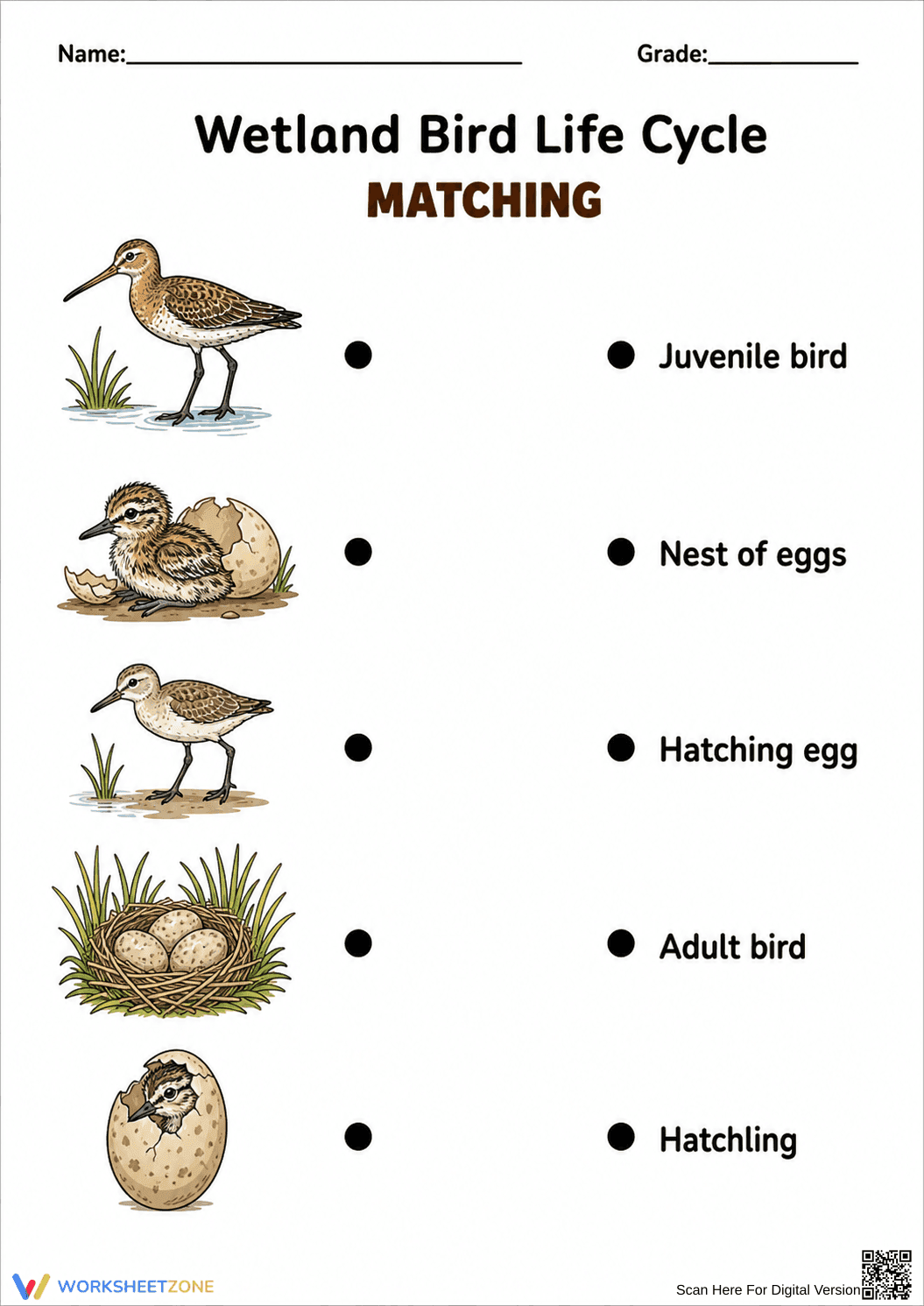
This Wetland Bird Life Cycle worksheet helps students master the biological stages of avian development through visual identification. By connecting detailed illustrations with scientific terminology, learners build a concrete understanding of how organisms grow and change over time. It provides a clear, structured way to assess foundational life science concepts.
At a Glance
- Grade: 3 · Subject: Science
- Standard:
3-LS1-1— Develop models to describe that organisms have unique and diverse life cycles- Skill Focus: Life cycle stage identification
- Format: 1 page · 5 problems · Answer key included · PDF
- Best For: Quick formative assessment or science centers
- Time: 10–15 minutes
The worksheet features five high-quality illustrations depicting a wetland bird from egg to adulthood. Students are presented with a single-page layout containing a column of images and a column of vocabulary terms including "Juvenile bird," "Nest of eggs," and "Hatchling." The clear formatting ensures that young learners can focus entirely on the scientific content without visual distraction.
Zero-Prep Workflow
- Print: Open the PDF and print enough copies for your class in under 30 seconds.
- Distribute: Hand out the single-page activity to students for immediate engagement.
- Review: Use the included answer key to check for understanding in a 5-minute group review.
Total teacher preparation time is under two minutes, making it an ideal choice for emergency sub plans or transition periods.
Standards Alignment
This activity aligns with 3-LS1-1, which requires students to develop models to describe that organisms have unique and diverse life cycles but all have in common birth, growth, reproduction, and death. It also supports ELA standard CCSS.ELA-LITERACY.L.3.6 by reinforcing domain-specific vocabulary. Both standard codes can be copied directly into lesson plans, IEP goals, or district curriculum mapping tools.
How to Use It
Use this worksheet as a "hook" at the start of a unit on animal adaptations or as an exit ticket following a lesson on wetlands. For a formative assessment, observe if students can distinguish between the "hatchling" and "juvenile" stages, as this indicates a deeper understanding of growth patterns. Completion typically takes 10 to 15 minutes.
Who It's For
This resource is perfect for third-grade students exploring life sciences, though it remains accessible for second-grade enrichment. It serves English Language Learners well through its heavy reliance on visual cues. Pair this activity with a wetland bird observation video or a non-fiction passage about herons or sandpipers to provide additional context.
According to the RAND AIRS 2024 report on elementary science instruction, visual-to-text matching activities significantly improve the retention of domain-specific vocabulary in early learners. This worksheet addresses the 3-LS1-1 standard by providing a clear model of avian development, allowing students to visualize the progression from a nest of eggs to a fully grown adult bird. Research from Fisher & Frey (2014) suggests that such scaffolds are vital for moving students toward independent mastery of complex biological systems. By isolating the stages of a wetland bird's life cycle, the activity reduces cognitive load while reinforcing the concept that all organisms undergo distinct phases of growth. This printable resource offers a reliable method for teachers to verify student comprehension of life cycle sequences before moving on to more complex comparative biology topics in the upper elementary grades.


