


























Views
Downloads
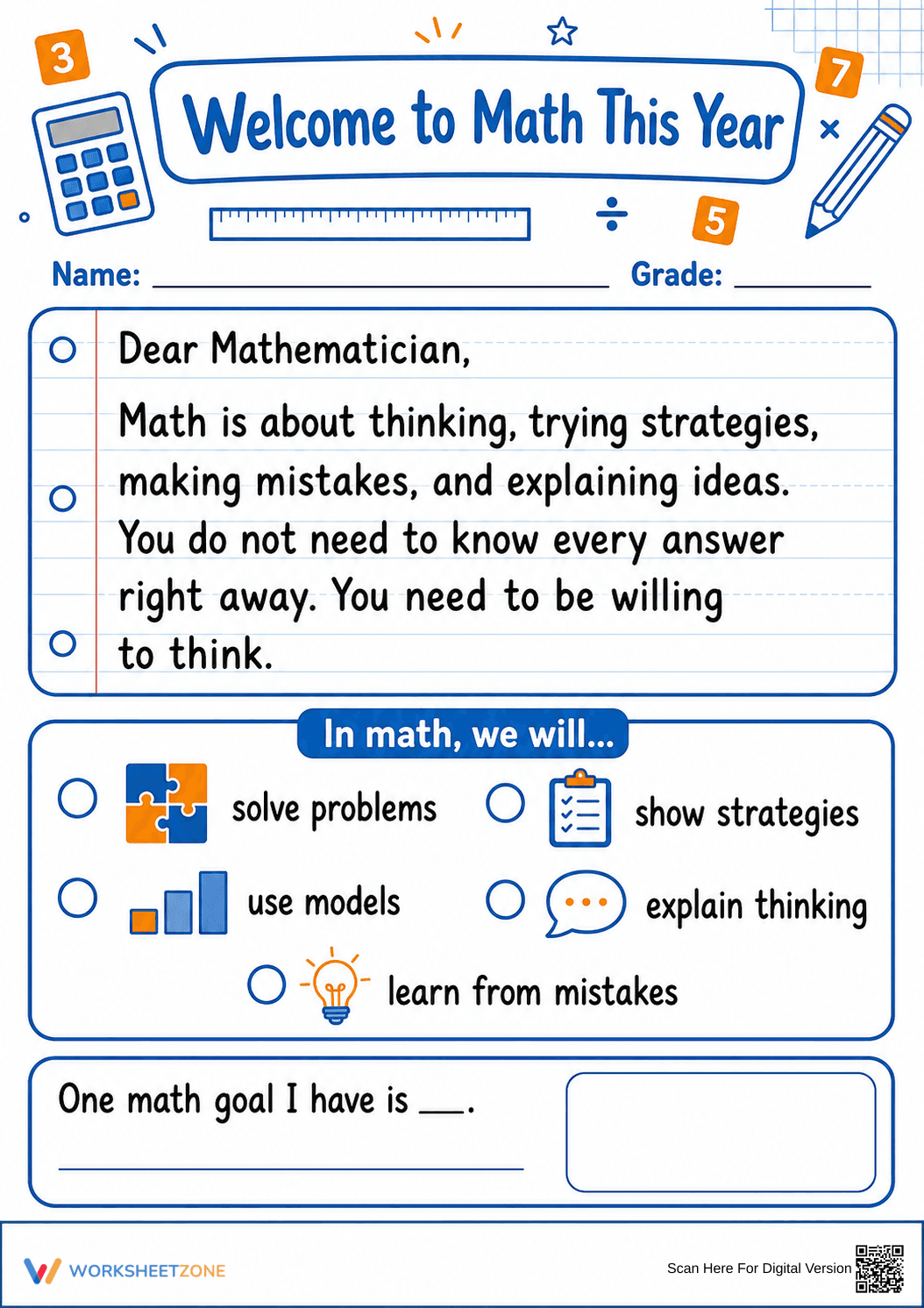

Welcome to Math This Year | Essential Grade 3-6 Letter
Paste this activity's link or code into your existing LMS (Google Classroom, Canvas, Teams, Schoology, Moodle, etc.).
Students can open and work on the activity right away, with no student login required.
You'll still be able to track student progress and results from your teacher account.
Establish a positive mathematical culture with this welcome letter. This resource shifts student focus from rote calculation to conceptual thinking, helping learners embrace mistakes as essential steps. By setting clear expectations and personal goals, students begin the year with the mindset required for rigorous mathematical exploration.
At a Glance
At a Glance
- Grade: 4 · Subject: Math
- Standard:
CCSS.MATH.PRACTICE.MP1— Students persevere through multi-step problems and develop strategies to find solutions independently- Skill Focus: Mathematical Mindset & Goal Setting
- Format: 1 page · 1 task · No answer key needed · PDF
- Best For: First day of school introduction
- Time: 10–15 minutes
What's Inside
This resource features a designed letter emphasizing persistence. It includes a header, a message about mathematics, and a checklist of five expectations: solving problems, showing strategies, using models, explaining thinking, and learning from mistakes. A student response section allows for personal goal setting.
Zero-Prep Workflow
The zero-prep design of this worksheet ensures that teachers can establish a positive classroom culture in under 2 minutes of preparation. Step 1: Print the single-page PDF for each student in your class. Step 2: Distribute the letter during the first week of school as a quiet reflection activity or a guided reading task. Step 3: Review the five core expectations as a group to build a shared language for mathematical inquiry and perseverance throughout the year.
Standards Alignment
This worksheet is primarily aligned with `CCSS.MATH.PRACTICE.MP1`, which requires students to make sense of problems and persevere in solving them. By framing math as a process of thinking, trying strategies, and making mistakes, the resource directly supports the development of mathematical habits of mind. This standard code can be copied directly into lesson plans, IEP goals, or district curriculum mapping tools.
How to Use It
Assign this worksheet during the first day of school to set a constructive tone for the upcoming curriculum. It serves as an excellent formative assessment tool; observe which goals students set to identify their initial comfort levels with the subject. The activity typically takes 10 to 15 minutes to complete. Once finished, students can glue the letter into the front of their math journals as a permanent reminder of classroom values.
Who It's For
This resource is designed for students in Grades 3 through 6 who are transitioning into more complex mathematical concepts. It is particularly effective for students with math anxiety or those who benefit from explicit social-emotional support in academic settings. Pair this letter with a growth mindset anchor chart or a direct instruction lesson on mathematical modeling for maximum impact.
The integration of growth mindset principles within the mathematics classroom is a critical factor in developing student agency and long-term academic success. According to Fisher & Frey (2014), establishing clear expectations and a culture that values the process of thinking over the speed of calculation allows students to engage more deeply with complex tasks. This worksheet aligns with CCSS.MATH.PRACTICE.MP1 by encouraging students to make sense of problems and persevere through challenges rather than seeking immediate answers. By explicitly stating that mistakes are part of the learning process, teachers can reduce math anxiety and foster a classroom environment where students feel safe to explain their thinking and use various models. Research indicates that when students set personal goals and understand the 'why' behind their mathematical practices, they are more likely to adopt the persistent behaviors necessary for mastery in upper elementary and middle school mathematics curricula.


