




























Views
Downloads

"We Grow Together" Printable Poster | Grade K-6 SEL

Paste this activity's link or code into your existing LMS (Google Classroom, Canvas, Teams, Schoology, Moodle, etc.).
Students can open and work on the activity right away, with no student login required.
You'll still be able to track student progress and results from your teacher account.
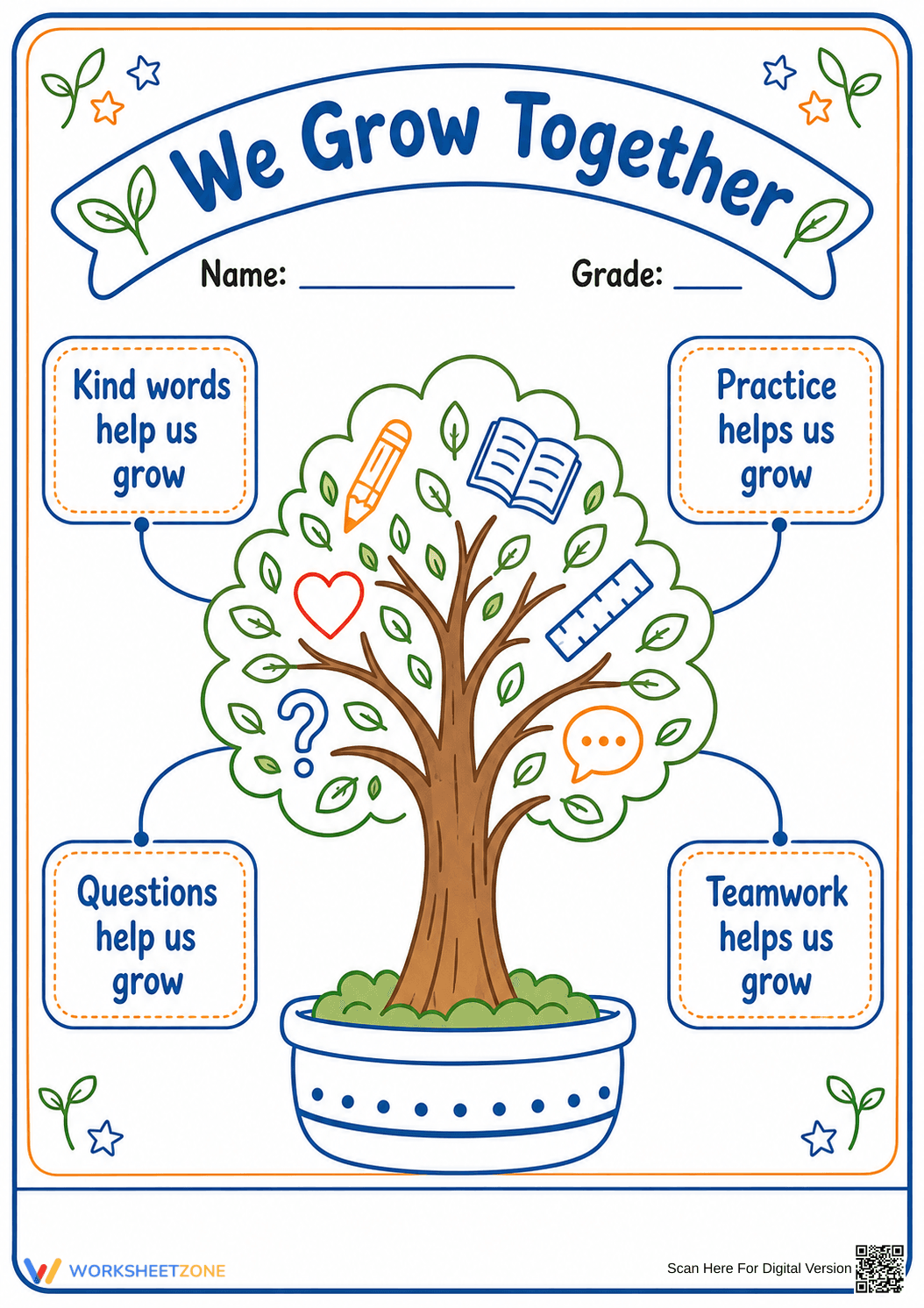
This Grade K-6 growth mindset poster establishes a positive classroom culture by highlighting four essential behaviors for student success. By visualizing growth through a central tree motif, students connect abstract concepts like teamwork and practice to tangible personal development. It serves as a visual anchor for daily social-emotional learning and collaborative discussions.
At a Glance
- Grade: K-6 · Subject: Social Emotional Learning
- Standard:
CCSS.ELA-LITERACY.SL.K.1— Participate in collaborative conversations with diverse partners about classroom topics- Skill Focus: Growth Mindset & Classroom Culture
- Format: 1 page · Visual Anchor · No answer key needed · PDF
- Best For: Classroom decor and morning meeting discussion
- Time: 5–10 minutes
This single-page PDF features a high-contrast, clean design centered around a "Growth Tree" in a planter. The visual includes six school-themed icons—a pencil, book, ruler, heart, question mark, and speech bubble—representing the multifaceted nature of learning. Four distinct message tabs are connected to the tree, providing clear, readable text for young learners. The layout includes a name and grade line, allowing it to be used as an individual reflection sheet or a large-scale classroom poster.
The zero-prep workflow for this resource is designed for immediate implementation. First, print the document on standard A4 paper or scale it up for a large-format poster (1 minute). Second, distribute to students for individual coloring and reflection or display it in a prominent meeting area (1 minute). Third, review the four key phrases during a morning meeting to set the tone for the day (5 minutes). Total teacher preparation time is under 2 minutes, making it an ideal sub-plan addition.
This resource aligns with CCSS.ELA-LITERACY.SL.K.1, which focuses on participating in collaborative conversations about classroom topics and following agreed-upon rules for discussion. By providing a shared vocabulary for "growth," the poster facilitates structured peer-to-peer interactions. This standard code can be copied directly into lesson plans, IEP goals, or district curriculum mapping tools to document social-emotional support strategies.
Use this poster during the first week of school to establish community norms. Ask students to point to the "Teamwork" tab and share one way they helped a peer. Alternatively, use it as a formative assessment tool by observing which students reference the "Questions help us grow" prompt when they feel stuck during independent work. It is best used during direct instruction on character building or as a permanent visual reference in a high-traffic classroom area.
This resource is ideal for general education teachers in Grades K-6, school counselors, and special education providers looking for visual supports. It is particularly effective for English Language Learners (ELLs) due to the clear icon-to-text associations. Pair this poster with a growth mindset picture book or a goal-setting anchor chart to create a comprehensive social-emotional learning unit that supports all learners.
According to the RAND AIRS 2024 report on social-emotional learning, visual environmental cues in the classroom significantly improve student self-regulation and help internalize positive behavioral norms. This "We Grow Together" resource utilizes the CCSS.ELA-LITERACY.SL.K.1 framework to encourage collaborative dialogue and a growth mindset. By explicitly labeling behaviors such as asking questions and using kind words as "growth," the worksheet provides a scaffold for students to transition from fixed to growth mindsets. Research indicates that consistent exposure to these visual anchors reduces classroom anxiety and increases student engagement in collaborative tasks. The clear, flat vector design ensures that the message remains accessible to students with diverse visual processing needs, making it a versatile tool for inclusive classrooms. This summary is supported by evidence-based practices in classroom management and early childhood development.


