


























Views
Plays

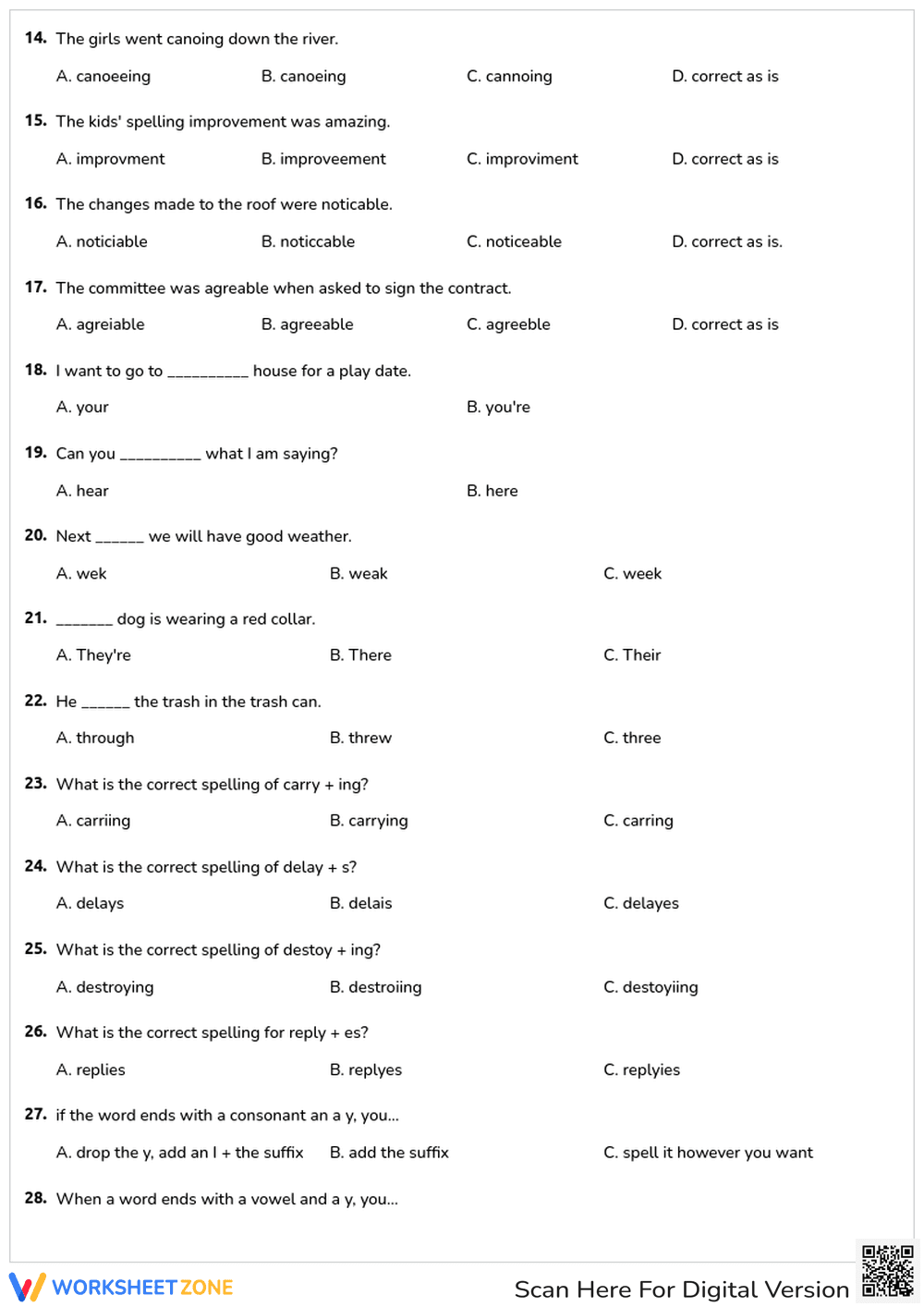


Spelling Patterns Worksheet | Grade 3 English Printable
Paste this activity's link or code into your existing LMS (Google Classroom, Canvas, Teams, Schoology, Moodle, etc.).
Students can open and work on the activity right away, with no student login required.
You'll still be able to track student progress and results from your teacher account.
This spelling patterns worksheet provides targeted practice for students mastering suffixes, the drop "e" rule, and homophones. By working through these multiple-choice questions, learners solidify their understanding of foundational spelling rules, ensuring they can accurately modify base words in their writing.
At a Glance
- Grade: 3 · Subject: English
- Standard:
CCSS.ELA-LITERACY.L.3.2.E— Use conventional spelling for adding suffixes to base words- Skill Focus: Spelling patterns and suffixes
- Format: 3 pages · 30 problems · Answer key included · PDF
- Best For: Independent practice and assessment
- Time: 20–30 minutes
Inside this resource, educators will find a 30-question multiple-choice assessment spanning three pages. Tasks are divided into distinct spelling challenges, including adding "-ed" and "-ing" to base words, identifying correct homophone usage, and applying the drop "e" rule. A complete answer key makes grading fast, while the clear layout helps students focus on spelling mechanics.
This worksheet supports a logical progression of spelling application:
- Guided practice: Initial questions focus on straightforward suffix addition, building confidence with familiar base words.
- Supported practice: Mid-level questions introduce sentence context, requiring learners to choose the correct homophone based on meaning.
- Independent practice: The final section tests explicit knowledge of spelling rules, asking students to articulate steps for modifying words ending in "y".
This gradual-release approach moves students from simple recognition to active rule application.
This material aligns to CCSS.ELA-LITERACY.L.3.2.E, requiring students to use conventional spelling for adding suffixes to base words. It also supports vocabulary acquisition by reinforcing homophones. Both standard codes can be copied directly into lesson plans, IEP goals, or district curriculum mapping tools.
This resource fits perfectly into a weekly spelling routine. Assign the first page as a warm-up before direct instruction on suffix rules to gauge prior knowledge. Alternatively, the full 30-question set serves as an end-of-unit assessment. As a formative-assessment observation tip, monitor which specific rules (like doubling the consonant) cause hesitation, and use that data for small-group review. Expected completion time is 20 to 30 minutes.
Designed primarily for third-grade students developing literacy skills, this serves as excellent review for fourth graders needing reinforcement. For differentiation, reduce the visual load for approaching learners by assigning one page at a time. This pairs perfectly with a classroom anchor chart detailing spelling rules.
Mastering spelling patterns is a critical component of early literacy development. According to Fisher & Frey (2014), explicit instruction and repeated practice with morphological structures significantly improve both reading fluency and writing accuracy in elementary classrooms. When students practice skills aligned to CCSS.ELA-LITERACY.L.3.2.E, they learn to use conventional spelling for adding suffixes to base words, which effectively reduces cognitive load during independent writing tasks. This crucial automaticity allows young writers to focus entirely on content, organization, and creativity rather than struggling with basic word formation. By engaging with structured multiple-choice formats, learners can visually discriminate between correct and incorrect spelling patterns, strongly reinforcing their orthographic mapping. Providing consistent, targeted opportunities to apply these specific rules ensures that foundational spelling mechanics become automatic, ultimately supporting broader reading comprehension and expressive writing capabilities across all academic subjects.


