


























Views
Plays
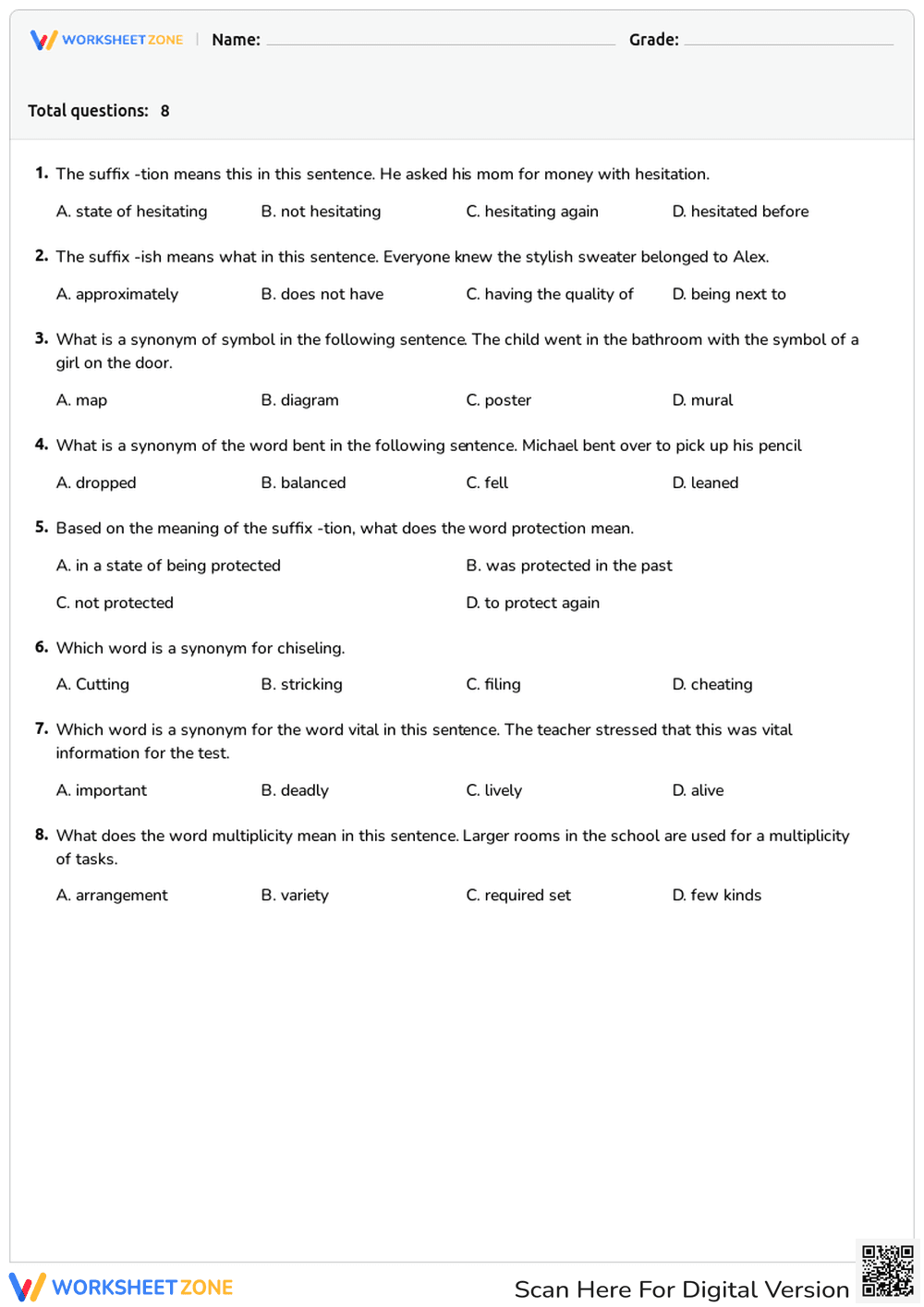

Printable Synonyms & Affixes Quiz | Grade 4 ELA
Paste this activity's link or code into your existing LMS (Google Classroom, Canvas, Teams, Schoology, Moodle, etc.).
Students can open and work on the activity right away, with no student login required.
You'll still be able to track student progress and results from your teacher account.
This Grade 4 vocabulary worksheet provides students with targeted practice identifying synonyms and determining the meaning of words using suffix clues. By analyzing words within sentence contexts, learners strengthen reading comprehension and expand academic vocabulary. This resource delivers immediate, actionable skill reinforcement.
At a Glance
- Grade: 4 · Subject: ELA
- Standard:
CCSS.ELA-LITERACY.L.4.4— Determine word meanings using context and affixes- Skill Focus: Synonyms and Suffixes
- Format: 1 page · 8 problems · Answer key included · PDF
- Best For: Quick formative assessment
- Time: 10–15 minutes
Inside this resource, educators will find a streamlined, single-page multiple-choice quiz featuring eight questions. Students identify the correct meaning of words containing common suffixes like "-tion" and "-ish" based on sentence context. The remaining questions require selecting the most accurate synonym for a target word. A complete answer key ensures rapid grading.
This resource is designed for maximum efficiency. First, print the single-page PDF (under one minute). Second, distribute copies as a warm-up or exit ticket (one minute). Finally, review answers using the included key (five minutes). With total prep time under two minutes, this worksheet is an excellent addition to any emergency sub plan.
This worksheet is directly aligned to primary standard CCSS.ELA-LITERACY.L.4.4, which requires students to determine or clarify the meaning of unknown and multiple-meaning words and phrases based on grade 4 reading and content. It also supports CCSS.ELA-LITERACY.L.4.5.C by having students demonstrate understanding of words by relating them to synonyms. Both standard codes can be copied directly into lesson plans, IEP goals, or district curriculum mapping tools.
Teachers can deploy this worksheet as a brief formative assessment after direct instruction on affixes and synonyms. It serves perfectly as an independent practice activity while the teacher pulls small groups for targeted reading intervention. As an observation tip, monitor students as they read the context sentences; if they struggle to select the correct synonym, prompt them to substitute each multiple-choice option into the original sentence to hear which one makes the most sense. Expected completion time is 10 to 15 minutes.
This resource is primarily designed for fourth-grade students, though it serves as excellent review material for fifth graders or an extension activity for advanced third graders. For students requiring accommodations, teachers can easily cross out one or two incorrect multiple-choice options to reduce visual clutter and cognitive load. This worksheet pairs naturally with a direct instruction lesson on Greek and Latin roots or a shared reading activity focusing on context clues.
Mastering vocabulary through context and morphological analysis is a critical component of reading comprehension. According to a RAND AIRS 2024 report on literacy development, students who receive explicit practice in identifying synonyms and decoding affixes demonstrate significantly higher reading fluency and text comprehension rates compared to peers who only memorize isolated word lists. This worksheet directly supports CCSS.ELA-LITERACY.L.4.4 by requiring students to determine word meanings using context and affixes in structured, sentence-level tasks. By integrating these skills into a brief, focused format, educators can efficiently measure student understanding and adjust subsequent instruction. Regular exposure to multiple-choice formats also builds testing stamina and familiarizes learners with the academic language they will encounter on standardized assessments. This targeted approach ensures that vocabulary acquisition remains an active, analytical process rather than a passive memorization exercise.


