


























Views
Downloads


Two-Digit Multiplication Worksheet | Grade 4 Printable
Paste this activity's link or code into your existing LMS (Google Classroom, Canvas, Teams, Schoology, Moodle, etc.).
Students can open and work on the activity right away, with no student login required.
You'll still be able to track student progress and results from your teacher account.
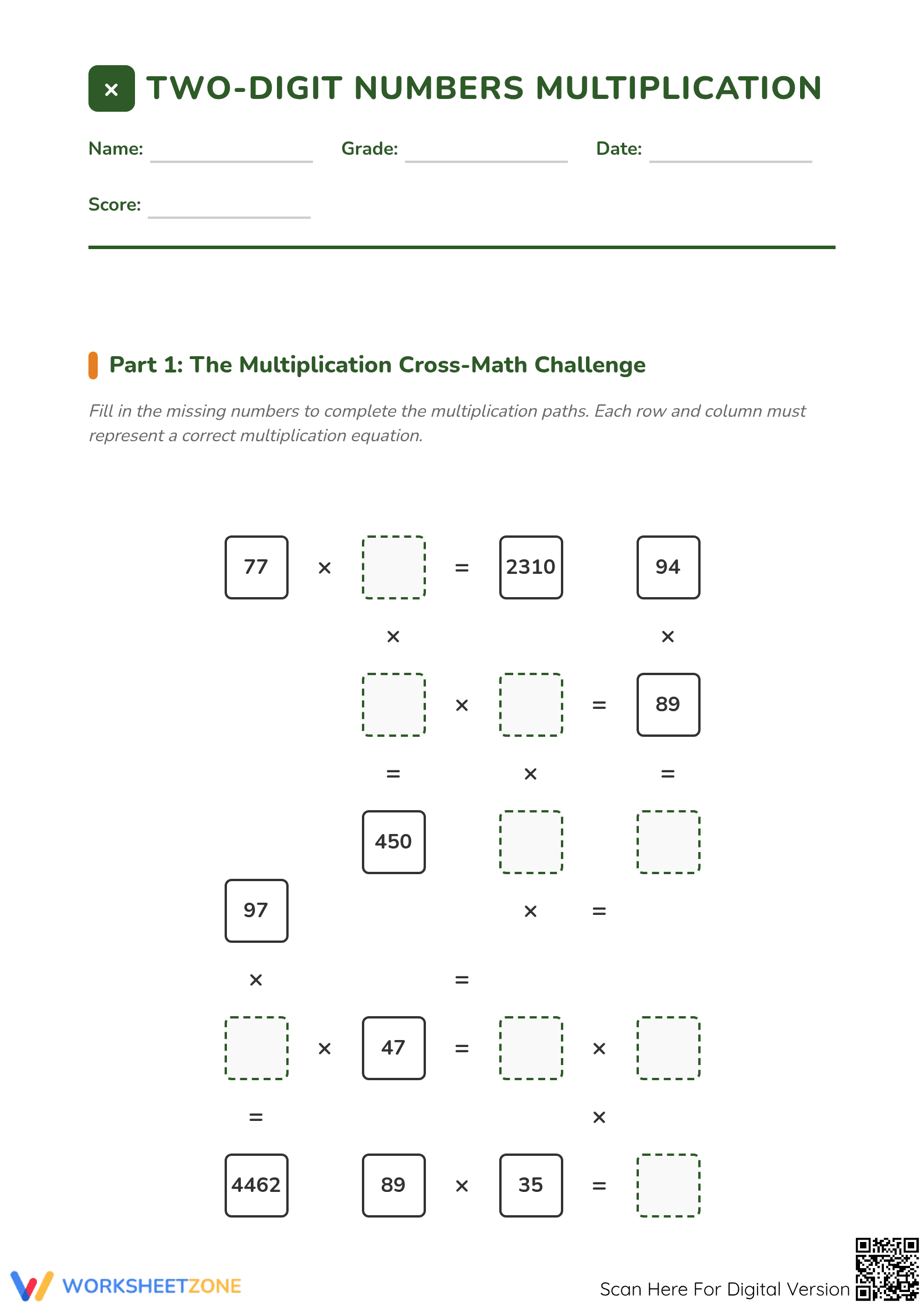
This two-digit multiplication worksheet provides targeted practice to help fourth-grade students master multi-digit arithmetic. By combining a unique cross-math puzzle with standard equations, students develop both computational fluency and logical problem-solving skills. The engaging format keeps learners focused while reinforcing essential place-value strategies required for advanced mathematics.
At a Glance
- Grade: 4 · Subject: Math
- Standard:
CCSS.MATH.CONTENT.4.NBT.B.5— Multiply two two-digit numbers accurately- Skill Focus: Two-Digit Multiplication
- Format: 2 pages · 20 problems · Answer key included · PDF
- Best For: Independent practice and review
- Time: 20–30 minutes
This comprehensive resource features two pages of carefully sequenced math activities. Part one introduces a multiplication cross-math challenge where students fill in missing numbers to complete intersecting equations. Part two transitions into traditional horizontal and vertical practice with nine standard problems. Finally, part three presents an ultimate challenge question to test mastery. A complete answer key is provided for quick grading and self-assessment.
- Guided practice: The cross-math puzzle acts as a scaffolded entry point, allowing students to use intersecting clues to self-correct and verify their two-digit multiplication steps.
- Supported practice: The nine standard horizontal and vertical equations provide straightforward, focused repetition to solidify standard algorithms and partial product strategies.
- Independent practice: The final "Ultimate Challenge" (99 x 99) pushes students to apply their skills independently to the highest possible two-digit values.
This gradual-release approach ensures students build confidence before tackling more complex, unsupported calculations.
This worksheet is directly aligned to CCSS.MATH.CONTENT.4.NBT.B.5, requiring students to multiply two two-digit numbers using strategies based on place value and the properties of operations. It also supports foundational fluency for fifth-grade volume and division standards. Both standard codes can be copied directly into lesson plans, IEP goals, or district curriculum mapping tools.
Deploy this worksheet during independent math centers or as a focused homework assignment after direct instruction on the standard algorithm or area model. For formative assessment, observe how students tackle the cross-math puzzle; if they struggle to find the missing factors, they may need a review of basic multiplication facts or place value concepts. Most students will complete the two pages in 20 to 30 minutes.
This resource is ideal for fourth-grade students mastering multi-digit multiplication, as well as fifth graders needing beginning-of-year review. To differentiate, allow students who need extra support to use grid paper to keep their place values aligned during the standard practice section. It pairs perfectly with an anchor chart demonstrating the box method or partial products.
Mastering the ability to multiply two two-digit numbers accurately is a critical milestone in elementary mathematics, directly supporting later algebraic reasoning. Aligned with CCSS.MATH.CONTENT.4.NBT.B.5, this resource ensures students develop the necessary procedural fluency and conceptual understanding of place value. According to EdReports 2024, instructional materials that provide varied problem types—such as combining logic puzzles with standard algorithmic practice—significantly improve student engagement and long-term retention of complex mathematical operations. By moving from a structured cross-math challenge to independent equations, learners build the cognitive stamina required for multi-step problem solving. This targeted practice helps prevent common calculation errors and solidifies the foundational skills needed for fifth-grade division and fraction work, ensuring a smoother transition to advanced middle school math concepts.


