


























Views
Downloads
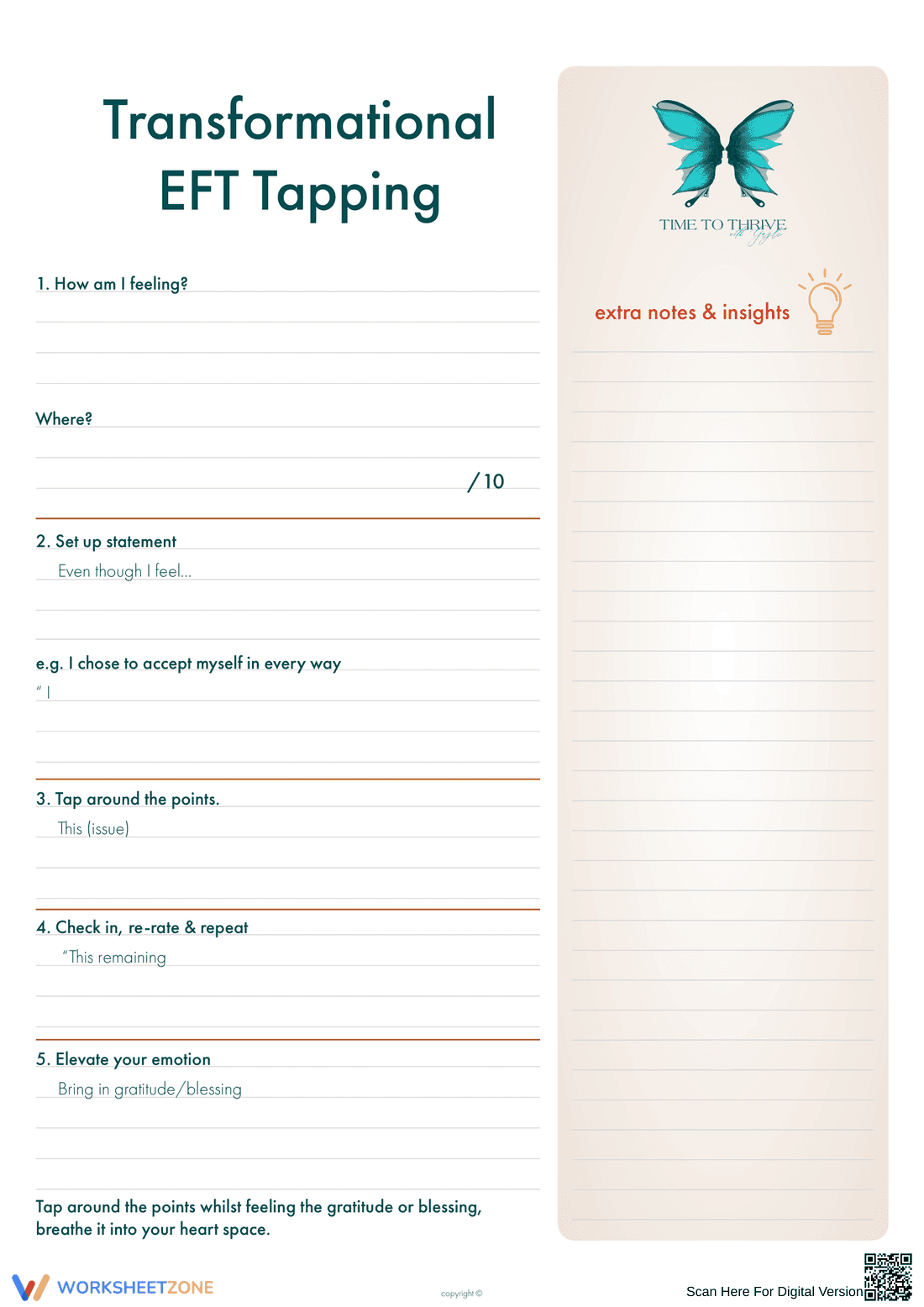

Transformational EFT Tapping | Essential SEL Worksheet
Paste this activity's link or code into your existing LMS (Google Classroom, Canvas, Teams, Schoology, Moodle, etc.).
Students can open and work on the activity right away, with no student login required.
You'll still be able to track student progress and results from your teacher account.
This Transformational EFT Tapping worksheet provides a structured framework for students to manage emotional stress through reflective writing and physical grounding. By identifying feelings and creating set up statements, learners develop self-awareness and self-regulation skills. This resource facilitates a calm classroom environment by giving students a concrete tool for processing complex emotions independently.
At a Glance
- Grade: 3–12 · Subject: English / SEL
- Standard:
CCSS.ELA-LITERACY.W.3.10— Write routinely for a range of tasks, purposes, and audiences- Skill Focus: Emotional regulation and reflective writing
- Format: 1 page · 5 tasks · No answer key · PDF
- Best For: Individual reflection and emotional cool-down
- Time: 10–15 minutes
The worksheet features a clean, intuitive layout divided into five distinct phases of the Emotional Freedom Technique (EFT). Students begin by identifying their current emotional state and rating its intensity on a scale of 1 to 10. The page includes specific prompts for set up statements and tapping points, alongside a dedicated sidebar for extra notes and insights. This single-page PDF is designed for immediate use without complex instructions.
This resource is optimized for a zero-prep workflow. First, print the single-page PDF (30 seconds). Second, distribute the worksheet to students during a transition period or as part of a dedicated SEL block (1 minute). Third, allow students to work through the five steps at their own pace, using the sidebar to capture personal breakthroughs (10 minutes). This streamlined process ensures that emotional support is always available without adding to teacher workload.
This resource aligns with CCSS.ELA-LITERACY.W.3.10, which requires students to write routinely over extended time frames for a range of discipline-specific tasks, purposes, and audiences. By engaging in this reflective writing exercise, students practice articulating internal states and intentions. Both standard codes can be copied directly into lesson plans, IEP goals, or district curriculum mapping tools to document social-emotional learning integration within the ELA framework.
Use this worksheet as a formative assessment tool during morning meetings to gauge the emotional temperature of the classroom. Observe which students struggle to articulate their set up statements to identify those needing additional one-on-one support. Alternatively, place copies in a cool-down corner for students to access autonomously when they feel overwhelmed. This provides a structured way for students to return to a state of readiness for learning.
This activity is designed for students in grades 3 through 12 who require support with emotional regulation or anxiety management. It is particularly effective for neurodivergent learners who benefit from structured, step-by-step processing. Pair this worksheet with a visual anchor chart demonstrating the physical tapping points or a short direct instruction lesson on mindfulness techniques to maximize its impact on student well-being.
The Transformational EFT Tapping worksheet addresses the critical need for self-regulation tools within the academic environment, aligning with CCSS.ELA-LITERACY.W.3.10. Research by Fisher & Frey (2014) emphasizes that metacognitive strategies, including reflective writing and self-monitoring, are essential for student agency and long-term academic success. By requiring students to identify emotional triggers and re-rate their intensity, this worksheet utilizes a gradual release of responsibility toward emotional self-management. The inclusion of a 1-to-10 rating scale provides quantitative data that can be used to track progress in emotional literacy over time. This evidence-based approach ensures that the 5-step process is not merely a distraction but a purposeful intervention. Educators can confidently integrate this tool into their curriculum, knowing it supports the development of the whole child while meeting literacy standards for routine, purposeful writing across various contexts and emotional landscapes.


