


























Views
Downloads

Letter D Tracing Worksheet | Essential Grade K Ready
Paste this activity's link or code into your existing LMS (Google Classroom, Canvas, Teams, Schoology, Moodle, etc.).
Students can open and work on the activity right away, with no student login required.
You'll still be able to track student progress and results from your teacher account.
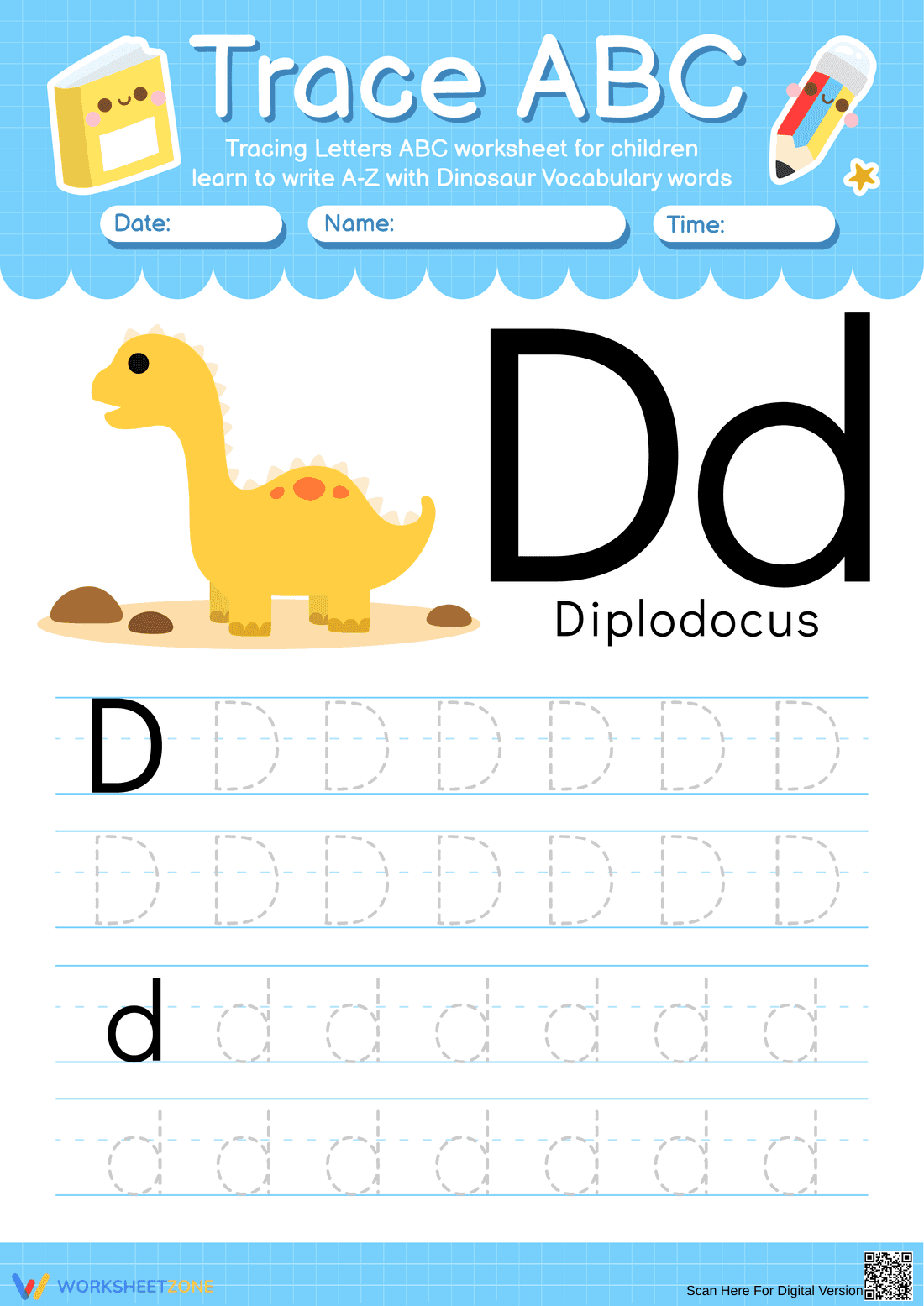
This Kindergarten letter D tracing worksheet helps young learners master uppercase and lowercase letter formation through repetitive, guided practice. By following dotted paths, students build the fine motor control necessary for legible handwriting. The engaging Diplodocus theme connects phonics with visual cues, ensuring students recognize the letter shape and its associated sound effectively.
At a Glance
- Grade: Kindergarten · Subject: Handwriting
- Standard:
CCSS.ELA-LITERACY.L.K.1.A— Print many upper- and lowercase letters- Skill Focus: Letter D formation
- Format: 1 page · 28 problems · Answer key not required · PDF
- Best For: Morning work or literacy centers
- Time: 10–15 minutes
What's Inside
The worksheet features a single-page layout dedicated to the letter D. It includes a large visual reference of the letter, a "Diplodocus" vocabulary anchor, and four rows of tracing practice. Two rows focus on uppercase "D" while the remaining two rows target lowercase "d," providing 28 total tracing opportunities. The clean design uses standard primary lines to support proper letter height and placement.
Zero-Prep Workflow
- Print: Select the PDF and print enough copies for your class (30 seconds).
- Distribute: Hand out the sheets during morning arrival or literacy center rotations (1 minute).
- Review: Circulate to check for proper pencil grip and stroke direction as students work (1 minute).
Total teacher preparation time is under two minutes, making it an ideal choice for emergency sub plans or daily warm-ups.
Standards Alignment
This resource aligns with `CCSS.ELA-LITERACY.L.K.1.A`, which requires students to print many upper- and lowercase letters. By providing structured paths for both cases of the letter D, the worksheet ensures students meet foundational conventions of standard English. Both standard codes can be copied directly into lesson plans, IEP goals, or district curriculum mapping tools.
How to Use It
Use this worksheet during the "You Do" phase of a handwriting lesson after demonstrating the correct stroke order on the board. It serves as an excellent formative assessment tool; observe students to ensure they start at the top line rather than the bottom. Completion typically takes 10 to 15 minutes depending on the student's fine motor development.
Who It's For
This activity is designed for preschool, kindergarten, and first-grade students who are developing letter recognition and manual dexterity. It is particularly helpful for students requiring extra support with spatial awareness on lined paper. Pair this worksheet with a letter D phonics song or a dinosaur-themed picture book to reinforce the "d" sound.
Handwriting instruction remains a cornerstone of early literacy, as evidenced by the Fisher & Frey (2014) framework for gradual release of responsibility. This worksheet facilitates the transition from guided to independent practice by providing 28 specific tracing tasks for the letter D. According to the RAND AIRS 2024 report, consistent fine motor engagement in early childhood is strongly correlated with later reading fluency and written expression. By targeting CCSS.ELA-LITERACY.L.K.1.A, this resource ensures that students develop the muscle memory required for automaticity in writing. The inclusion of both uppercase and lowercase forms allows for comprehensive skill acquisition within a single instructional session. Educators can utilize this structured approach to document progress toward foundational literacy benchmarks, ensuring that every child achieves the necessary precision for standard English conventions. This evidence-based design supports diverse learners in mastering the specific geometry of the letter D.


