


























Views
Downloads
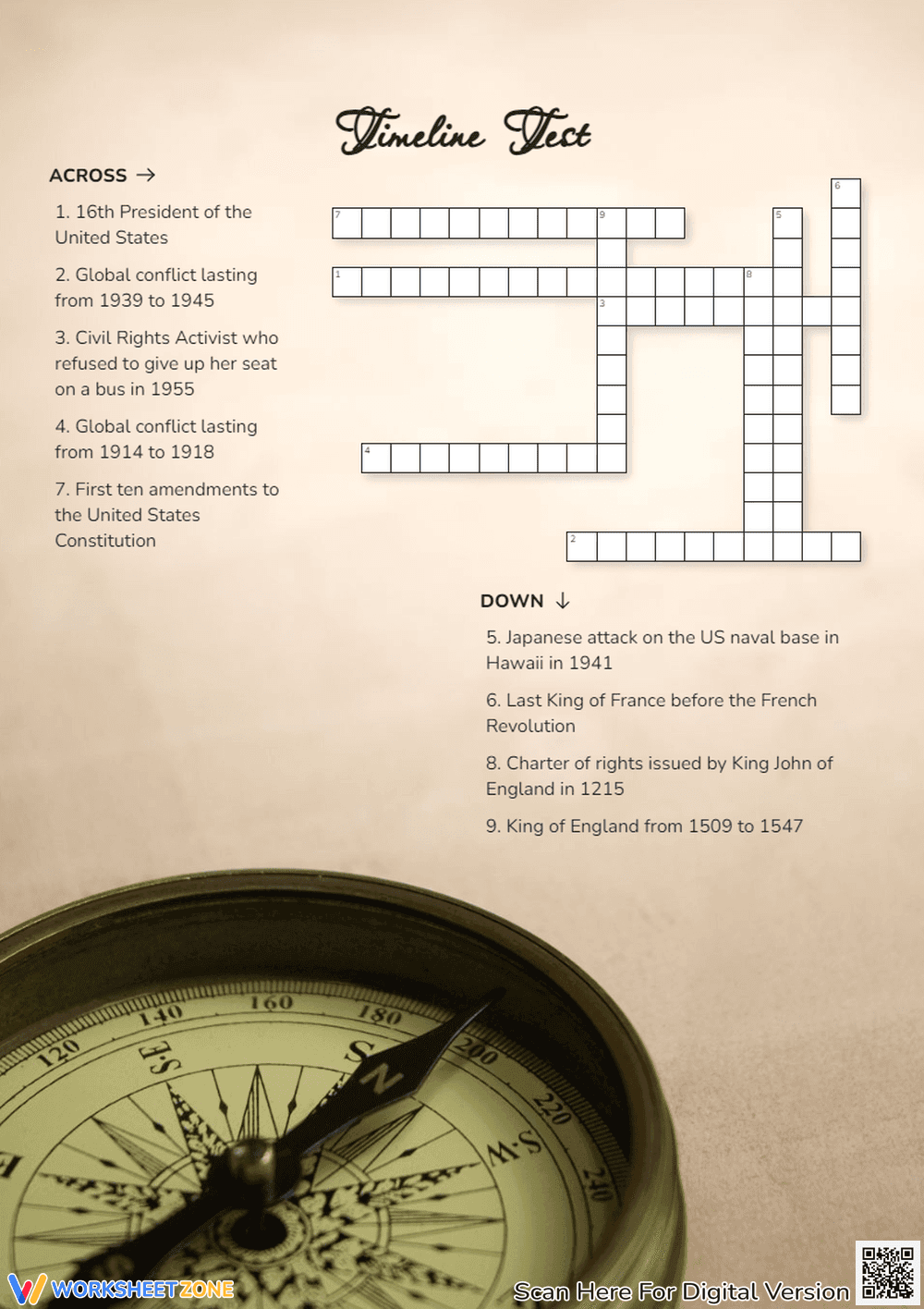

Grade 3 Timeline Test — Printable No-Prep Worksheet
Paste this activity's link or code into your existing LMS (Google Classroom, Canvas, Teams, Schoology, Moodle, etc.).
Students can open and work on the activity right away, with no student login required.
You'll still be able to track student progress and results from your teacher account.
This Grade 3 history worksheet uses a crossword format to reinforce chronological thinking and recognition of pivotal world events. Students analyze nine specific clues ranging from the Magna Carta to the Civil Rights Movement, identifying the names and terms that define these eras. It transforms rote memorization into an engaging vocabulary-building exercise that supports long-term retention.
At a Glance
- Grade: 3 · Subject: Social Studies
- Standard:
CCSS.ELA-LITERACY.RI.3.3— Describe the relationship between a series of historical events using time language- Skill Focus: Historical Chronology & Key Figures
- Format: 1 page · 9 problems · Answer key included · PDF
- Best For: Unit review or early finisher activity
- Time: 15–20 minutes
The worksheet features a clean, thematic layout with a compass rose graphic to anchor the historical theme. It contains nine clues—five across and four down—covering US Presidents, global conflicts, and foundational documents. The PDF includes the puzzle grid and a clear list of clues with specific dates to assist student recall and ensure successful completion.
The zero-prep workflow is designed for immediate classroom integration. First, print the single-page PDF (30 seconds). Second, distribute the sheets to students as a warm-up or transition activity (1 minute). Finally, review the answers using the included key to clarify historical dates and spelling (5 minutes). Total teacher preparation time is under two minutes, making this an ideal sub-plan addition.
This resource aligns with `CCSS.ELA-LITERACY.RI.3.3`, focusing on describing the relationship between historical events. By identifying events like World War I and World War II through their specific date ranges, students practice temporal sequencing. This standard code can be copied directly into lesson plans, IEP goals, or district curriculum mapping tools.
Use this worksheet as a formative assessment after a unit on world history to gauge student retention of key dates. It also serves as an excellent "hook" at the start of a lesson to see what prior knowledge students have about figures like Abraham Lincoln or Rosa Parks. Expected completion typically takes 15 to 20 minutes for most learners.
This activity is ideal for third and fourth-grade students developing their understanding of timelines. It provides enough context clues for independent work while remaining challenging enough for small group collaboration. Pair this with a classroom timeline poster or a primary source reading on the Bill of Rights for a complete, multi-modal lesson.
According to the RAND AIRS 2024 report on social studies instruction, the integration of gamified elements like crossword puzzles significantly increases student engagement with historical facts. This worksheet targets CCSS.ELA-LITERACY.RI.3.3 by requiring students to connect specific years (such as 1215 or 1955) with their corresponding historical significance. By identifying nine distinct milestones, learners build a mental framework of global and American history. Research from Fisher & Frey (2014) suggests that vocabulary acquisition in the content areas is most effective when students interact with terms in varied formats. This resource provides that interaction, moving beyond simple flashcards to a logic-based puzzle. The inclusion of dates within the clues reinforces chronological awareness, a foundational skill for later mastery of complex historical cause-and-effect relationships. Educators can use this tool to bridge the gap between reading informational text and long-term memory retention of essential historical data.


