




























Views
Downloads
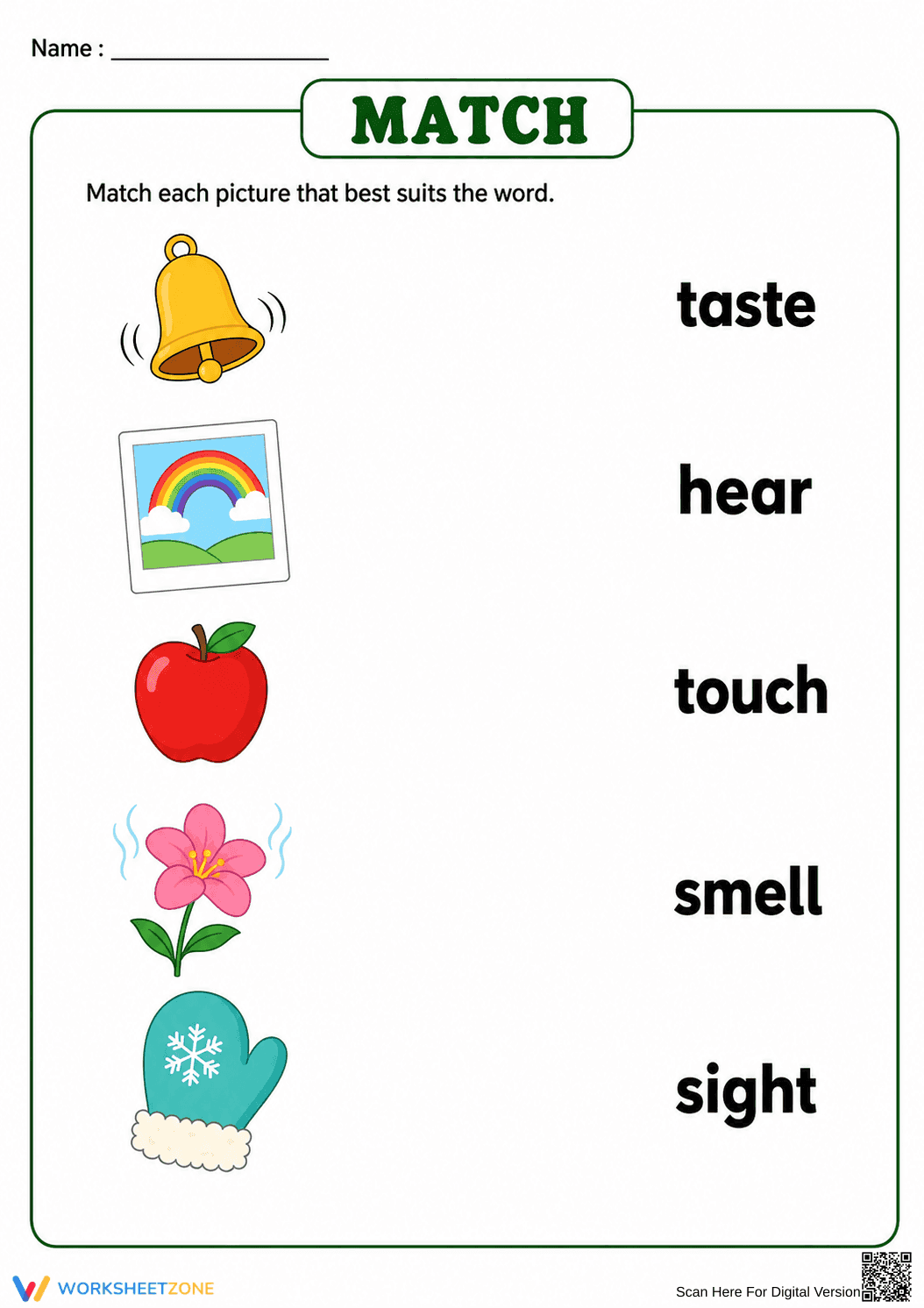

Grade 1 Five Senses — Printable No-Prep Worksheet

Paste this activity's link or code into your existing LMS (Google Classroom, Canvas, Teams, Schoology, Moodle, etc.).
Students can open and work on the activity right away, with no student login required.
You'll still be able to track student progress and results from your teacher account.
This Grade 1 science worksheet helps early elementary students identify sensory experiences through visual association. By linking everyday objects to sensory verbs, learners strengthen their scientific observation skills. This matching activity provides an immediate, hands-on way for students to demonstrate their understanding of how humans perceive the world.
At a Glance
- Grade: 1 · Subject: Science
- Standard:
K-LS1-1— Use observations to describe patterns of what humans perceive- Skill Focus: Five Senses Identification
- Format: 1 page · 5 problems · Answer key included · PDF
- Best For: Science centers, morning work, or sub plans
- Time: 5–10 minutes
This single-page PDF features five vibrant illustrations paired with the sensory words: hear, sight, taste, smell, and touch. The layout is designed for clarity, with large font sizes and distinct icons like a ringing bell and a colorful rainbow to support emerging readers. A full answer key is included to facilitate quick grading or self-correction in class.
The workflow for this resource is designed for maximum efficiency. Teachers can print the single-page document in seconds, distribute it for an independent warm-up within one minute, and review the answers together in under five minutes. With a total preparation time of under two minutes, this worksheet is an ideal solution for unexpected sub plans or quick transitions between science lessons.
Aligned to K-LS1-1, students use observations to describe patterns of how organisms use their senses to interact with their environment. This supports the foundational science practice of categorizing sensory information. Both standard codes can be copied directly into lesson plans, IEP goals, or district curriculum mapping tools.
Assign this worksheet as a formative assessment after an introductory lesson to gauge student mastery of sensory vocabulary. Alternatively, use it as a morning bell-ringer to activate prior knowledge before a hands-on experiment. While students work, observe if they can explain the logic behind their matches, such as why the apple represents "taste." This resource typically takes 5 to 10 minutes to complete.
This activity is designed for Kindergarten through Grade 2 students. It is particularly effective for English Language Learners who benefit from visual cues paired with high-frequency vocabulary. Pair this worksheet with a sensory walk or a "mystery box" touch-and-feel activity for a comprehensive direct instruction lesson.
According to the NAEP Science Framework, the ability to categorize sensory data is a critical precursor to complex scientific inquiry and data analysis in later grades. Research from Fisher & Frey (2014) emphasizes that gradual release activities, such as this structured matching task, allow students to solidify their conceptual understanding before moving to independent writing or experimentation. This Grade 1 Five Senses worksheet provides exactly that scaffold, ensuring students can accurately identify sensory inputs before they are asked to describe the biological mechanisms behind them. By focusing on observable patterns, this resource adheres to the rigorous demands of K-LS1-1 while remaining accessible to young learners. The integration of visual literacy with scientific terminology makes it an essential tool for early childhood educators aiming to build a robust foundation in life sciences. Educators can rely on this vetted evidence-based approach for effective science instruction.


