


























Views
Downloads
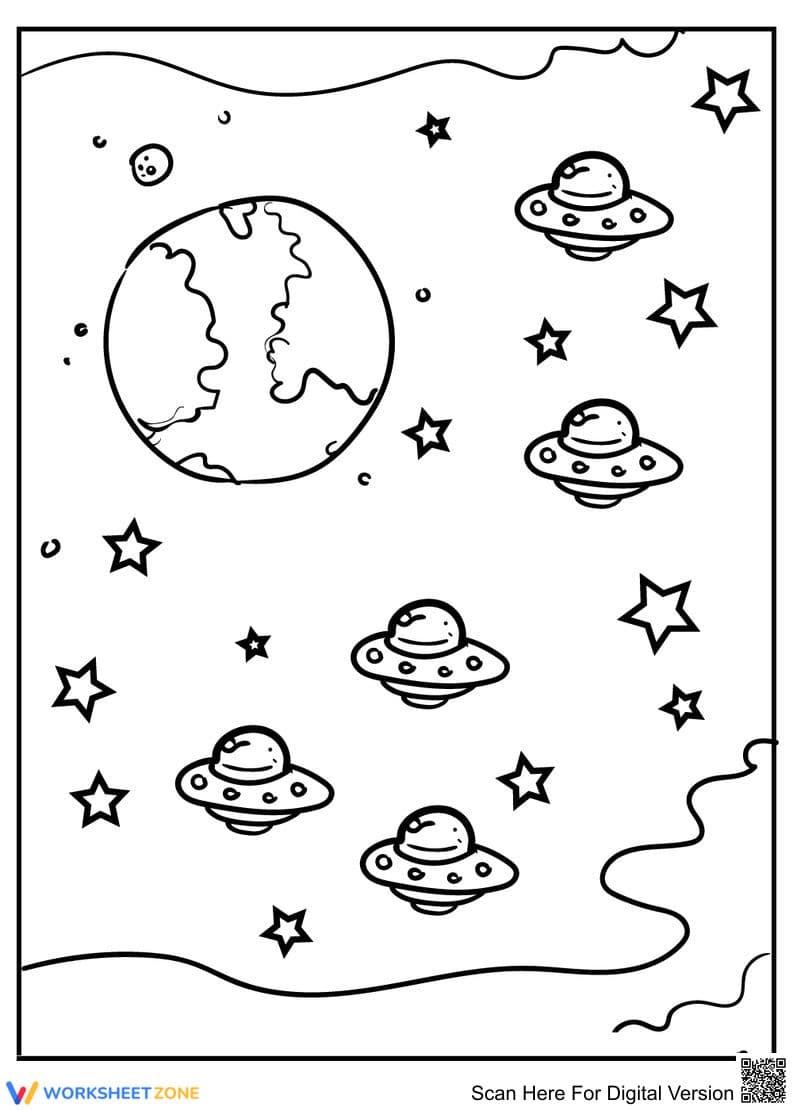

Space Coloring Page | Printable Grade K-2 Worksheet
Paste this activity's link or code into your existing LMS (Google Classroom, Canvas, Teams, Schoology, Moodle, etc.).
Students can open and work on the activity right away, with no student login required.
You'll still be able to track student progress and results from your teacher account.
This engaging space coloring page provides young students with a creative outlet while developing essential fine motor control. Featuring a detailed cosmic scene with a planet, stars, and flying saucers, this printable resource encourages artistic expression. Students will practice hand-eye coordination as they bring this extraterrestrial landscape to life.
At a Glance
- Grade: K-2 · Subject: Art & English
- Standard:
CCSS.ELA-LITERACY.SL.K.5— Add drawings to descriptions to provide detail- Skill Focus: Fine Motor Skills
- Format: 1 page · 1 task · No answer key · PDF
- Best For: Morning work or early finishers
- Time: 15–20 minutes
This single-page printable features a captivating outer space illustration ready for student customization. The design includes a large Earth-like planet, five flying saucers, and scattered stars. The bold outlines help early elementary students practice staying within the lines while experimenting with crayons or markers. No answer key is required, allowing complete creative freedom.
This resource is designed for immediate classroom implementation with a streamlined three-step workflow. First, print the PDF copies (under one minute). Second, distribute the pages along with coloring supplies (one minute). Third, review the finished artwork or have students describe their color choices (five minutes). Total teacher preparation requires less than two minutes, making this an ideal emergency sub plan, quiet transition activity, or engaging center station that requires absolutely no prior setup.
This worksheet aligns with CCSS.ELA-LITERACY.SL.K.5: Add drawings or other visual displays to descriptions as desired to provide additional detail. While primarily a fine motor activity, educators can extend the lesson by having students verbally describe their completed scene, connecting visual arts to expressive language development. Both standard codes can be copied directly into lesson plans, IEP goals, or district curriculum mapping tools.
Teachers can utilize this coloring page during morning arrival to establish a calm, focused classroom environment before direct instruction begins. Alternatively, it serves as an excellent independent activity for early finishers during literacy or science blocks. As a formative assessment observation tip, watch how students grip their coloring utensils and manage spatial boundaries within the illustration. Expected completion time ranges from 15 to 20 minutes depending on the student's attention to detail.
This resource is primarily designed for Kindergarten through second-grade students developing their fine motor coordination and visual-spatial awareness. It naturally accommodates diverse learners, as students can engage with the material at their own developmental level without the pressure of right or wrong answers. For a comprehensive lesson, pair this coloring sheet with a read-aloud book about the solar system or a basic vocabulary anchor chart featuring space-related terminology.
Integrating visual arts into early education yields significant cognitive and physical benefits for young learners. According to a comprehensive EdReports 2024 analysis on early childhood development, activities requiring sustained attention to visual details, such as coloring within defined boundaries, directly support the foundational muscle memory required for handwriting proficiency. This space-themed worksheet targets these exact developmental milestones while aligning with CCSS.ELA-LITERACY.SL.K.5, encouraging students to add drawings to descriptions to provide detail. By combining creative expression with fine motor practice, educators facilitate a multidisciplinary approach to early learning. The open-ended nature of the task allows children to process visual information and practice decision-making regarding color and spatial relationships. Providing these structured creative tasks ensures students build the stamina and coordination necessary for advanced academic writing in later grades.


