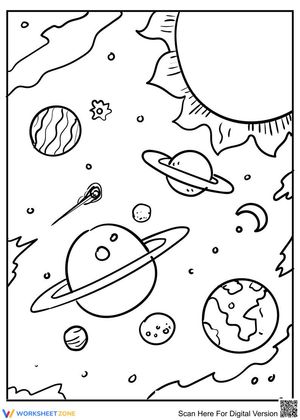
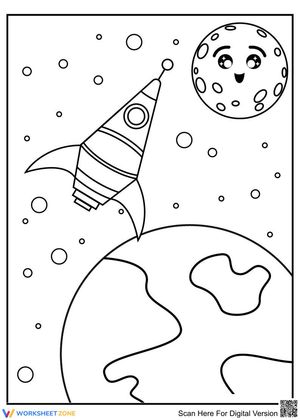
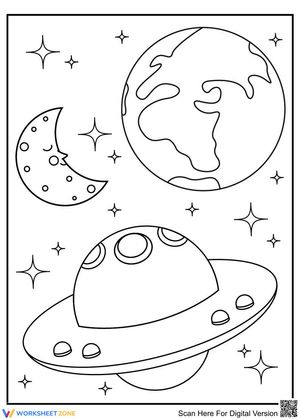
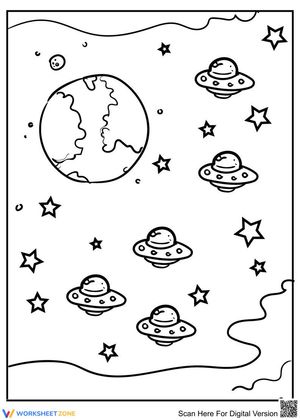
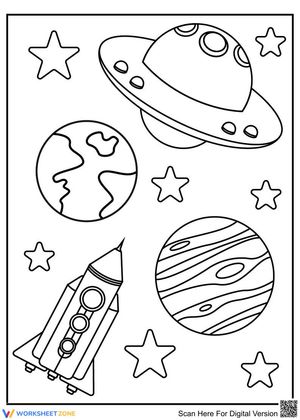
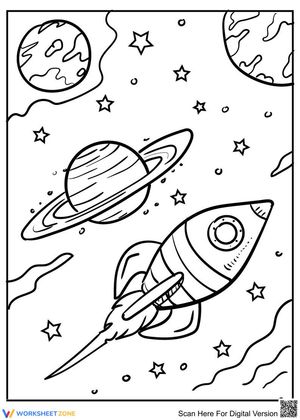
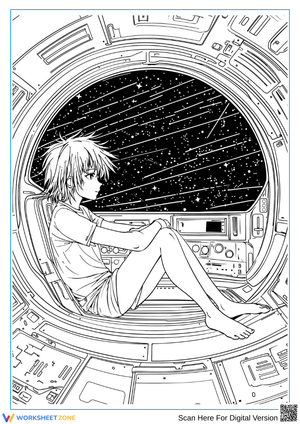
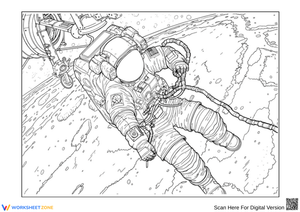
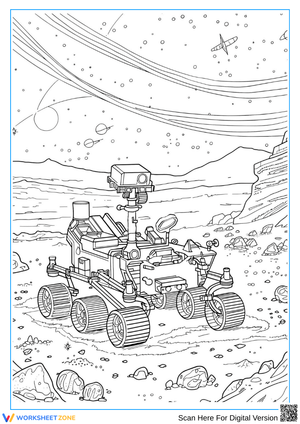
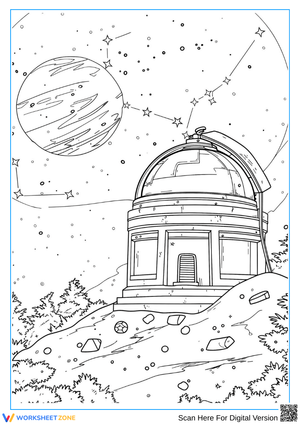
I still remember the afternoon a student in my third-grade class stared blankly at a diagram of the solar system, looking completely lost. No amount of pointing to the chalkboard seemed to break through the confusion. That changed the moment I handed out a set of space coloring pages and asked the class to color each planet a different shade. Within minutes, that same student was eagerly asking whether Saturn's rings were really that wide. The shift from passive observer to active explorer happened in an instant, and it taught me something I carry into every lesson I plan at Worksheetzone.
Space coloring pages work because they transform abstract astronomical concepts into something students can hold, color, and revisit. A child who spends ten minutes carefully shading a nebula or sketching the surface of Mars begins to build a mental model that a textbook page rarely achieves on its own. Teachers find that pairing a printable worksheet with a short read-aloud about the universe creates a rhythm that keeps even reluctant learners engaged throughout the lesson. The tactile process of coloring anchors the vocabulary - orbit, atmosphere, constellation - in a way that sticks well beyond the school day.
When curiosity is the engine, learning accelerates on its own. If you want to extend the activity into a broader unit, our solar system project ideas offer structured frameworks that connect coloring sessions to science inquiry, writing prompts, and group presentations. Students who begin with a simple coloring page often arrive at the next class full of questions about black holes, the speed of light, and life on other planets. That natural progression from art to inquiry is exactly what educators hope to spark with well-designed classroom resources.
Parents supporting learning at home will find space coloring pages just as valuable. A quiet Saturday afternoon with a printed galaxy scene and a set of colored pencils becomes an unexpected conversation about what lies beyond our sky. Children who color alongside a parent tend to ask more questions and retain the answers longer than those who complete worksheets alone. For a focused extension at home, our solar system coloring pages give families a starting point that is both educational and enjoyable without requiring any special materials or setup.
The goal of any good resource is to leave students wanting more, and space coloring pages do exactly that. Whether used in a science lesson, an art period, or a quiet home activity, these printable worksheets give students, teachers, and parents a concrete way to explore the universe together. Worksheetzone is committed to providing materials that meet that standard at every grade level, turning each space coloring page into a small but meaningful step toward a lifelong love of learning.
Frequently Asked Questions
Question 1: What age group benefits most from space coloring pages?
Space coloring pages are most effective for students in kindergarten through fifth grade, roughly ages five to eleven. During these years, children are building foundational science vocabulary and spatial reasoning skills. The visual and hands-on nature of coloring supports both early readers and advanced learners, making these worksheets a flexible tool for mixed-ability classrooms and home learning environments alike.
Question 2: How can teachers connect space coloring pages to science standards?
Teachers can align space coloring pages with earth and space science standards by pairing each printable with a brief lesson on the featured topic, such as planets, stars, or the moon. Labeling exercises, writing prompts, and group discussions following the coloring activity help meet literacy and inquiry standards simultaneously. This cross-curricular approach lets a single worksheet support multiple learning objectives within one class period.
Question 3: Can parents use space coloring pages without a structured lesson plan?
Yes, parents can use space coloring pages informally at home without any prepared lesson plan. Simply printing a worksheet and coloring alongside a child naturally sparks questions and conversation about the universe. Parents can answer questions as they arise, look up answers together, or let curiosity guide the session. The unstructured format is often when children engage most deeply with the material and retain what they discover.
Question 4: What supplies do students need to use space coloring pages effectively?
Students need only a printed worksheet and a set of colored pencils, crayons, or markers to get started with space coloring pages. No special art supplies are required, making these resources accessible for all classrooms and budgets. Teachers may optionally provide reference images of real planets or star charts to encourage accurate coloring choices, which adds a layer of scientific observation to the creative process.












 Interactive Worksheet Maker
 Quiz Maker
 Word Search Maker
 Crossword Puzzle Maker
 Word Scramble Generator
 Sentence Scramble Generator
 Handwriting Worksheet Generator
 Name Tracing Generator
 Fill In The Blank Generator