


























Views
Downloads
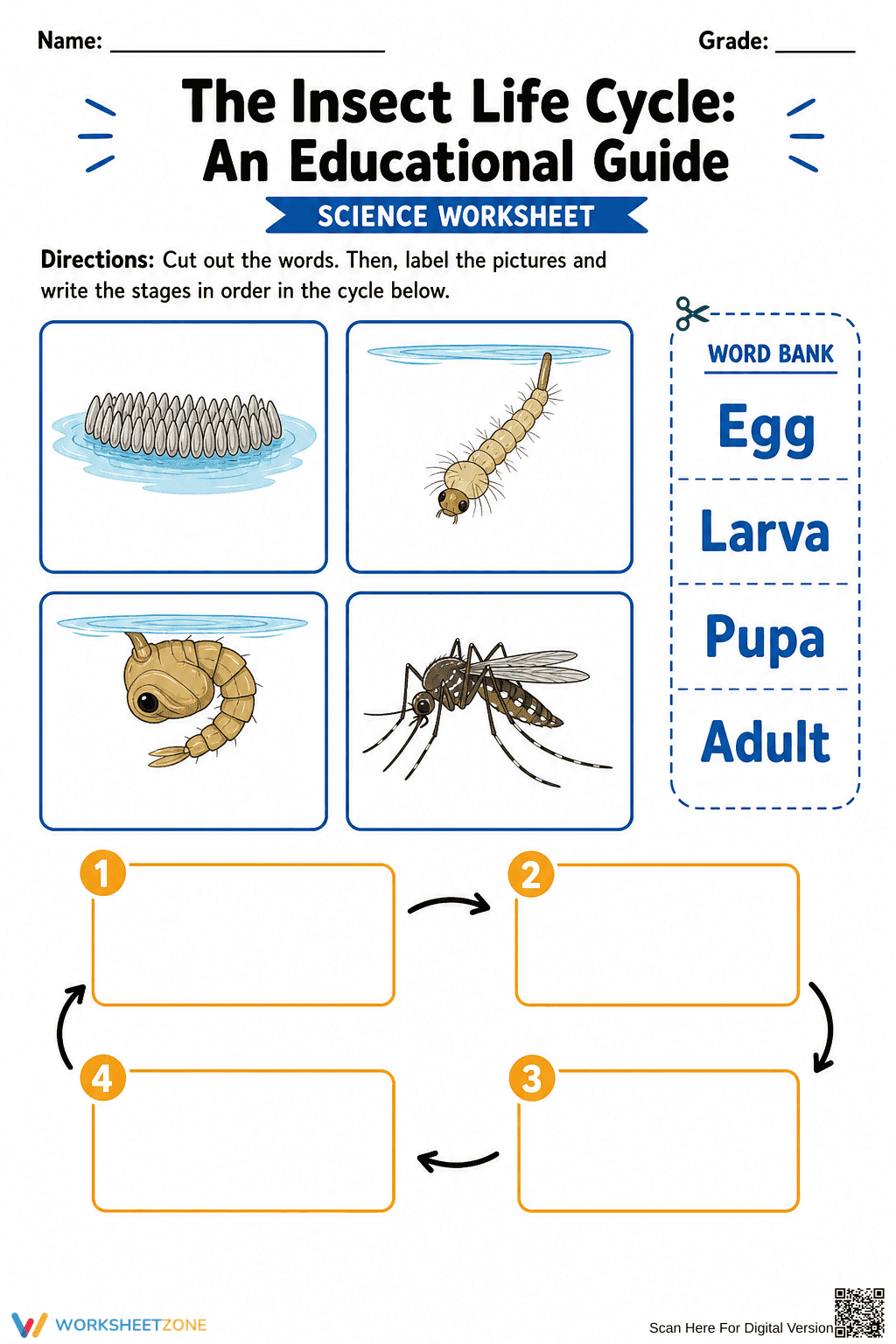

Grade 3 Insect Life Cycle — Printable No-Prep Worksheet
Paste this activity's link or code into your existing LMS (Google Classroom, Canvas, Teams, Schoology, Moodle, etc.).
Students can open and work on the activity right away, with no student login required.
You'll still be able to track student progress and results from your teacher account.
This printable science worksheet helps students master the stages of the insect life cycle by sequencing the development of a mosquito. By cutting, labeling, and ordering the stages from egg to adult, learners build foundational biology skills and visualize how organisms grow and change over time.
At a Glance
- Grade: 3 · Subject: Science
- Standard:
3-LS1-1— Develop models to describe organism life cycles- Skill Focus: Sequencing life cycle stages
- Format: 1 page · 4 stages · Answer key included · PDF
- Best For: Independent practice or science centers
- Time: 15–20 minutes
This single-page resource features detailed illustrations of a mosquito at four developmental phases: egg, larva, pupa, and adult. Students utilize a word bank to cut out terminology and paste it next to the corresponding image. Below the illustrations, a cyclical graphic organizer with numbered boxes prompts students to arrange the stages in chronological sequence. A complete answer key is included.
Zero-Prep Workflow
- Print (1 minute): Simply print the PDF. No special materials are required beyond standard classroom scissors and glue sticks.
- Distribute (1 minute): Hand out the worksheet during your science block or place it in a designated center folder.
- Review (3 minutes): Use the included answer key to quickly check student sequences or project it on the board for self-correction.
With under two minutes of total teacher preparation time, this activity is an excellent addition to any emergency sub plan or busy instructional day.
Standards Alignment
This activity is directly aligned with Next Generation Science Standard 3-LS1-1: Develop models to describe that organisms have unique and diverse life cycles but all have in common birth, growth, reproduction, and death. By constructing a visual model of the mosquito's development, students demonstrate their understanding of these universal biological patterns. Both standard codes can be copied directly into lesson plans, IEP goals, or district curriculum mapping tools.
How to Use It
This worksheet fits perfectly into various instructional moments. Use it as independent practice immediately following a direct instruction lesson on insect metamorphosis. Alternatively, it serves as an engaging hands-on science station where students collaborate to determine the correct sequence. As a formative assessment tip, observe students while they place the pupa and larva stages; watching their placement process provides immediate insight into vocabulary retention. Expected completion time is 15 to 20 minutes.
Who It's For
This resource is designed for third-grade general education students, though easily adaptable for second or fourth graders reviewing basic biology. The cut-and-paste format provides built-in scaffolding for visual and kinesthetic learners, as well as students developing fine motor skills. It pairs perfectly with an introductory reading passage on mosquitoes or a classroom anchor chart.
Understanding biological progression through visual models is a critical component of early elementary science education. This resource supports standard 3-LS1-1 by requiring students to develop models to describe organism life cycles. According to a 2024 report by EdReports, instructional materials that integrate hands-on sequencing tasks with clear visual representations significantly improve student retention of complex scientific vocabulary. By physically manipulating the terms and placing them within a cyclical diagram, learners transition from rote memorization to conceptual understanding of continuous biological processes. The inclusion of specific, recognizable organisms like the mosquito further grounds abstract concepts in observable reality, fostering deeper engagement and scientific inquiry. This structured approach ensures that foundational life science principles are firmly established before students encounter more advanced ecological systems in upper grades.


