




























Views
Downloads

Essential Cell Cycle Worksheet | Grade 9-10 Biology

Paste this activity's link or code into your existing LMS (Google Classroom, Canvas, Teams, Schoology, Moodle, etc.).
Students can open and work on the activity right away, with no student login required.
You'll still be able to track student progress and results from your teacher account.
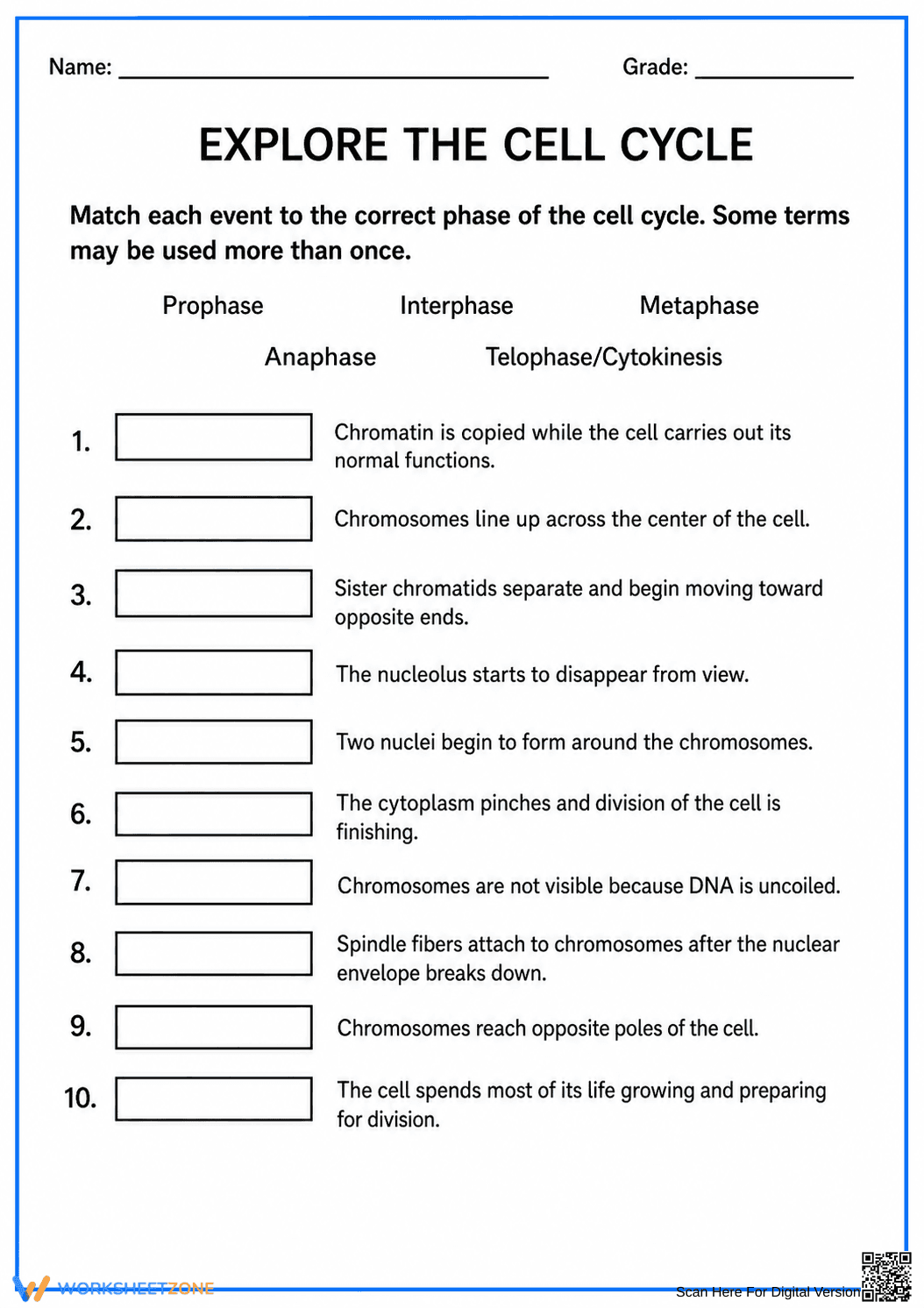
This Grade 9-10 biology worksheet provides a focused review of the cell cycle phases. Students match specific biological events, such as sister chromatid separation and chromatin replication, to the correct mitotic or interphase stage. It ensures students can distinguish between complex cellular processes to build a foundation for understanding genetics and organismal growth.
At a Glance
- Grade: 9-10 · Subject: Biology
- Standard:
HS-LS1-4— Illustrate the role of cellular division in producing and maintaining complex organisms- Skill Focus: Cell Cycle Phase Identification
- Format: 1 page · 10 problems · Answer key included · PDF
- Best For: Formative assessment or quick review
- Time: 15–20 minutes
The worksheet features a clean, single-page layout containing ten descriptive prompts. Students are provided with a word bank of five key terms: Prophase, Interphase, Metaphase, Anaphase, and Telophase/Cytokinesis. The task requires identifying events like the nucleolus disappearing or chromosomes lining up at the cell equator. A comprehensive answer key is included for rapid grading and immediate student feedback.
The zero-prep design allows for immediate classroom implementation. First, print the single-page PDF (30 seconds). Second, distribute the sheets to students for independent or partner work (1 minute). Finally, use the included answer key to review responses as a whole class or for individual grading (5 minutes). This streamlined workflow makes it an ideal resource for busy instructional days or emergency sub plans.
This resource aligns with HS-LS1-4. The standard requires students to use models to illustrate the role of cellular division. By identifying the specific events within the cell cycle, students develop the conceptual model necessary to explain how DNA is organized and distributed. This standard code can be copied directly into lesson plans, IEP goals, or district curriculum mapping tools.
Use this worksheet as a "ticket-out-the-door" formative assessment after a lecture on mitosis. Observe if students confuse anaphase with telophase to identify common misconceptions. Alternatively, assign it as a warm-up activity to activate prior knowledge before a laboratory investigation involving onion root tip slides. Completion typically takes 15 to 20 minutes depending on student familiarity with the vocabulary.
This resource is designed for high school biology students, including those in general, honors, or college-prep tracks. It provides excellent support for visual learners who benefit from concise, descriptive text. Pair this worksheet with a labeled cell cycle diagram or an interactive animation to reinforce the chronological order of the stages and the physical changes occurring within the nucleus.
The study of the cell cycle is a cornerstone of secondary science education, requiring students to master the vocabulary of HS-LS1-4. Research from Fisher & Frey (2014) emphasizes that checking for understanding through structured matching tasks helps solidify the academic language necessary for higher-order biological reasoning. This worksheet targets the identification of discrete cellular events, a prerequisite skill for understanding how errors in division lead to conditions like cancer. By isolating ten specific descriptors, the resource provides the repetition needed for long-term retention of complex terminology. According to the RAND AIRS 2024 report on instructional materials, high-quality, focused practice sheets reduce cognitive load by allowing students to apply specific concepts without the distraction of extraneous information. This printable PDF serves as a reliable tool for verifying student mastery of the cell cycle before progressing to more complex genetic inheritance patterns or biotechnology units.


