




























Thanksgiving Myths vs Facts: Paired Text Analysis | Grade 7
Paste this activity's link or code into your existing LMS (Google Classroom, Canvas, Teams, Schoology, Moodle, etc.).
Students can open and work on the activity right away, with no student login required.
You'll still be able to track student progress and results from your teacher account.
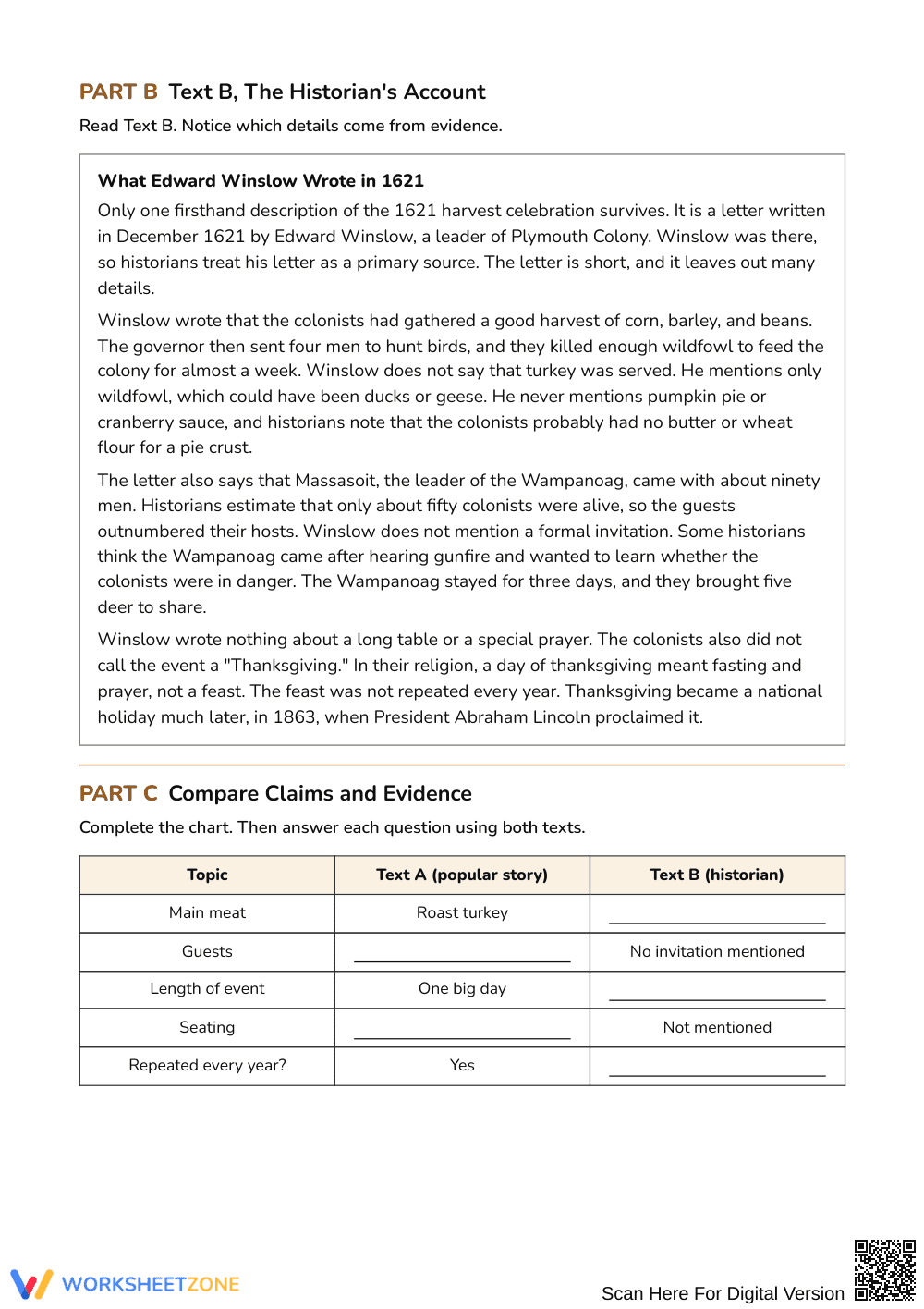
This Grade 7 reading worksheet guides students through paired text analysis by contrasting popular cultural folklore with authentic historical documentation. Students read two accounts of the 1621 harvest feast, evaluate factual claims against primary source evidence, and complete structured analytical questions to develop critical reading and historical reasoning skills.
At a Glance
- Grade: 7 · Subject: English Language Arts
- Standard:
RI.7.9— Compare and contrast how two authors present similar events using evidence.- Skill Focus: Paired text analysis and claim evaluation
- Format: 3 pages · 12 problems · Answer key included · PDF
- Best For: Close reading and cross-text analysis
- Time: 40–50 minutes
What's Inside
This resource spans three structured student pages containing two contrasting passages, a five-row comparative matrix, five selected-response questions, one short-answer evaluation, and a multi-sentence constructed response prompt. It also includes an identical three-page teacher answer key providing sample written responses, point-by-point claim comparisons, and complete factual justifications for every item.
Skill Progression
- Guided practice (Tasks 1–5): Students fill in a structured comparative chart aligning key historical details between the narrative account and Edward Winslow's 1621 letter.
- Supported practice (Tasks 6–11): Students analyze central ideas, evaluate conflicting claims regarding food and attendance, and explain evidentiary reliability through multiple-choice and short-answer prompts.
- Independent practice (Task 12): Students compose an evidence-based constructed response determining text reliability using cited details from both sources.
This sequence follows an intentional gradual-release model, shifting learners from direct textual comparison to independent evidentiary evaluation.
Standards Alignment
This worksheet directly addresses RI.7.9: "Compare and contrast a text to another text in a different genre or one that treats the same subject from a different perspective." Students also apply supporting standard RI.7.1 by citing specific textual evidence to support cross-textual inferences. Both standard codes can be copied directly into lesson plans, IEP goals, or district curriculum mapping tools.
How to Use It
Use this worksheet after direct instruction on source credibility or during a comparative text unit. For close reading, have students annotate secondary narrative assumptions in Text A before cross-referencing Winslow's primary testimony in Text B. During independent work, monitor whether students attribute source reliability to firsthand participation rather than passage length. Completion typically requires 40 to 50 minutes.
Who It's For
This activity is designed for middle school ELA students learning to separate myth from historical reality. The structured matrix provides built-in scaffolding for developing readers, while the final constructed response challenges advanced analytical writers. Pair this worksheet with an anchor chart detailing primary versus secondary historical sources.
Paired text analysis enables middle school students to examine conflicting narratives, evaluate source credibility, and synthesize information across distinct perspectives. Under standard RI.7.9, seventh-grade learners compare how authors present identical historical occurrences, distinguishing between unsupported traditional folklore and verified primary documentation. As demonstrated in research by Fisher & Frey (2014), structured instructional progressions that guide students from comparative graphic organizers to analytical constructed responses foster robust text comprehension and disciplinary literacy. By analyzing a popular narrative alongside Edward Winslow's 1621 letter, students directly observe how historical accounts evolve and diverge from foundational source records. This three-page, twelve-problem curriculum resource provides guided alignment charts, multiple-choice items, and written analysis prompts that explicitly train seventh graders to cross-examine claims, cite relevant textual evidence, and substantiate reasoned conclusions about historical reliability in middle school English language arts classrooms.


