




























Views
Downloads
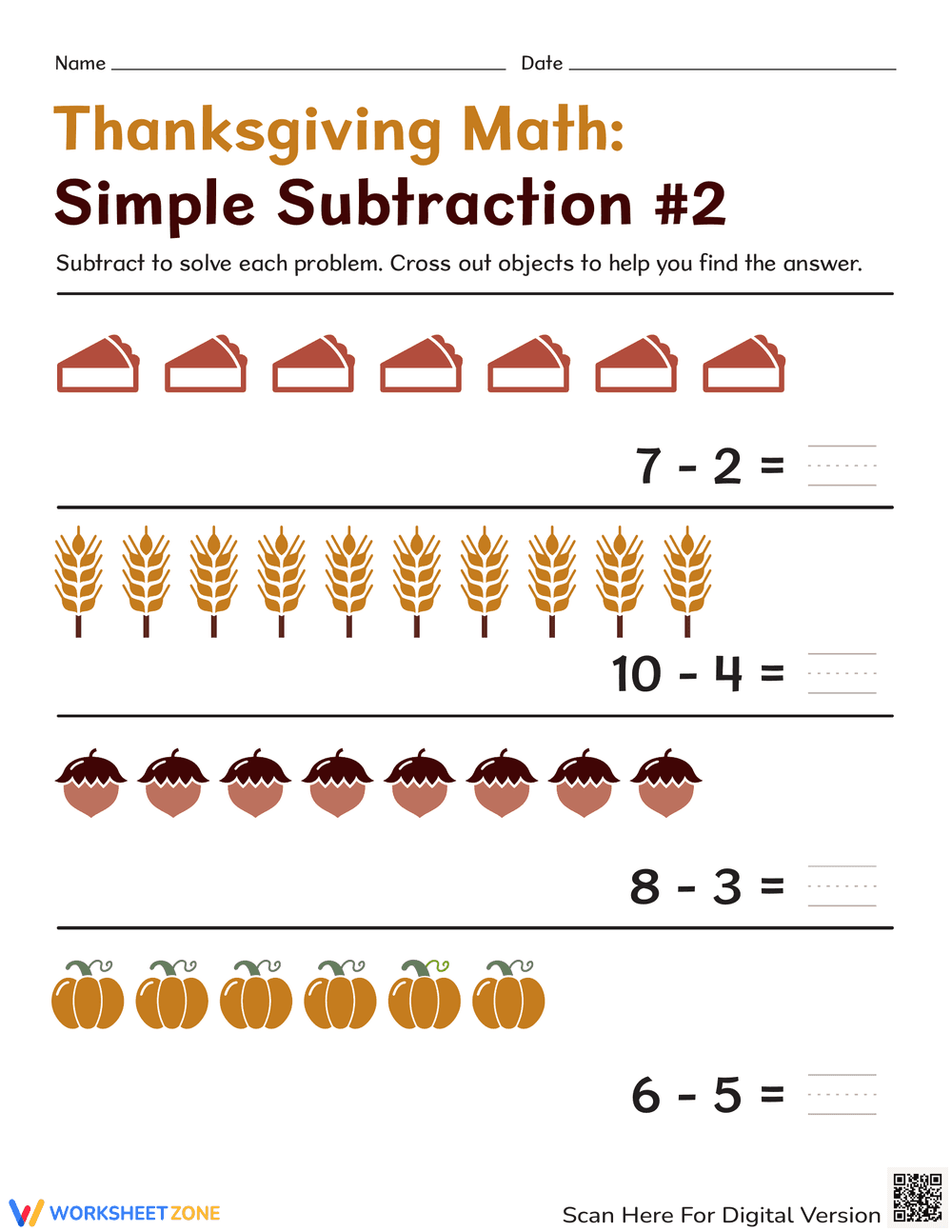

Printable Thanksgiving Subtraction Worksheet | Grade K-1

Paste this activity's link or code into your existing LMS (Google Classroom, Canvas, Teams, Schoology, Moodle, etc.).
Students can open and work on the activity right away, with no student login required.
You'll still be able to track student progress and results from your teacher account.
This Grade K-1 subtraction worksheet helps early learners master basic math facts within 10 using festive Thanksgiving imagery. Students solve four distinct problems by crossing out visual representations of pies, wheat, hazelnuts, and pumpkins. This concrete modeling approach ensures young mathematicians build a strong conceptual foundation for operations before moving to abstract mental math.
At a Glance
- Grade: Kindergarten · Subject: Math
- Standard:
CCSS.MATH.CONTENT.K.OA.A.1— Represent subtraction with objects and drawings to find the difference- Skill Focus: Subtraction within 10
- Format: 1 page · 4 problems · Answer key included · PDF
- Best For: Holiday-themed math centers or morning work
- Time: 10–15 minutes
Inside this single-page PDF, you will find four horizontal subtraction equations paired with high-quality seasonal clip art. Each problem includes a set of objects corresponding to the minuend, allowing students to physically mark off the subtrahend. The layout features large fonts and clear lines for writing differences, making it accessible for small hands developing fine motor skills.
The zero-prep workflow for this resource is designed for maximum efficiency. First, print the single-page PDF (30 seconds). Next, distribute the sheets to your students during a transition or math block (1 minute). Finally, review the visual solutions as a whole group or check against the included answer key (30 seconds). Total teacher preparation time is under two minutes, making it an ideal sub plan addition.
This resource aligns with CCSS.MATH.CONTENT.K.OA.A.1, which requires students to represent addition and subtraction with objects, fingers, mental images, drawings, sounds, acting out situations, verbal explanations, expressions, or equations. It also supports Grade 1 fluency goals for subtraction within 10. Both standard codes can be copied directly into lesson plans, IEP goals, or district curriculum mapping tools.
Use this worksheet as a formative assessment during the week of Thanksgiving to gauge student progress with "take-away" concepts. It works exceptionally well as a quiet morning work activity or a focused station in a math rotation. Teachers should observe if students are correctly counting the remaining objects after crossing out the specified number to ensure conceptual accuracy and mastery of the subtraction process.
This activity is ideal for Kindergarten students introduced to subtraction and Grade 1 learners requiring seasonal review. It provides excellent support for English Language Learners and students with IEPs through its heavy reliance on visual cues rather than word problems. Pair this with physical manipulatives like plastic counters or mini-erasers for a multi-sensory learning experience during your holiday instruction.
According to the RAND AIRS 2024 report, visual scaffolding in early mathematics is essential for transitioning students from concrete to representational thinking. This worksheet utilizes the "cross-out" method, a proven strategy for demonstrating the concept of "less" in subtraction. By aligning with CCSS.MATH.CONTENT.K.OA.A.1, the resource ensures that students are not just memorizing facts but are actively modeling the mathematical process. Research from Fisher & Frey (2014) emphasizes that seasonal, high-interest materials can increase student engagement and task persistence in early elementary settings. This specific resource provides 4 targeted opportunities for students to practice subtraction within 10, a foundational skill identified by NAEP as a critical predictor of later mathematical success. The integration of festive imagery like pumpkins and pies serves as a non-threatening entry point for learners who may experience math anxiety during independent practice sessions.


