































Thanksgiving Equivalent Fractions with Pie Models | Grade 3

Paste this activity's link or code into your existing LMS (Google Classroom, Canvas, Teams, Schoology, Moodle, etc.).
Students can open and work on the activity right away, with no student login required.
You'll still be able to track student progress and results from your teacher account.
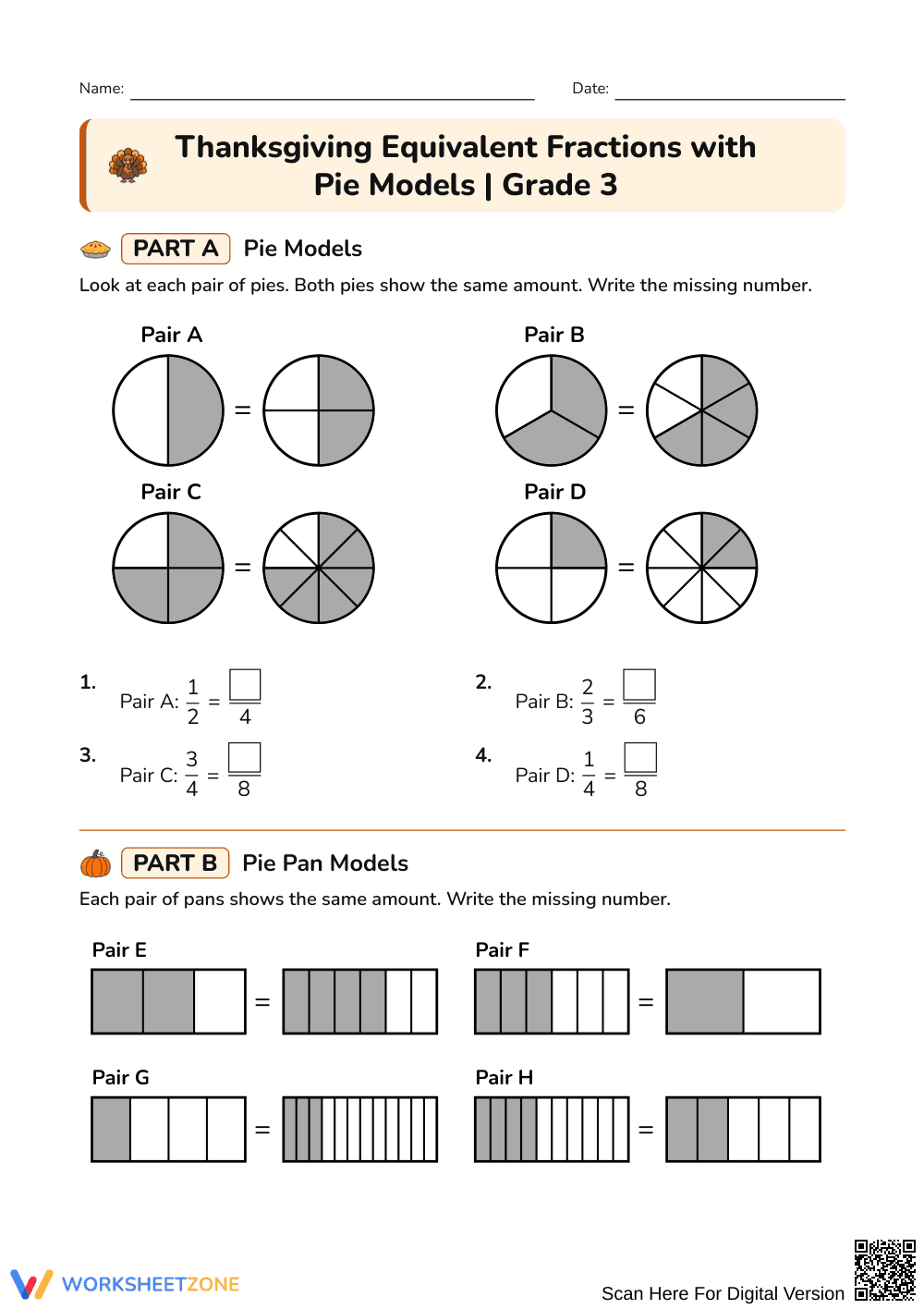
This Grade 3 math worksheet helps students understand fraction equivalence by comparing shaded visual area models. Students analyze circular pie slices and rectangular pan models to identify equal quantities, complete equivalent number sentences, and evaluate fraction pairs, establishing a concrete foundation for abstract fraction reasoning.
At a Glance
- Grade: 3 · Subject: Math
- Standard:
3.NF.A.3— Understand two fractions as equivalent if they represent the same size fraction models- Skill Focus: Equivalent fractions using visual pie and rectangular pan models
- Format: 2 pages · 12 problems · Answer key included · PDF
- Best For: Independent practice or seasonal math centers
- Time: 20–30 minutes
What's Inside: The two-page activity features 12 scaffolded tasks divided into three distinct sections. Students complete missing numerators and denominators across eight visual pie and pan displays before evaluating multiple fraction pairings to identify equal values. A full two-page answer key provides clear solutions for rapid grading.
Skill Progression
- Guided practice (Tasks A–D): Students examine paired circular pie models with equivalent shaded areas to determine missing numerators and denominators.
- Supported practice (Tasks E–H): Learners transition to rectangular pie pan representations, reinforcing that equivalence applies across varied geometric shapes and partition sizes.
- Independent practice (Tasks 9–12): Students analyze sets of numerical fraction pairs without immediate illustrations, circling the single mathematically equal pair in each set.
This structured sequence follows the gradual-release framework, guiding learners from concrete visual comparison to conceptual evaluation.
Standards Alignment
Primary Standard: `3.NF.A.3` — Explain equivalence of fractions in special cases, and compare fractions by reasoning about their size, specifically recognizing that two fractions are equivalent if they are the same size. Supporting Standard: `3.NF.A.1` — Understand a fraction 1/b as the quantity formed by 1 part when a whole is partitioned into b equal parts. Both standard codes can be copied directly into lesson plans, IEP goals, or district curriculum mapping tools.
How to Use It
Deploy this activity immediately after direct instruction on area models or as a focused Thanksgiving-themed math station. While students work through Part B, circulate to verify that learners count total partitions accurately rather than only focusing on unshaded pieces. Expect students to complete the 12 problems within 20 to 30 minutes.
Who It's For
Designed for third-grade general education classrooms, this resource also supports fourth-grade students requiring visual intervention and math intervention small groups. Pair this worksheet directly with circular fraction tile manipulatives or a whole-class fraction bar anchor chart to support developing learners.
According to Fisher & Frey (2014), purposeful instructional shifts from visual representations to abstract problem-solving significantly strengthen conceptual retention in elementary mathematics. Grounded in standard 3.NF.A.3, this Grade 3 equivalent fractions worksheet equips students to recognize that fractions with different numerators and denominators represent the same quantity when their visual areas match. By systematically progressing from partitioned circular models to rectangular pans and finally to symbolic fraction sets, the 12 targeted tasks cultivate durable numerical reasoning. The clear layout and included answer key provide educators with reliable diagnostic data to inform subsequent fraction instruction.


