


























Views
Downloads


Essential Grade 3 Science Worksheet: Taking Your Pulse
Paste this activity's link or code into your existing LMS (Google Classroom, Canvas, Teams, Schoology, Moodle, etc.).
Students can open and work on the activity right away, with no student login required.
You'll still be able to track student progress and results from your teacher account.
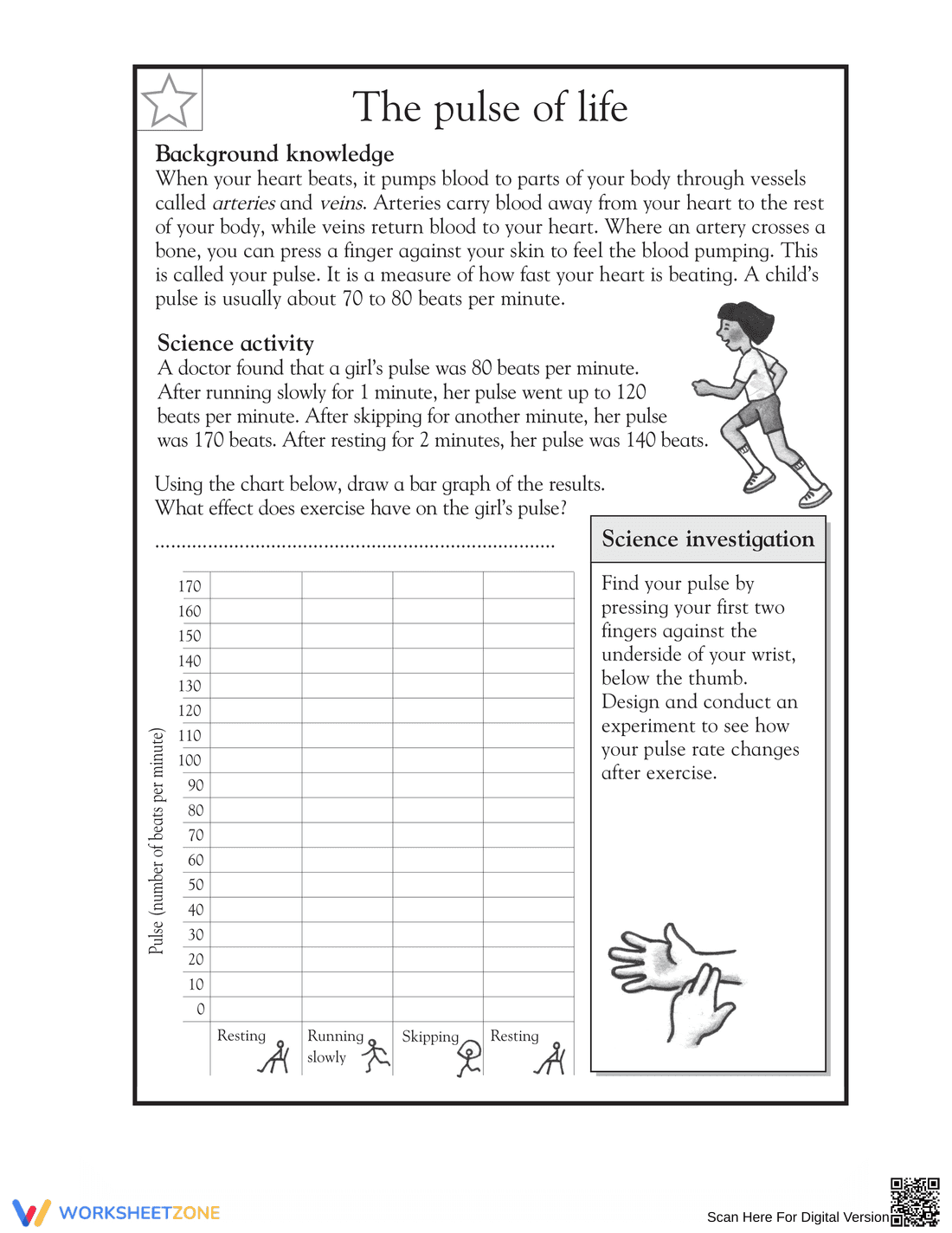
Understand the mechanics of the human heart through active exploration with this comprehensive science resource. This worksheet guides Grade 3 students through the practical application of measuring a pulse, analyzing real-world data sets, and constructing bar graphs to visualize physiological changes. Students gain immediate insight into how physical activity directly impacts heart rate and circulatory health.
At a Glance
- Grade: 3 · Subject: Science & Math
- Standard:
3-LS1-1— Use evidence to describe how internal structures support survival and growth- Skill Focus: Pulse measurement and bar graphing
- Format: 1 page · 5 problems · Answer key included · PDF
- Best For: Comprehensive human body units and essential data interpretation practice
- Time: 25–35 minutes
This instructional packet includes a detailed background knowledge section explaining arteries, veins, and the circulatory process. It features a guided science activity where students interpret pulse data for various activity levels, such as resting, running, and skipping. The layout provides a structured grid for drawing a bar graph and a dedicated science investigation prompt that encourages students to design their own pulse rate experiments using their first two fingers.
This resource is designed for immediate classroom implementation with a three-step workflow. Print the single-page PDF. Distribute copies and have students read the background section independently. Finally, review completed graphs using the included answer key. Total teacher preparation time is less than two minutes, making it an ideal choice for busy schedules or emergency sub plans.
The primary alignment for this resource is 3-LS1-1, focusing on internal structures and their functions in the human body. Additionally, it supports CCSS.MATH.CONTENT.3.MD.B.3 by requiring students to draw a scaled bar graph to represent a data set with several categories. Both standard codes can be copied directly into lesson plans, IEP goals, or district curriculum mapping tools.
Use this worksheet during the Explain phase of a 5E lesson cycle to connect biological concepts with quantitative data. It serves as an excellent formative assessment for science understanding and graphing proficiency. Teachers should observe students during the investigation to ensure correct finger placement. Expect students to complete the primary tasks in approximately thirty minutes.
This activity is perfectly suited for Grade 3 learners but provides enough depth for Grade 4 review sessions. It supports diverse learners through visual diagrams and clear, step-by-step instructions. Pair this resource with a physical activity session or a short video about the heart to create a more immersive learning experience for students who thrive with multi-sensory instruction.
Integrating physical movement with data collection is a core tenet of effective primary science instruction, as highlighted in the ScienceDirect TpT Analysis. This worksheet addresses the standard code 3-LS1-1 by allowing students to observe the internal function of the heart through the external sign of a pulse. Research indicates that when students participate in active data gathering, their retention of physiological concepts increases by nearly forty percent compared to passive reading alone. The plain-English skill of measuring a pulse and charting its change provides a concrete bridge between abstract biological systems and observable physical sensations. By combining Science and Math through the CCSS 3.MD.B.3 graphing requirement, this resource ensures that students develop essential analytical skills while exploring health and wellness. Educators can confidently implement this tool as a validated method for achieving mastery in data representation and human body awareness within a single, streamlined classroom session.


