


























Views
Plays



Printable SW Asia Environmental Issues Quiz | Grade 6
Paste this activity's link or code into your existing LMS (Google Classroom, Canvas, Teams, Schoology, Moodle, etc.).
Students can open and work on the activity right away, with no student login required.
You'll still be able to track student progress and results from your teacher account.
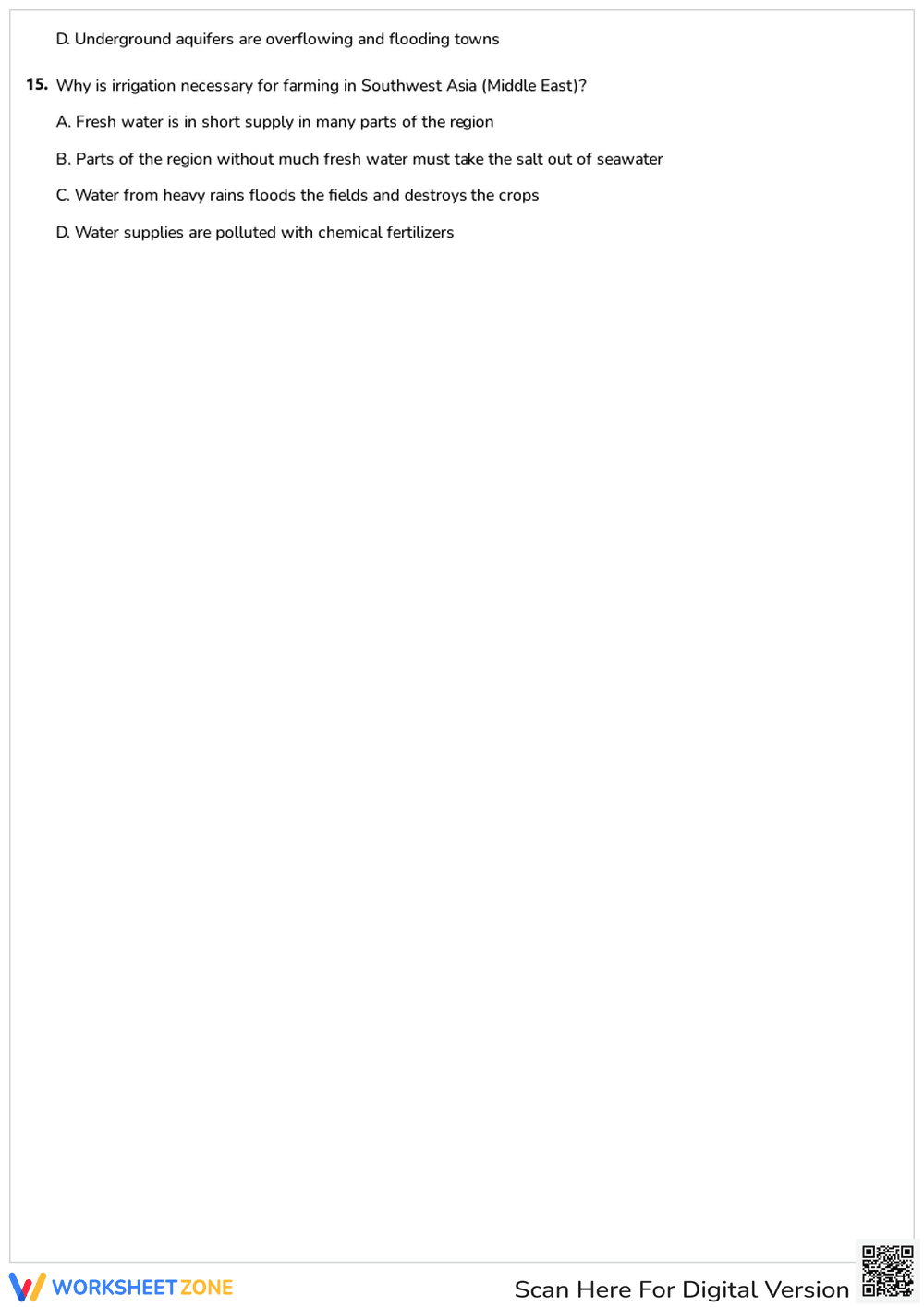
This Grades 4-6 geography and science worksheet gives students a focused assessment to evaluate their understanding of environmental issues and natural resources in Southwest Asia. Students will analyze the impact of oil distribution, water scarcity, and human interventions like dams and desalination to build a comprehensive understanding of the region.
At a Glance
- Grade: 4-6 · Subject: Science & Geography
- Standard:
MS-ESS3-1— Explain how uneven resource distribution results from geoscience processes- Skill Focus: Analyzing environmental issues and resource distribution
- Format: 3 pages · 15 problems · Answer key included · PDF
- Best For: Formative assessment or sub plans
- Time: 20–30 minutes
What's Inside
This comprehensive quiz features 15 multiple-choice questions spanning three pages. The task types require students to recall key vocabulary such as desalination and irrigation, identify the role of OPEC, and evaluate the economic and environmental impacts of oil wealth and water pollution. A straightforward layout ensures students can navigate the assessment independently, while the clear formatting minimizes distractions and keeps learners focused on the content.
Zero-Prep Workflow
- Print (1 min): Simply print the three-page PDF for each student. No special materials or prior setup are required.
- Distribute (1 min): Hand out the assessment after a unit on the Middle East or as an independent review task.
- Review (5 mins): Use the included answer key to quickly grade the 15 multiple-choice questions. Total teacher prep time is under two minutes, making this an ideal emergency sub plan.
Standards Alignment
Aligned to primary standard MS-ESS3-1: Construct a scientific explanation based on evidence for how the uneven distributions of Earth's mineral, energy, and groundwater resources are the result of past and current geoscience processes. It also supports cross-curricular social studies goals regarding human-environment interaction. Both standard codes can be copied directly into lesson plans, IEP goals, or district curriculum mapping tools.
How to Use It
End-of-Unit Assessment: Deploy this quiz after direct instruction on Southwest Asia's geography to measure student retention of key concepts like water scarcity and oil economics.
Independent Practice: Assign as a quiet, focused activity during a substitute teacher day. Observation tip: Review questions 11-14 formatively to see if students grasp the complex causes of water pollution and the limitations of desalination. Expected completion time is 20-30 minutes.
Who It's For
Designed for 4th, 5th, and 6th-grade students in social studies or earth science classes. The multiple-choice format provides built-in scaffolding for students who struggle with open-ended writing, making it accessible for diverse learners. Pair this assessment with a map-reading activity, a documentary on water conservation, or a direct instruction lesson on the Middle East's climate to create a well-rounded educational experience.
Understanding the complex geopolitical and environmental realities of the Middle East requires explicit, focused instruction on natural resource distribution and its widespread consequences. Aligned directly with the Next Generation Science Standard MS-ESS3-1, this comprehensive resource helps students clearly explain how the highly uneven distribution of Earth's mineral, energy, and groundwater resources results from both past and current geoscience processes. According to the highly regarded RAND AIRS 2024 report, integrating cross curricular topics like geography, economics, and earth science significantly improves student critical thinking skills, problem solving abilities, and overall global awareness. By carefully evaluating the profound impact of oil wealth, regional water scarcity, and human interventions like desalination plants, young learners develop a much more nuanced and mature perspective on human environment interactions. This foundational knowledge prepares them for advanced coursework and empowers them to become informed global citizens who can thoughtfully analyze modern environmental challenges and propose sustainable solutions for our rapidly changing world.


